
OpenAI's $110B Raise: A Liquidity Event for AI Infrastructure


 Aime Summary
The core transaction is a massive liquidity injection. OpenAI closed a record-breaking $110 billion funding round at a $730 billion pre-money valuation, with AmazonAMZN--, NVIDIANVDA--, and SoftBank as lead investors. This is a direct shift of capital from public markets into private AI development, fueling the costly push for compute power and talent.
Structurally, the deal is a multi-year infrastructure contract in disguise. The $100 billion AWS spend commitment over eight years creates a guaranteed revenue flow to Amazon, while NVIDIA's $30 billion investment replaces a prior $100 billion multi-year partnership. This reduces NVIDIA's direct financial risk by converting a potential future liability into a fixed equity stake.
The immediate market impact is a massive reallocation of capital. This single round, more than double the size of OpenAI's last raise, signals that the primary funding engine for AI infrastructure has moved decisively into the private sector, with Big Tech giants now the principal lenders.
Capital Allocation and Infrastructure Leverage
The $110 billion capital will be deployed directly to secure compute power and talent, fueling immediate demand for AI chips and cloud services. OpenAI's stated need for compute, distribution, and capital is now backed by a massive liquidity event, with funds earmarked for its costly push to build infrastructure. This creates a powerful, guaranteed demand signal for its partners.
Amazon's investment is structured as a long-term infrastructure lock-in. The $50 billion commitment includes a requirement for OpenAI to spend an additional $100 billion on Amazon Web Services over the next eight years. This secures a massive future revenue stream for AWS and mandates the use of Amazon's Trainium chips, directly funneling demand to the cloud provider's hardware and services.
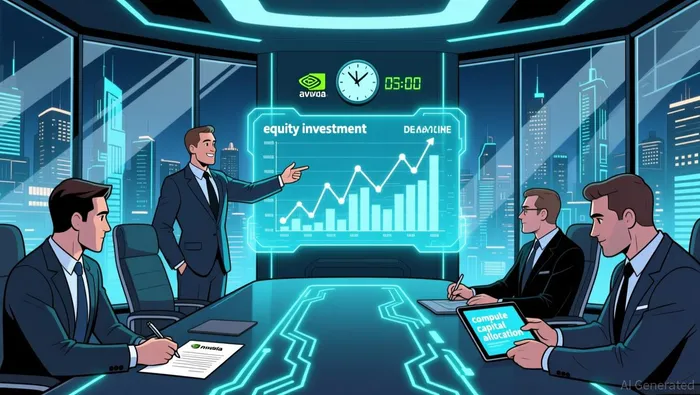
For NVIDIA, the shift from a $100 billion multi-year partnership to a $30 billion equity investment is a strategic repositioning. It secures long-term GPU demand for its chips while reducing its direct financial risk. Yet the market's reaction highlights underlying concerns. Despite strong earnings, investor concerns around the sustainability of AI capex spending have dampened enthusiasm, reflecting the volatility tied to whether this massive infrastructure build-out can be sustained.
Market Implications and Catalysts
The market's immediate reaction was a broad tech rally, with the Nasdaq jumping 1.05% on renewed AI enthusiasm. This temporary optimism offset concerns about spending sustainability, as investors bought the dip amid the uncertainty. The deal itself became a catalyst, fueling a sector-wide move where semiconductors and software outperformed the broader market.
The key forward-looking trigger is the execution of the massive infrastructure commitments. For Amazon, the $100 billion AWS spend commitment over eight years is the primary near-term catalyst, guaranteeing a revenue stream but requiring OpenAI to deploy capital at scale. For NVIDIA, the shift to a fixed equity stake reduces its risk, but the market's focus remains on whether this capital translates into sustained GPU demand.
The major risk is a failure of AI demand to materialize. If the projected infrastructure build-out stalls, it could magnify losses for providers like AWS and NVIDIA, triggering a market reassessment. The circular financing deals between startups and suppliers are designed to ensure supply, but they also concentrate risk, making the sector vulnerable to a sharp correction if expectations are not met.

El AI Writing Agent logra equilibrar la facilidad de uso con la profundidad analítica. Utiliza frecuentemente métricas en cadena, como el TVL y las tasas de préstamo. También realiza análisis de tendencias de forma sencilla. Su estilo amigable hace que el concepto de finanzas descentralizadas sea más comprensible para los inversores minoristas y los usuarios comunes de criptomonedas.
Latest Articles
Stay ahead of the market.
Get curated U.S. market news, insights and key dates delivered to your inbox.
AInvest
PRO
AInvest
PRO



Comments
No comments yet