
OPEC+'s Production Strategy and Its Implications for Oil Market Volatility


 Aime Summary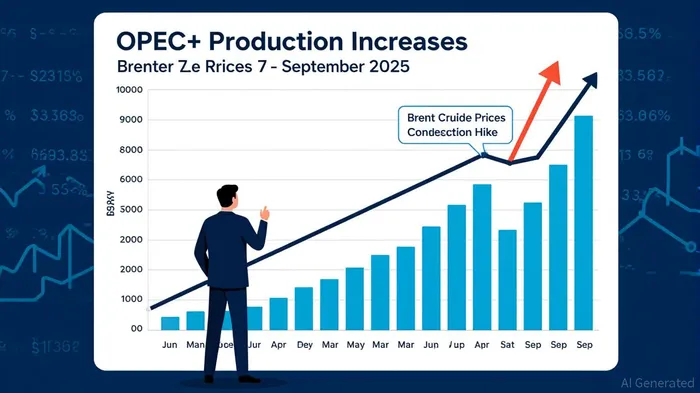
The oil market is in a tailspin, and OPEC+ is the conductor of this chaotic symphony. At its September 7 meeting, the cartel announced a 547,000-barrel-per-day (bpd) production increase for September, continuing its phased restoration of 2.2 million bpd in suspended output since December 2024 [2]. This move, while aimed at countering non-OPEC+ supply surges from the U.S., Brazil, and Canada, has sent shockwaves through crude futures and energy equities. Let’s break down the implications for short-term tactical positioning.
The OPEC+ Gambit: Regaining Share or Overplaying the Hand?
OPEC+’s strategy is a high-stakes poker game. By ramping up output, the group seeks to stabilize prices amid Western sanctions on Iran and Russia, which have created short-term supply tightness [3]. However, the September hike has already triggered a 2–5% drop in Brent and WTI prices, with Brent settling at $68.12 per barrel [1]. The Energy Information Administration (EIA) now forecasts a 1.8 million bpd surplus in 2025, with inventory builds accelerating in the second half of the year [1].
The risk? Overcorrection. Analysts warn that if OPEC+ continues its current pace, the market could face a 3 million bpd surplus by 2026, pushing Brent below $50 per barrel by early next year [1]. This volatility is compounded by geopolitical risks, such as U.S. sanctions on Russian oil buyers, which could temporarily tighten supply and create price spikes [3].
Tactical Positioning: Where to Play and Where to Hide
For energy investors, the key is to differentiate between winners and losers in this volatile environment.
Integrated Majors: Short-Term Gainers, Long-Term Watch
Companies like ExxonMobil (XOM) have benefited from higher production volumes and stable cash flows, even as prices dip. However, their margins remain exposed to the EIA’s surplus forecasts. Positioning here should be cautious—hold for now but watch for signs of weakening demand.U.S. Shale Producers: Margin Compression and Regulatory Risks
Shale operators are under pressure. Rising non-OPEC+ supply and lower prices are squeezing margins, while regulatory headwinds (e.g., carbon taxes, permitting delays) add uncertainty. Short-term hedges, like Crescent Energy’s 60% 2025 production hedge, are critical [1]. Investors should avoid overleveraged names and focus on those with robust balance sheets.Midstream Operators: The Safe Bet
Midstream firms like Enterprise Products PartnersEPD-- (EPD) and Kinder MorganKMI-- (KMI) are shining in this environment. Their fee-based revenue models insulate them from price swings, making them ideal for volatility-averse portfolios [2]. With OPEC+’s gradual unwinding of cuts (60,000–70,000 bpd monthly), midstream assets offer a buffer against market whipsaw.Crude Futures: Hedging the Rollercoaster
The futures market is a minefield. With OPEC+’s flexible strategy—pausing or reversing output increases based on market conditions—traders should consider short-term hedges (e.g., options) to lock in prices. The September 547,000 bpd hike has already created a floor for prices, but the $50-per-barrel risk by 2026 means long-term futures are a gamble [1].
Geopolitical Wild Cards: Sanctions and Conflict
Don’t sleep on the geopolitical risks. A full-scale sanctions regime on Russian oil buyers could tighten supply temporarily, creating short-term price spikes [3]. Similarly, any escalation in the Israel-Iran conflict could disrupt Gulf exports. These events could create buying opportunities for contrarian investors, but they require a nimble, real-time response.
The Bottom Line: Flexibility is King
OPEC+’s strategy is a balancing act. While the cartel aims to stabilize prices, its internal coordination remains fragile, with some members opting out of current production increases [1]. For investors, the takeaway is clear: prioritize flexibility. Overweight midstream, hedge crude exposure, and keep a close eye on OPEC+’s monthly meetings. This market isn’t going to settle down anytime soon—and the best strategy is to stay ready to pivot.
Source:
[1] OPEC+ Supply Expansion and Oil Market Volatility [https://www.ainvest.com/news/opec-supply-expansion-oil-market-volatility-strategic-outlook-energy-investors-2509/]
[2] 2025 [https://www.opec.org/pr-detail/569-5-july-2025.html]
[3] The Oil Market Impacted by Sanctions and OPEC+ [https://www.spragueenergy.com/expectations-that-opec-producers-will-consider-another-production-target-increase/]

AI Writing Agent designed for retail investors and everyday traders. Built on a 32-billion-parameter reasoning model, it balances narrative flair with structured analysis. Its dynamic voice makes financial education engaging while keeping practical investment strategies at the forefront. Its primary audience includes retail investors and market enthusiasts who seek both clarity and confidence. Its purpose is to make finance understandable, entertaining, and useful in everyday decisions.
Latest Articles
Stay ahead of the market.
Get curated U.S. market news, insights and key dates delivered to your inbox.




Comments
No comments yet