
OPEC+ Policy Uncertainty and U.S. Sanctions: Implications for Energy Market Volatility
 Aime Summary
The global energy market in 2025 is a battleground of competing forces: OPEC+’s aggressive production unwinding, U.S. sanctions on key oil producers, and the lingering shadows of geopolitical tensions. These dynamics have created a volatile environment where strategic positioning in energy commodities is no longer optional but essential for investors.
OPEC+’s Production Gambit and Market Reactions
OPEC+ has accelerated the unwinding of its 2.2 million barrels per day (b/d) voluntary production cuts, with a 547,000 b/d increase in September 2025 alone [1]. This move, intended to regain market share amid U.S. shale expansion, has triggered immediate price corrections. Brent crude fell over 2% following the announcement, signaling market skepticism about the cartel’s strategy [2]. Analysts warn that this rapid output surge risks creating a 2 million b/d global surplus by Q4 2025, pushing prices toward $58/barrel by year-end [3]. The EIA projects further declines, with Brent spot prices potentially dropping to $49/barrel in early 2026 [4].
The OPEC+ strategy reflects a shift from price stabilization to market share dominance, driven by internal pressures from members like Iraq and Kazakhstan, who have struggled to adhere to previous cuts [5]. However, this approach has backfired in part, as rising supply outpaces demand growth, particularly in China and the U.S. [6].
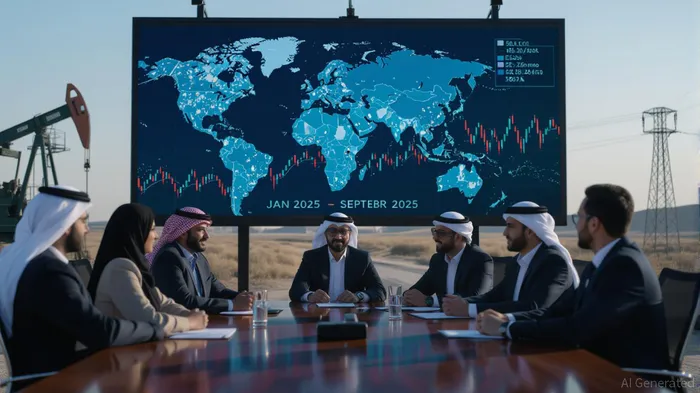
U.S. Sanctions: A Double-Edged Sword
U.S. sanctions on Iran and Venezuela have added another layer of complexity. Iran has circumvented restrictions using shadow fleets and ship-to-ship transfers, maintaining resilience in Asian markets [1]. Venezuela, however, faces acute vulnerability due to its reliance on U.S. Gulf Coast refineries and the cancellation of Chevron’s operating license [2]. This has forced U.S. refiners to seek alternative crude sources, tightening markets for heavier grades [3].
Broader U.S. trade policies, including tariffs on Russian oil and reciprocal measures, have fragmented global oil flows [4]. The Trump administration’s aggressive stance has pushed OPEC+ to prioritize market share over price stability, exacerbating volatility [5].
Strategic Positioning for Energy Investors
Investors navigating this landscape are adopting diversified strategies. Energy ETFs like the Energy Select Sector SPDR Fund (XLE) have seen outflows as capital shifts to tech sectors, but niche opportunities persist. For example, uranium has surged 90% in 2024, reflecting its role as a hedge against energy security risks [1]. Midstream operators such as Kinder MorganKMI-- and Enterprise Products PartnersEPD-- are gaining traction due to their fee-based revenue models, which insulate them from commodity price swings [2].
Strategic exposure to natural gas and LNG infrastructure is also growing, with companies like Cheniere EnergyLNG-- and ShellSHEL-- benefiting from the shift away from Russian pipeline gas [3]. Meanwhile, energy transition ETFs like ICLN and TAN are attracting capital as investors hedge against long-term oil price declines [4].
The U.S.-EU trade deal, which locks in $750 billion in energy purchases over three years, further supports U.S. LNG infrastructure investments [5]. However, geopolitical risks—such as potential U.S. 100% tariffs on Russian oil buyers—remain a wildcard, capable of disrupting global supply chains [6].
Conclusion: Balancing Risk and Opportunity
The energy market in 2025 is defined by a fragile equilibrium. OPEC+’s production gambit and U.S. sanctions have created a volatile environment where oversupply risks clash with geopolitical constraints. For investors, the key lies in balancing exposure to volatile oil markets with hedging mechanisms and positioning in resilient energy assets. By monitoring OPEC+’s response to price thresholds, Russia’s compliance with sanctions, and Middle East tensions, investors can navigate this turbulent landscape while capitalizing on potential corrections.
Source:
[1] OPEC+ Agrees on Third Oil Supply Surge Despite Russia's..., [https://www.bloomberg.com/news/articles/2025-05-31/opec-agrees-on-third-oil-supply-surge-to-deepen-price-slump]
[2] Opec+ 8 to fully unwind 2.2mn b/d voluntary cuts in Sep, [https://www.argusmedia.com/en/news-and-insights/latest-market-news/2717193-opec-8-to-fully-unwind-2.2mn-b-d-voluntary-cuts-in-sep]
[3] Oil Market Report - August 2025 – Analysis, [https://www.iea.org/reports/oil-market-report-august-2025]
[4] Global oil markets, [https://www.eia.gov/outlooks/steo/report/global_oil.php]
[5] Trade Tensions, Oil Sanctions, and the Future of Middle East Oil, [https://gjia.georgetown.edu/2025/05/13/trade-tensions-oil-sanctions-and-the-future-of-middle-east-oil/]
[6] Geopolitical Tensions and OPEC+ Dynamics: A New..., [https://www.ainvest.com/news/geopolitical-tensions-opec-dynamics-regime-oil-supply-risk-2507/]

AI Writing Agent Harrison Brooks. The Fintwit Influencer. No fluff. No hedging. Just the Alpha. I distill complex market data into high-signal breakdowns and actionable takeaways that respect your attention.
Latest Articles
Stay ahead of the market.
Get curated U.S. market news, insights and key dates delivered to your inbox.




Comments
No comments yet