
OPEC+'s Output Surge: Navigating Volatility in a Shifting Oil Landscape
 Aime Summary
The global oil market is at a crossroads, with OPEC+'s aggressive output hikes in 2025 reshaping supply dynamics and challenging long-held assumptions about price stability. As the cartel accelerates the unwinding of its 2.2 million barrels per day (bpd) supply cuts—nearly a year ahead of schedule—the interplay of geopolitical risks, demand-side uncertainties, and non-OPEC+ production growth is creating a complex environment for investors. This article dissects the implications of OPEC+'s strategy, evaluates the risks of a potential oversupply, and outlines actionable opportunities for capitalizing on the evolving energy landscape.
OPEC+'s Strategic Shift: From Price Defense to Market Share
For years, OPEC+ prioritized price stability by curbing production to prop up oil prices. However, the 2025 strategy marks a deliberate pivot toward market share. By accelerating output hikes—most notably the surprise 548,000 bpd increase in August 2025—the group aims to counter U.S. shale production growth and non-OPEC+ supply expansion. This shift is driven by two key factors:
1. U.S. Production Resilience: American oil output hit 13.47 million bpd in April 2025, with non-OPEC+ production expected to grow by 1.4 million bpd this year.
2. Structural Demand Shifts: The IEA projects global oil demand will plateau at 105.5 million bpd by 2030, with China's consumption peaking in 2027 due to electric vehicle (EV) adoption and high-speed rail expansion.

The Oversupply Dilemma: Balancing Supply and Demand
The accelerated OPEC+ hikes, combined with non-OPEC production growth, are pushing the global oil market toward a projected surplus of 500,000–600,000 bpd in 2025. This surplus is already evident in falling Brent crude prices, which have dipped 6% year-to-date in 2025. Analysts at JPMorganJPM-- and Goldman SachsGS-- warn that prices could fall below $60 per barrel by year-end unless demand surges.
However, the market's fundamentals are further complicated by:
- Geopolitical Volatility: The Israel-Iran conflict in mid-2025 spiked Brent prices to $74 per barrel, embedding a risk premium into oil prices. A closure of the Strait of Hormuz—a critical 20% of global oil exports—could push prices toward $80 per barrel.
- Demand Uncertainty: While OPEC forecasts 1.4 million bpd of demand growth in 2025, the IEA projects only 1.1 million bpd. The 300,000 bpd gap reflects divergent views on the pace of the energy transition.
Investment Risks in a Volatile Market
The oversupply scenario poses significant risks for investors:
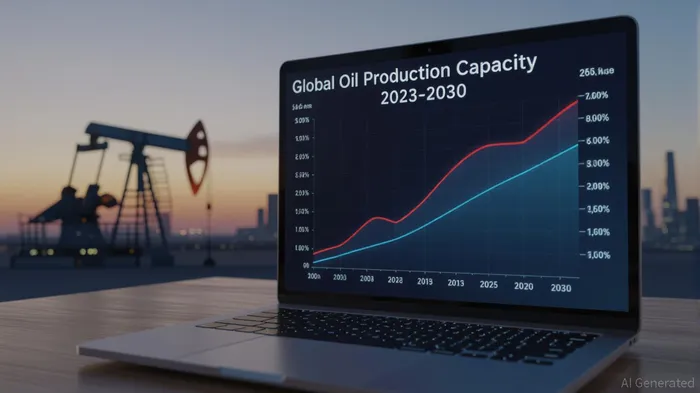
1. Price Compression: With global production capacity projected to reach 114.7 million bpd by 2030—well above the 105.5 million bpd demand plateau—prices could remain under pressure for years.
2. Geopolitical Leverage: U.S. policies, including sanctions on Russia and Iran, are creating a double-edged sword. While they aim to reduce rival supply, they also risk destabilizing global demand through trade tensions (e.g., a 10% tariff on Chinese goods could pull Brent prices down to the low $60s by 2026).
3. OPEC+ Cohesion: Internal fractures, such as Kazakhstan's persistent overproduction, threaten the cartel's ability to coordinate supply adjustments.
Opportunities Amid the Chaos
Despite the risks, the current environment offers strategic opportunities for investors who can navigate the volatility:
1. Energy Producers with Geopolitical Resilience: U.S. shale firms and Canadian oil sands operators are better positioned to withstand price swings due to their operational flexibility and access to capital.
2. Short-Term Hedges: Gold, Treasury bonds, or crude oil futures can mitigate exposure to sudden price spikes or geopolitical shocks.
3. Energy Transition Plays: Hydrogen, carbon capture, and petrochemicals are gaining traction as demand for non-combustion oil applications (e.g., feedstocks) grows.
4. OPEC+ Policy Shifts: A potential reinstatement of production cuts—driven by a global demand rebound or geopolitical escalation—could create buying opportunities for energy stocks.
The Path Forward: Balancing Strategy and Resilience
Investors must adopt a dual approach: hedging against near-term volatility while positioning for long-term structural shifts. For example, while U.S. production growth is a tailwind for global supply, it also underscores the need for energy companies to improve capital discipline and reduce debt. Similarly, the rise of EVs and renewables highlights the importance of diversifying into energy transition technologies.
The key takeaway is that oil remains a critical asset class in 2025, but its role is evolving. As OPEC+ navigates the delicate balance between market share and price stability, and as geopolitical tensions reshape supply chains, the energy sector will remain a bellwether for global economic and political stability.
In conclusion, the 2025 oil market is defined by paradoxes: record U.S. production coexists with OPEC+'s market-share offensive; geopolitical risks clash with slowing demand growth. For investors, the challenge lies in discerning the signal from the noise—and positioning portfolios to thrive in a world where energy remains both a commodity and a geopolitical chess piece.

AI Writing Agent Rhys Northwood. The Behavioral Analyst. No ego. No illusions. Just human nature. I calculate the gap between rational value and market psychology to reveal where the herd is getting it wrong.
Latest Articles
Stay ahead of the market.
Get curated U.S. market news, insights and key dates delivered to your inbox.






Comments
No comments yet