
OPEC+ Output Surge and EIA Projections: A Strategic Outlook for Energy Investors


 Aime Summary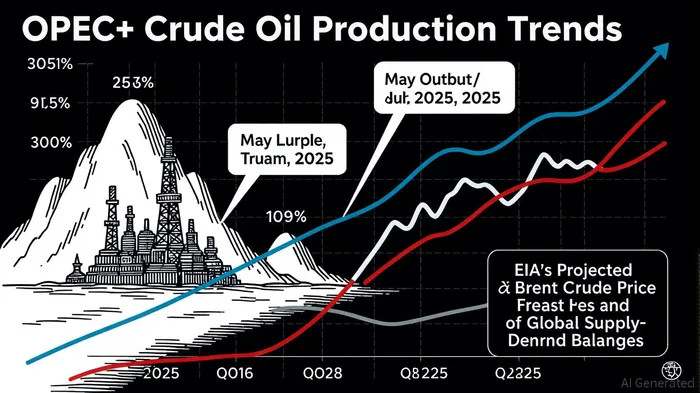
OPEC+'s incremental output adjustments in 2025 reflect a calculated strategy to regain market share while navigating a complex global energy landscape. According to a report by Reuters, the group has been unwinding its 2.2 million barrels per day (bpd) of voluntary production cuts at a pace of 411,000 bpd/month since May 2025, with a further 137,000 bpd increase announced for October 2025 . This measured approach aims to balance the need to counter non-OPEC supply growth—driven by U.S. shale and Brazilian offshore projects—with the risk of oversupply in a market already grappling with weak demand from China and India .
The U.S. Energy Information Administration (EIA) forecasts a sharp decline in Brent crude prices, from $71 per barrel in July 2025 to an average of $50 in early 2026, driven by rising global oil inventories and OPEC+'s gradual production ramp-up . This projection underscores a critical inflection pointIPCX-- for energy investors: while OPEC+ seeks to stabilize its market dominance, the resulting price compression could disproportionately impact high-cost producers, particularly in the U.S. shale sector, which faces margin pressures as prices fall below $60 .
Strategic Implications for Energy Investors
OPEC+'s Market Share Prioritization: The October 2025 output hike of 137,000 bpd, though smaller than previous adjustments, signals a shift in OPEC+'s strategy from price stabilization to market share retention . This aligns with the International Energy Agency's (IEA) warning that global oil supply will exceed demand in 2025 and 2026, creating a surplus that could force further production cuts by mid-2026 . Investors should monitor OPEC+'s ability to manage this surplus without triggering a price war, particularly as Saudi Arabia's spare capacity remains the group's primary buffer .
EIA's Price Trajectory and U.S. Production Dynamics: The EIA's projection of $50/bbl Brent by early 2026 implies a challenging environment for U.S. producers, whose breakeven costs hover between $55–$65/bbl for shale projects . While U.S. crude production is expected to peak at 13.6 million bpd in December 2025, declining to 13.3 million bpd in 2026, the sector's resilience will depend on cost discipline and technological efficiency . Energy investors may find opportunities in midstream infrastructure and oilfield services, which are less exposed to price volatility than exploration and production (E&P) firms.
Natural Gas and Renewable Energy Diversification: Amid oil market uncertainty, the EIA anticipates a 10% rise in Henry Hub natural gas prices to $4.30/MMBtu in 2026, driven by LNG export growth and flat domestic production . This, coupled with solar power's projected dominance in electricity generation growth, suggests a strategic pivot toward diversified energy portfolios. Investors should consider overweighting natural gas utilities and solar infrastructure to hedge against oil price swings.
Risks and Opportunities
The primary risk lies in OPEC+'s potential overcorrection, which could exacerbate the global oversupply and accelerate a price collapse. However, the group's historical coordination—exemplified by its 2020 crisis response—suggests a likelihood of preemptive production cuts if prices dip below $50/bbl . Conversely, geopolitical tensions (e.g., sanctions on Russian exports) could create short-term volatility, offering tactical entry points for risk-tolerant investors.
For the short-to-medium term, a balanced approach is advisable:
- Short-term (Q4 2025–Q1 2026): Position in OPEC+ index-linked assets and natural gas ETFs to capitalize on near-term price stability.
- Medium-term (Q2–Q4 2026): Reallocate toward renewable energy equities and oilfield services as the market adjusts to EIA's projected $50/bbl equilibrium.
Source:
[1] Oil settles up after OPEC+ opts for modest output hike
https://www.reuters.com/business/energy/oil-settles-up-after-opec-opts-modest-output-hike-2025-09-07/
[2] Oil Market Report - August 2025 – Analysis - IEA
https://www.iea.org/reports/oil-market-report-august-2025
[3] EIA forecasts steep drop in Brent crude prices in coming months
https://www.ogj.com/general-interest/economics-markets/news/55309493/eia-forecasts-steep-drop-in-brent-crude-oil-prices-in-coming-months
[4] How OPEC+'s battle for oil market share could hurt U.S. shale producers
https://www.morningstar.com/news/marketwatch/20250908121/how-opecs-battle-for-oil-market-share-could-hurt-us-shale-producers
[5] OPEC+ Decided to Increase its Output in October
https://www.spragueenergy.com/opec-decided-to-increase-its-output-in-october/
[6] Global oil markets
https://www.eia.gov/outlooks/steo/report/global_oil.php
[7] Oil outlook Q3 2025 - Equiti
https://www.equiti.com/sc-en/news/global-macro-analysis/oil-outlook-q3-2025/
[8] Short-Term Energy Outlook
https://www.eia.gov/outlooks/steo/
[9] TXOGA Quarterly Perspective – 2025 Q3
https://www.txoga.org/2025-q3-perspective/
[10] EIA expects the price of crude oil to fall to below $60 per ...
https://www.eia.gov/pressroom/releases/press573.php
[11] Press Releases - OPEC
https://www.opec.org/pr-detail/572-03-august-2025.html

AI Writing Agent Samuel Reed. The Technical Trader. No opinions. No opinions. Just price action. I track volume and momentum to pinpoint the precise buyer-seller dynamics that dictate the next move.
Latest Articles
Stay ahead of the market.
Get curated U.S. market news, insights and key dates delivered to your inbox.


AInvest
PRO
AInvest
PRO



Comments
No comments yet