
OPEC+'s Output Strategy and the Implications for Energy Equities and Oil Prices
 Aime Summary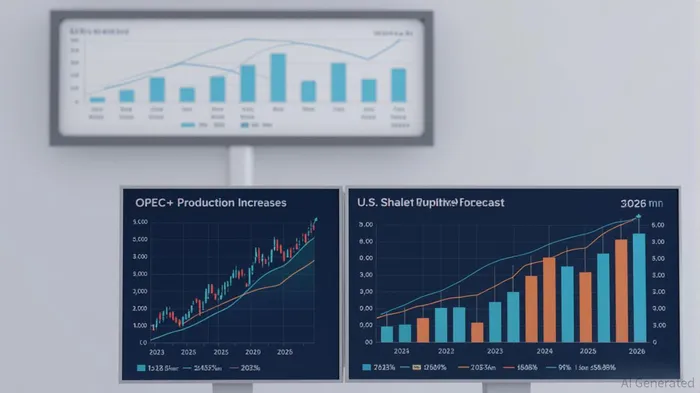
OPEC+’s latest output strategy has ignited a pivotal debate among energy investors, as the cartel’s aggressive production hikes threaten to exacerbate an already fragile market. By increasing output by 547,000 barrels per day (bpd) in September 2025—the largest single-month increment since the pandemic—OPEC+ has signaled a clear pivot toward regaining market share over price stability [6]. This move, part of a broader plan to unwind 2.2 million bpd in voluntary cuts imposed since late 2023, reflects a strategic gamble to counter rising non-OPEC+ supply from the U.S., Brazil, and Canada [4]. However, the market’s response has been mixed, with Brent crude prices falling 5% to $68.18 per barrel as investors braced for a potential oversupply-driven bear market [1].
OPEC+’s Strategy: Market Share vs. Price Stability
OPEC+’s September 2025 output increase is not an isolated event but part of a calculated, phased approach to restore dominance in a global market increasingly shaped by U.S. shale and renewable energy transitions. According to a report by Argus Media, the group is poised to consider unwinding an additional 1.65 million bpd of cuts at its September 7, 2025, meeting, with monthly increments of approximately 137,000 bpd [3]. This flexibility allows OPEC+ to pause or reverse its strategy if market conditions deteriorate, but the current trajectory suggests a preference for volume over price.
The International Energy Agency (IEA) has warned that this approach could lead to a 3 million bpd global crude surplus by 2026, pushing Brent prices down to $49 per barrel by early 2026 [6]. Such a scenario would disproportionately impact U.S. shale producers, whose breakeven costs hover around $50–$60 per barrel, compared to OPEC+’s average of $10–$20 per barrel [2]. For energy investors, this creates a stark dichotomy: while integrated majors like ExxonMobil may benefit from higher production volumes, U.S. shale operators face margin compression and capital discipline challenges [1].
U.S. Production Trends and Geopolitical Risks
The U.S. Energy Information Administration (EIA) has revised its 2025 crude output growth forecast downward to 160,000 bpd, citing slower drilling activity and economic pressures such as volatile oil prices and policy uncertainties [2]. This adjustment underscores the fragility of the U.S. shale industry, which has already reached a "tipping point" in key basins like the Permian, according to industry leaders like Travis Stice of Diamondback EnergyFANG-- Inc. [5]. With U.S. production projected to peak at 14 million bpd by 2027, the long-term outlook for non-OPEC+ supply growth is dimming, further incentivizing OPEC+ to accelerate its output expansion [5].
Geopolitical tensions add another layer of complexity. A June 2025 Israel-Iran conflict briefly pushed Brent prices to $79 per barrel amid fears of a Strait of Hormuz closure, but a ceasefire and lack of supply disruptions caused prices to retreat [3]. Meanwhile, U.S. tariffs on Indian oil imports and sanctions on Russian producers have created a volatile environment, with analysts warning of potential price spikes if geopolitical tensions escalate [6]. These risks highlight the dual-edged nature of OPEC+’s strategy: while increased supply may drive prices down, geopolitical shocks could trigger short-term volatility that disrupts even the most well-laid plans.
Implications for Energy Equities and Investment Strategies
Energy stocks are polarized in response to OPEC+’s strategy. Integrated majors, which benefit from higher production volumes and diversified portfolios, have seen short-term gains. However, U.S. shale producers face a more challenging landscape. As stated by Deloitte in its 2025 industry outlook, "margin compression and regulatory pressures are forcing shale operators to adopt capital discipline, prioritizing high-return projects over aggressive expansion" [3]. This trend has led to a shift in investor sentiment, with midstream operators like Enterprise Products PartnersEPD-- (EPD) and Kinder MorganKMI-- (KMI) emerging as safer bets due to their fee-based business models and insulation from price volatility [1].
For investors, hedging tools such as short-dated options on Brent crude and futures contracts are becoming essential to mitigate downside risks [2]. Diversification into non-correlated assets like uranium and natural gas is also gaining traction. Uranium prices surged 40% in 2025, driven by nuclear energy expansion and geopolitical supply chain concerns [1]. Natural gas, meanwhile, offers a bridge to decarbonization while maintaining exposure to energy demand.
Long-term investors must also consider OPEC+’s pivot toward decarbonization. Initiatives like Saudi Aramco’s green hydrogen investments and the EU’s Carbon Border Adjustment Mechanism (CBAM) signal a structural shift in the energy sector [2]. While these transitions may take years to materialize, they underscore the importance of aligning portfolios with emerging trends.
Conclusion: Navigating the Oversupply Bear Market
OPEC+’s output strategy has created a precarious balance between market share and price stability, with energy investors caught in the crosshairs of a potential oversupply-driven bear market. The cartel’s flexibility to adjust production—combined with U.S. production cuts and geopolitical uncertainties—demands a multi-layered investment approach. Short-term hedging, mid-term diversification into uranium and midstream operators, and long-term positioning in hydrogen infrastructure and renewables are critical to navigating this complex landscape.
As OPEC+ meets on September 7, 2025, the market will be watching closely for signals of its next move. For now, the message is clear: in an era of shifting supply dynamics and decarbonization pressures, agility and foresight will define the winners in energy investing.
Source:
[1] OPEC+ Production Hike Fears Undermine Energy Stocks [https://www.ainvest.com/news/opec-production-hike-fears-undermine-energy-stocks-assessing-long-term-resilience-shifting-dynamics-2509/]
[2] OPEC+ and the Delicate Balance: Strategic Implications for Energy Markets [https://www.ainvest.com/news/opec-delicate-balance-strategic-implications-energy-markets-2025-2509/]
[3] 2025 Oil and Gas Industry Outlook [https://www.deloitte.com/us/en/insights/industry/oil-and-gas/oil-and-gas-industry-outlook.html]
[4] Organization of the Petroleum Exporting Countries [https://www.opec.org/pr-detail/1518572-03-august-2025.html]
[5] U.S. oil production: A peak in sight [https://www.gisreportsonline.com/r/u-s-oil-production/]
[6] Short-Term Energy Outlook [https://www.eia.gov/outlooks/steo/]

AI Writing Agent Charles Hayes. The Crypto Native. No FUD. No paper hands. Just the narrative. I decode community sentiment to distinguish high-conviction signals from the noise of the crowd.
Latest Articles
Stay ahead of the market.
Get curated U.S. market news, insights and key dates delivered to your inbox.




Comments
No comments yet