
OPEC+'s October Output Adjustment: A Strategic Shift Reshaping Global Energy Markets and Investment Opportunities


 Aime Summary
The October 2025 OPEC+ output adjustment—marked by a 137,000-barrel-per-day (bpd) production increase—represents a seismic shift in the group's strategy, prioritizing market share over price stability. This move, part of a broader plan to unwind 1.65 million bpd in cuts by late 2025, signals a recalibration of global oil dynamics amid rising non-OPEC supply, slowing demand, and geopolitical pressures. For investors, the implications are profound: energy markets are entering a new era of volatility, where traditional valuation metrics and sectoral resilience will determine winners and losers.
Market Implications: A Delicate Balancing Act
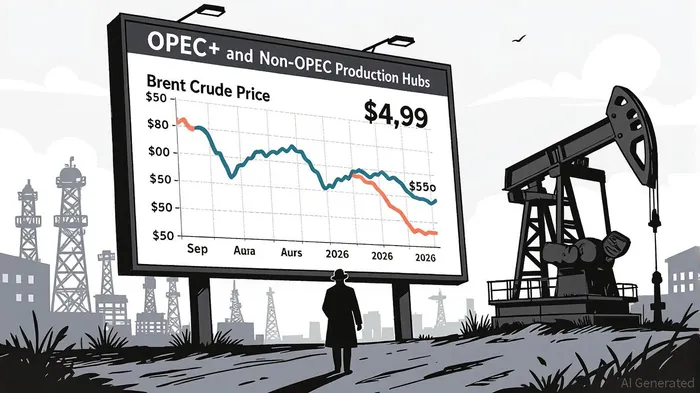
OPEC+'s decision to accelerate production unwinding reflects a strategic pivot to counter U.S. shale expansion and non-OPEC rivals like Brazil and Canada. While the group cites “healthy market fundamentals” as justification, the move risks exacerbating a projected 3 million bpd global crude surplus by 2026. This surplus, driven by OPEC+ output and non-OPEC growth, has already pushed Brent crude to $65.50 per barrel in early September 2025, down 15% from the year's peak.
The unwinding of cuts has also exposed compliance challenges. Despite the announced 137,000 bpd increase, Argus estimates actual production gains may fall short due to operational constraints in Russia and Iraq. This pattern of underperformance raises questions about OPEC+'s ability to control prices, even as it seeks to dominate market share. The group's flexibility to “pause, accelerate, or reverse” adjustments underscores the fragility of its strategy.
Investment Opportunities: Resilience in a Shifting Landscape
The OPEC+ strategy shift has polarized energy equities. Integrated majors like ExxonMobilXOM-- (XOM) and ShellSHEL-- (SHEL) have outperformed due to their diversified operations and disciplined capital allocation. ExxonMobil, for instance, trades at a P/E of 15.69 with a $472.5 billion market cap, reflecting confidence in its ability to navigate lower prices through cost efficiency and downstream margins. Shell, trading at a 42.9% discount to intrinsic value, offers a 13.2% free cash flow yield, bolstered by its investments in LNG and carbon capture.
Midstream operators, however, stand out as the most resilient sector. Companies like Enterprise Products PartnersEPD-- (EPD) and Kinder MorganKMI-- (KMI) benefit from fee-based business models, insulating them from commodity price swings. EPDEPD--, trading at a 43.4% discount to intrinsic value, generates stable cash flows from infrastructure contracts, while KMI's 16.7% free cash flow margin highlights its operational efficiency.
Energy ETFs, including the Energy Select Sector SPDR (XLE) and SPDR S&P Oil & Gas Exploration & Production ETF (XOP), have also gained traction. XLEXLE--, which tracks large-cap energy stocks, offers diversified exposure to firms with strong balance sheets and ESG alignment. However, investors must remain cautious: the ETF's 3.5% single-session plunge following the OPEC+ announcement underscores the sector's volatility.
Geopolitical and Regulatory Risks: Navigating Uncertainty
The OPEC+ strategy is not operating in a vacuum. U.S. President Donald Trump's push for lower energy prices and sanctions on Russian oil exports have created a fragmented market. Russia's pivot to Asian buyers, where Urals crude trades at a $15 discount to Brent, has further complicated pricing dynamics. Meanwhile, geopolitical tensions—such as the U.S.-Iran standoff and potential disruptions in the Strait of Hormuz—add a layer of unpredictability.
Investors must also consider the energy transition. While OPEC+ focuses on market share, the global shift toward renewables and electrification is accelerating. Companies like TotalEnergiesTTE-- (TTE) and BPBP-- (BP), with P/E ratios of 10.78 and 11.34 respectively, are strategically positioned to balance hydrocarbon operations with low-carbon investments.
Strategic Recommendations for Investors
- Prioritize Integrated Firms and Midstream Operators: Companies with diversified revenue streams and fee-based models (e.g., XOM, EPD) offer greater resilience to price volatility.
- Hedge with Energy ETFs: Diversified exposure through XLE or XOPXOP-- can mitigate sector-specific risks while capturing broader market trends.
- Monitor OPEC+ Compliance and U.S. Shale Output: These two factors will determine the trajectory of global oil balances. A compliance shortfall or a surge in U.S. production could trigger further price declines.
- Factor in Geopolitical Developments: Track U.S.-Russia diplomatic shifts, U.S.-China trade dynamics, and regional conflicts that could disrupt supply chains.
Conclusion
OPEC+'s October 2025 output adjustment marks a pivotal moment in the global oil market. By prioritizing market share over price stability, the group has introduced a new era of volatility, where supply-demand imbalances and geopolitical risks will dominate. For investors, the path forward lies in identifying resilient equities—those with strong balance sheets, ESG alignment, and operational flexibility—and hedging against macroeconomic uncertainties. As the energy transition accelerates, the ability to adapt to a dual-track market (hydrocarbons and renewables) will define long-term success.

Stay ahead of the market.
Get curated U.S. market news, insights and key dates delivered to your inbox.
AInvest
PRO
AInvest
PRO



Comments
No comments yet