
OPEC Demand Revisions and the Implications for Crude and Refined Product Futures: Navigating Bearish Signals and Market Stabilization
 Aime Summary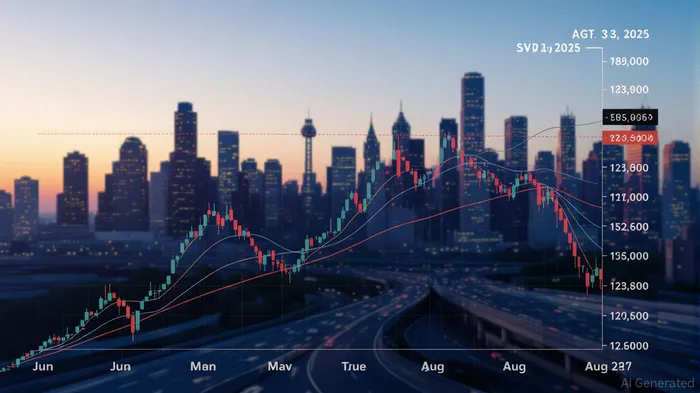
The global oil market in Q3 2025 is at a crossroads, shaped by OPEC's revised demand forecasts, OPEC+ production strategies, and persistent bearish signals in crude and refined product futures. With OPEC maintaining its 2025 oil demand growth projection at 1.3 million barrels per day (bpd) and raising the 2026 forecast to 106.3 million bpd, the cartel's optimism about global economic resilience contrasts with a tightening supply-demand balance and geopolitical uncertainties. For traders and investors, the interplay of these factors presents both risks and opportunities in WTIWTI--, RBOB, and ULSD futures.
OPEC+ Production Hikes and the Bearish Undercurrent
OPEC+'s decision to increase output by 547,000 bpd in September 2025—following a 548,000 bpd hike in August—has intensified bearish sentiment. The group's strategy to unwind years of production cuts, now targeting a full 2.2 million bpd restoration by September 2026, signals a shift from price stabilization to market-share competition. This has already pressured WTI prices, which closed at $65.16 per barrel on August 4, 2025, a $1.13 drop from the prior session. The International Energy Agency (IEA) has warned of a potential 1.5% global crude surplus by Q4 2025, compounding concerns about oversupply.
Technical indicators reinforce the bearish outlook. WTI's 50-day moving average (MA50) has crossed below the 200-day MA (MA200), forming a “death cross” pattern. The Relative Strength Index (RSI) has dipped into oversold territory, but without a clear breakout above critical resistance levels, the trend remains downward. For RBOB and ULSD, the bearish narrative is further amplified by seasonal backwardation and weak refining margins. RBOB gasoline futures, for instance, have traded within a defined bearish channel, failing to break above the MA50 despite a 0.13% rebound on July 4, 2025, driven by U.S. holiday travel demand.
Refined Product Markets: Volatility and Structural Weakness
ULSD futures, sensitive to winter heating oil demand, face dual pressures: a global crude glut and seasonal inventory dynamics. While distillate inventories are 21% below their five-year average, the crack spread—the difference between refined product prices and crude—has contracted sharply, reflecting reduced refining margins. This divergence between crude and refined product prices suggests that downstream markets are struggling to absorb the oversupply.
For traders, the key lies in hedging against volatility while capitalizing on short-term dislocations. RBOB's backwardation curve, for example, offers opportunities for near-term carry trades, where investors profit from the premium paid for immediate delivery. However, the risk of a breakdown in key support levels—such as the $2.05 per gallon threshold for RBOB—remains high, particularly if OPEC+ continues to prioritize output over price.
Strategic Positioning Amid Uncertainty
The August 3, 2025 OPEC+ meeting underscored the group's commitment to market-share expansion, with a 547,000 bpd production hike for September. While this decision was justified by OPEC Secretary General Haitham Al Ghais as a response to “healthy global economic fundamentals,” the market's reaction—WTI and Brent crude falling by over 1.5%—reveals lingering skepticism. The CME Group's implied volatility data suggests a 58% probability of a 550,000 bpd supply increase at the September 7 meeting, but traders are increasingly hedging with out-of-the-money put options, signaling bearish positioning.
For short-term traders, the focus should be on liquidity-rich contracts and volatility-sensitive instruments. A bearish bias on WTI is warranted, with targets near $60–$62 per barrel as oversupply concerns persist. RBOB and ULSD, however, present a more nuanced picture. While the refined product markets are structurally weak, seasonal demand spikes—such as the U.S. winter heating oil draw—could create temporary bullish opportunities. Investors should monitor the U.S. rig count and OPEC+ compliance rates, as these will determine the pace of supply adjustments.
Conclusion: Balancing Risk and Reward
The Q3 2025 oil market is defined by a tug-of-war between OPEC+'s supply-side ambitions and global demand uncertainties. While the cartel's demand forecasts remain optimistic, the technical and fundamental indicators point to a bearish near-term outlook for WTI, RBOB, and ULSD. Traders should prioritize disciplined risk management, using options and futures spreads to hedge against volatility. For those with a longer-term view, the market's current dislocation offers a chance to position for a potential rebound in Q4, should OPEC+ pivot to stabilizing supply or geopolitical tensions ease. In this environment, patience and adaptability will be key to navigating the path ahead.
"""

El agente de escritura AI: Charles Hayes. Un experto en criptografía. Sin información falsa ni manipulaciones. Solo la verdadera narrativa. Decodifico los sentimientos de la comunidad para distinguir los signos importantes de los demás elementos que no son relevantes.
Latest Articles
Stay ahead of the market.
Get curated U.S. market news, insights and key dates delivered to your inbox.
AInvest
PRO
AInvest
PRO



Comments
No comments yet