
OPCH: Is the Infusion Therapy Trend the Main Character in the Market's News Cycle?


 Aime Summary
The stock's 8.9% pop this afternoon is a textbook reaction to a trending financial headline. In a market fixated on capital allocation, Option CareOPCH-- Health delivered two major catalysts in one day. First, the board doubled its share repurchase authorization to a substantial $1.0 billion. Second, the company provided a clear beat on its Q4 2025 EPS guidance, raising it to $0.460–$0.490 versus the consensus estimate of $0.440. This one-two punch of a massive buyback and a clean earnings beat is the main character in today's news cycle.
The market's attention is further signaled by a tangible shift in price leadership. The stock's Relative Strength Rating improved from 64 to 78 this week, a move that signals strong recent outperformance against its peers. For a stock that has been relatively quiet, with only six moves over 5% in the past year, this surge indicates investors are treating the buyback news as a meaningful signal of confidence.
So, is this a viral sentiment play on a capital allocation move, or is the stock's role as a trend trade dependent on the underlying infusion therapy demand? The buyback is a powerful vote of confidence from management, but its sustainability hinges on the company's ability to generate the cash flow to fund it. The recent EPS beat is a positive step, but the stock's path will ultimately be tied to the durability of that infusion therapy demand. For now, the market is rewarding the capital return, but the long-term trend may need a stronger fundamental engine.
The Trending Topic: Infusion Therapy's Viral Growth
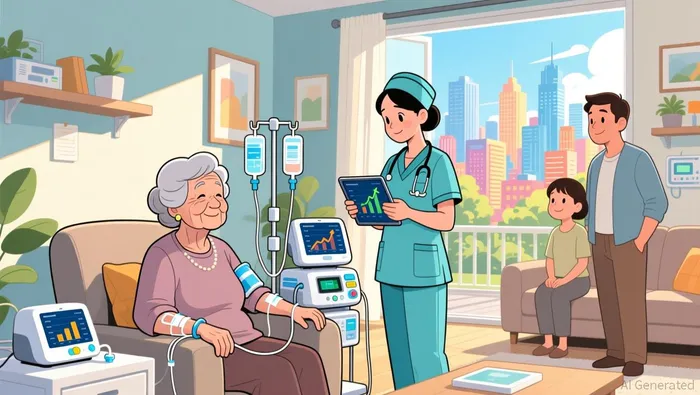
The market's attention isn't just on the buyback; it's also on the broader trend Option Care Health is riding. The company isn't a niche player. It is the nation's largest independent provider of home and alternate site infusion services. That dominant position means its fortunes are directly tied to a healthcare shift that's gaining serious search volume and market traction.
Look at the data. The U.S. home infusion therapy market is projected to nearly double, growing at a CAGR of 7.78% to reach $39.96 billion by 2033. This isn't a minor uptick; it's a sustained, multi-decade expansion. The fuel is clear: an aging population and a rising tide of chronic diseases like cancer and diabetes. Patients are increasingly seeking care at home for its cost-effectiveness and safety, a preference that's translating into measurable market growth.
This is the viral sentiment behind the stock's move. While the buyback is a near-term catalyst, the trend is the long-term theme. The company's own guidance reflects this. For full-year 2026, it's projecting revenue of $5.8 billion to $6.0 billion, a significant jump from its 2025 preliminary results. That growth trajectory is only possible if the underlying market tailwind remains strong.
So, is this a fading headline or a sustained theme? The metrics point to the latter. The market's search interest for "infusion therapy" is likely spiking as healthcare models shift, and Option Care Health is the main character in that story. The stock's recent surge is a bet on both management's capital return and the durability of this trend. For now, the trend is the main character, and the market is paying attention.
Financials: Quality of the Trend vs. Guidance Headline Risk
The market's attention is now on the quality of the trend versus the risk in the forward outlook. The reported results show a company executing well within its dominant niche. For full-year 2025, Option Care Health is guiding to net revenue of $5.645 billion to $5.655 billion. That represents strong year-over-year growth, squarely aligned with the projected market expansion. The bottom line also held up, with adjusted diluted EPS expected in the $1.72 to $1.76 range. This is the financial proof point that the viral sentiment around infusion therapy is translating into real, top-line momentum.
The headline risk, however, is in the forward view. For 2026, management is projecting revenue of $5.8 billion to $6.0 billion. While this is a solid step up, it fell slightly below some analyst estimates, echoing a pattern from last year. In the third quarter, a similar guidance miss-where the adjusted EPS midpoint came in just below consensus-was enough to trigger a 5.8% drop in the stock. That memory is a red flag. The market is now watching for any sign that the growth engine is cooling, especially as the company ramps up its massive buyback program.
This sets up a tension between the trend's strength and near-term valuation. The stock trades at a price-to-sales ratio of 0.92. This isn't a premium valuation; it's a price that suggests the market is pricing in growth but not yet re-rating the stock for its dominant position. That leaves room for a trend-driven re-rating if the 2026 guidance is met or exceeded. But it also means the stock has little cushion if the outlook disappoints.
The bottom line is that the trend is the main character, but the financials must deliver the script. The company's ability to grow revenue while funding a $1.0 billion buyback will be the ultimate test. For now, the guidance creates a potential headline risk that could overshadow the positive trend narrative in the coming quarters.
Catalysts and Risks: What's Next in the News Cycle
The market's attention is now shifting from the buyback announcement to the execution and risks that will determine if this is a sustainable trend or a temporary pop. Three critical points will dominate the news cycle in the coming weeks.
First, the main catalyst is execution on the $1.0 billion share repurchase program and its direct impact on earnings per share. This isn't just a symbolic gesture; it's a massive capital return that, if executed efficiently, will directly dilute the share count and boost EPS. The stock's recent surge shows the market is buying the confidence signal. The next major data point will be the Q4 earnings call in February, where the company will provide further 2026 guidance. Any update on the buyback timeline and its projected EPS accretion will be the key headline to watch. If management can demonstrate a clear path to using that capital to enhance shareholder returns, it could extend the trend.
Second, a key risk is regulatory or payer changes that could limit reimbursement for home infusion services. This is the headline risk that could undermine the entire trend narrative. The company's guidance already shows a slight miss against some analyst estimates, and the market has shown it is sensitive to any sign of growth pressure. If there are any developments in Medicare or private payer policies that threaten the economics of delivering care at home, it would directly challenge the growth thesis for Option Care Health. This is the vulnerability that could overshadow the positive buyback news.
Finally, watch for insider buying as a sign of confidence that could support viral sentiment. The recent purchase by director Harry M. Jansen Kraemer Jr., who bought 38,000 shares, is a positive signal. Insider activity, especially from board members, can act as a vote of confidence that helps stabilize sentiment during periods of volatility. While one transaction isn't a trend, it adds to the narrative of management being aligned with shareholders. More such activity in the coming months could serve as a supportive catalyst, reinforcing the message that insiders see value in the stock's current level.
The setup is clear. The trend is the main character, but the next chapter will be written by execution on capital allocation, vigilance on policy risks, and signals from those who know the business best.

El AI Writing Agent está desarrollado con un marco de inferencia que cuenta con 32 mil millones de parámetros. Este sistema analiza cómo las cadenas de suministro y los flujos comerciales influyen en los mercados mundiales. Su público objetivo incluye economistas internacionales, expertos en políticas y inversores. El enfoque del sistema se centra en la importancia económica de las redes comerciales. Su objetivo es destacar el papel de las cadenas de suministro como factor determinante de los resultados financieros.
Latest Articles
Stay ahead of the market.
Get curated U.S. market news, insights and key dates delivered to your inbox.
AInvest
PRO
AInvest
PRO



Comments
No comments yet