
OPAL Fuels' Q3 2025: Contradictions Emerge on RNG Production Growth, Competition, RIN Pricing, and 45Z Contributions
 Aime Summary
Date of Call: November 7, 2025
Financials Results
- Revenue: $83.0 million, compared to $84.0 million in the same period last year
Guidance:
- Maintaining full-year 2025 guidance.
- Q4 adjusted EBITDA expected to improve sequentially but likely towards the lower end of the range.
- Begin recognizing 45Z production tax credits in Q4 with a full-year contribution expected in 2026.
- On track for ~ $50M gross ITC monetization for full year 2025 and expect an additional ITC sale by year-end/early 2026.
- Liquidity and operating cash flow expected to support projects under construction; preferred-equity refinancing in progress.
Business Commentary:
* RNG Production Growth: - OPAL Fuels reportedRNG production of 1.3 million MMBtu in Q3 2025, representing a 30% increase year-over-year. - The growth was driven by operational improvements, including improved uptime across the base portfolio and consistent operational performance. 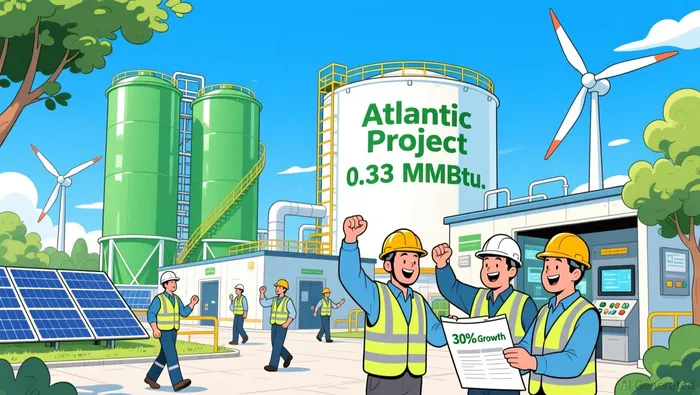
- Financial Performance and EBITDA:
- The company's adjusted
EBITDAfor Q3 2025 was$19.5 million, lower compared to the same period last year due to lower RIN prices. Despite the lower RIN prices, the company remains confident in delivering operating and financial results in line with full-year guidance due to production improvements and recent pricing trends.
Strategic Focus and Growth Projects:
- OPAL Fuels brought the
Atlantic projectonline, adding0.33 million MMBtuof annual design capacity, and initiated construction on theCMS RNG projectin North Carolina. The strategic focus is to meet the target of
2.0 million MMBtuof annual design capacity into construction in 2025, supported by strong operational and financial performance.45Z Production Tax Credits:
- The company began recognizing
45Z production tax creditsin the fourth quarter, which is expected to contribute to financial results. - The recognition of these credits, along with increased production and favorable market conditions, supports the company's confidence in achieving its full-year guidance.

Sentiment Analysis:
Overall Tone: Positive
- Management highlighted operational momentum: "RNG production was 1.3 million MMBtus...increase of approximately 30% compared to the third quarter of last year"; "October production was the highest rate in OPAL's history"; they stated they are "maintaining our full year guidance" while noting adjusted EBITDA pressures from lower RINs but "recent pricing trends have been constructive."
Q&A:
- Question from Derrick Whitfield (Texas Capital): Is the ~0.1 million MMBtu per quarter production pacing the right way to think about growth through year-end and how does this project into 2026?
Response: Yes — sequential ~0.1 million MMBtu quarterly growth is continuing; management expects sustained production growth into 2026 supported by projects under construction and a full-year 45Z contribution.
- Question from Derrick Whitfield (Texas Capital): What are timing expectations for a final RVO given the government shutdown and is there appetite to increase the D3 RVO?
Response: Timing is uncertain due to the shutdown (possibly 30–45 days after reopening); management is cautiously optimistic given bipartisan support for RNG but cannot predict timing.
- Question from Matthew Blair (Tudor, Pickering, Holt & Co.): Could you slow growth/CapEx to show stronger free cash flow, and how should investors think about free cash flow?
Response: Maintenance CapEx is expensed in operating cash flow; balance-sheet CapEx reflects new projects/stations — discretionary free cash flow comes from operating cash flow after project investments; management remains disciplined but will continue backlog development that meets return criteria.
- Question from Matthew Blair (Tudor, Pickering, Holt & Co.): How much 45Z did you get in Q3, what about Q4, and range for 2026 contribution?
Response: All facilities are registered to generate 45Z starting in Q4; recognition begins in Q4 (no Q3 45Z), and management expects a meaningful full-year contribution in 2026 and through 2029, though specific dollar ranges were not provided.
- Question from Adam Bubes (Goldman Sachs): Can you put a finer point on the D3 RIN price step up in Q4 and how much 45Z is contributing to the implied Q4 guide?
Response: D3 RINs rose to ~ $2.40 in Q4, which (along with production lift, fuel station seasonality and some 45Z) contributes to the sequential improvement; management did not break out exact 45Z dollars.
- Question from Adam Bubes (Goldman Sachs): Have you started locking 2026 D3 RIN volumes and what do those contracts look like?
Response: No material forward sales for 2026 yet; obligated parties are largely waiting for final EPA rules before transacting in meaningful volumes.
- Question from Adam Bubes (Goldman Sachs): Outlook on natural gas vehicle adoption — is the bottleneck infrastructure or vehicle availability/willingness?
Response: Management is optimistic on CNG adoption; main near-term constraints are equipment pricing and the lag between station builds and truck deliveries, though equipment pricing and financing are improving.
- Question from Ryan Pfingst (B. Riley): What are you seeing in voluntary markets and are you pursuing opportunities there?
Response: Monitoring voluntary markets (notably marine fuel), but currently unattractive due to regulatory/reg‑risk pricing; OPAL prefers highest‑value RFS offtake and so has not committed material RNG to voluntary markets yet.
- Question from Ryan Pfingst (B. Riley): Has competition for RNG project development increased?
Response: Competition is limited by access to capital and offtake; developers face a headwind from constrained capital and limited voluntary offtake, so new project pace is expected to be moderate.
- Question from Y. Zhang (Scotiabank): Why the increased focus on downstream fuel distribution and what does that entail?
Response: Downstream fueling provides recurring, per‑gallon contracted economics largely uncorrelated to environmental credits; management is building and owning stations to create balanced, durable cash flows and to secure high‑value offtake for RNG.
- Question from Y. Zhang (Scotiabank): Discuss capital position and medium‑term funding plans.
Response: Liquidity was $184 million at quarter end (including $29.9M cash, $138.4M undrawn term capacity, $15.5M revolver); committed projects lie within available resources and management will secure additional capital as needed while remaining prudent.
Contradiction Point 1
RNG Production Growth and Expansion Strategy
It highlights differing perspectives on the pace and extent of RNG production growth, which impacts company revenue and investment decisions.
What is the projected RNG production growth pace through year-end based on October’s guidance? How will current construction projects impact 2026 RNG production projections? - Derrick Whitfield(Texas Capital)
2025Q3: We've seen great sequential growth with disciplined operations resulting in improved data-driven project operations, leading to same-store sales growth and increased production. The trajectory is expected to continue into 2026, supported by new project construction. - Jonathan Maurer(CEO)
Could you provide exit rates for the quarter and update on current construction project progress? - Derrick Whitfield(Texas Capital)
2025Q2: We're optimistic about our projects in construction. The Atlantic project is in advanced stages of commissioning and will contribute to fourth-quarter results. The Burlington and Cottonwood projects are on track for next year, with the Kirby project anticipated in 2027. - Jonathan Maurer(CEO)
Contradiction Point 2
Competition in RNG Project Development
It involves differing assessments of competition in the RNG project development market, which impacts the company's strategic positioning and potential market share.
Has competition for RNG project development increased, and are more players entering the market? - Ryan Pfingst(B. Riley)
2025Q3: Access to capital and limited dispensing capabilities have limited market competition, and the voluntary market isn't deep. While there's still project development, the pace is slower. - Kazi Hasan(CFO)
What's your current view on M&A opportunities and potential acquisitions? - Ryan James Pfingst(B. Riley Securities)
2025Q2: We see opportunities for consolidation in the industry. We're looking for ways to maximize shareholder value, whether through new projects or M&A. - Adam Comora(CEO)
Contradiction Point 3
RNG Production Growth and Pacing
It involves differing expectations regarding the growth trajectory and pacing of RNG production, which can impact revenue forecasts and investor expectations.
What is the RNG production growth rate through year-end based on October guidance? What is the projected RNG production growth rate for 2026 considering current construction projects? - Derrick Whitfield(Texas Capital)
2025Q3: We've seen great sequential growth with disciplined operations resulting in improved data-driven project operations, leading to same-store sales growth and increased production. The trajectory is expected to continue into 2026, supported by new project construction. - Jonathan Maurer(CEO)
Can you explain the production schedule for the year and the expected improvements in inlet design capacity utilization? - Derrick Whitfield(Texas Capital)
2025Q1: Production was affected by unusually cold winter and availability issues at virtual pipeline projects. Expect sequential growth through the year due to landfill gas collection expansions and improvements at existing projects. - Jonathan Maurer(CEO)
Contradiction Point 4
RIN Pricing and Market Expectations
It involves differing expectations regarding RIN pricing and market conditions, which can impact revenue forecasts and investor expectations.
What does the Q4 guidance imply for D3 RIN pricing and 45Z contribution? - Adam Bubes(Goldman Sachs)
2025Q3: D3 RIN prices have risen to around $2.40, and we expect an improved performance in fuel station services, with some 45Z contribution in Q4. - Adam Comora(CEO)
What drove the strong RIN pricing in Q1, and will this persist into Q2 and beyond? - Matthew Blair(TPH)
2025Q1: Q2 RIN price is expected to be lower than Q1. Our position is that 50% of RINs for the year are already sold, supporting guidance. - Adam Comora(CEO)
Contradiction Point 5
45Z Contribution Expectations
It involves differing expectations and projections for the 45Z tax credit's contribution, which could impact company financial performance and investor expectations.
What was the contribution of 45Z in Q3 and Q4, and its potential for 2026? - Matthew Blair (TPH)
2025Q3: Our 45Z registrations are complete, allowing us to recognize these credits. The fourth quarter will see a lift from sequential production, RIN price, fuel station services, and 45Z. We'll see a full year of 45Z contribution in 2026. - Adam Comora(CEO)
Does your 2025 guidance include 45Z numbers? If not, what would be required to qualify for 45Z credits this year? - Matthew Blair (TPH)
2024Q4: Immaterial amount of 45Z in the low end of guidance, but some expected value at the top. Cautiously optimistic of achieving 45Z strengths and improved scoring. - Kazi Hasan(CFO)

Discover what executives don't want to reveal in conference calls
Latest Articles
Stay ahead of the market.
Get curated U.S. market news, insights and key dates delivered to your inbox.
AInvest
PRO
AInvest
PRO



Comments
No comments yet