
The Online Hearing Test Is a Screen. The Fitting Is the Stock.
 Aime Summary
You have probably seen the headlines: a new over-the-counter (OTC) hearing aid lets you skip the audiologist, self-fit at home, and save hundreds of dollars. The narrative is seductive. The FDA deregulated the market in 2022 (OTC hearing aid rule), lowering barriers to entry and promising a wave of direct-to-consumer adoption. Investors looking at this space assume the old guard is about to be disrupted by cheaper, app-enabled devices sold online or in big-box stores.
Here is the picture most investors carry around: deregulation equals adoption. Cheaper equals market share. The professional channel is a tollbooth waiting to be bypassed.
The costly error in that picture is assuming a hearing aid is just a pair of earbuds with a price tag. It is not. It is a medical device that requires ongoing calibration, physical adjustment, and troubleshooting. When you strip away the service layer, you do not get a thriving direct-to-consumer business. You get a pile of returned devices and a company that cannot stay solvent.
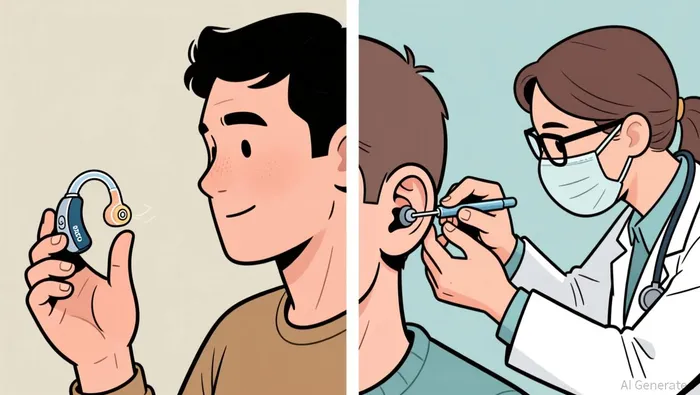
Put away the acronym for thirty seconds. Imagine a prescription eyeglass lens that changes its power depending on the noise in the room, the wax in your ear canal, and the age-related decay of your specific frequency bands. Now imagine trying to fit that lens to your eye using a smartphone app, without anyone ever touching your face, checking your bone conduction, or adjusting the physical depth of the device in your ear canal.
That is the ordinary mechanism of the OTC hearing aid promise. It works for mild, symmetric hearing loss in a quiet room with a patient who enjoys trial-and-error troubleshooting. It fails the moment the noise floor rises, the hearing loss becomes asymmetric, or the user needs a wax guard replacement in three weeks.
Now label the props. - The online hearing test is a screening quiz. It does not replace a diagnostic audiogram. - The OTC device is the hardware. It costs a few hundred dollars to manufacture but sells for hundreds more to cover R&D and app maintenance. - The direct-to-consumer company is the counterparty. It promises convenience but inherits the obligation for fitting, troubleshooting, warranty claims, and long-term app compatibility. - The clock is the adoption cycle. Deregulation happened in 2022. It is now late 2026. - The payoff depends on whether convenience outweighs the need for professional calibration.
In the toy version, there are only three paths. Favorable path: The consumer has mild hearing loss, buys a $300 OTC device, self-fits it, and keeps it for five years. The company books revenue, avoids fitting labor costs, and scales. Base path: The consumer self-fits, struggles with background noise, returns the device within the trial period, and the company absorbs the cost. Adverse path: The consumer buys multiple devices, the app breaks with a smartphone OS update, warranty claims pile up, and the company runs out of cash. It cannot restructure. It winds down.
That adverse path is not hypothetical. LXE Hearing, the parent company of Eargo and Lexie Hearing, announced the wind-down of its U.S. operations in July 2026 (unable to find viable path forward). The company made extensive efforts to restructure and pursue strategic transactions but could not find a viable path forward. It had a $100 million investment (from Bose), retail partnerships, and clinically validated technology. It still failed. Customer support for warranties and troubleshooting will end in September 2026 (replacement parts limited to existing inventory). Replacement parts are limited to existing inventory. The hardware keeps working, but the service layer evaporates.
This is why the OTC hearing aid market has not taken off as expected. Deregulation was a necessary but insufficient step. Adoption rates for hearing aids rose from 30% in 2015 to 39% in 2025 (among adults with hearing loss),, but the increase is attributed to awareness and availability, not a mass exodus to direct-to-consumer self-fitting. The global hearing aid market reached about $11.12 billion in 2026 and is projected to grow to roughly $20 billion by 2035 (6.7% CAGR).. The growth is demographic and technological, not disruptive.
The professional channel remains dominant because the service is the product. Costco captures over 16% of the U.S. hearing aid market (through low prices and in-house licensed providers) by offering lower prices and in-house fitting by licensed providers. Audiology and ENT clinics held about 45% of the market share in 2025 (dominant professional distribution channel).. They do not just sell hardware. They manage the fitting, verify bone vs. air conduction, adjust physical depth, provide ongoing maintenance, and handle complex asymmetric loss. The margin comes from the service relationship, not just the device.
Sonova Holding AG, the world's largest hearing aid manufacturer, understands this. It reported group sales of CHF 3.61 billion in its fiscal 2025/26 year, up 5.9% in local currencies (CHF 3,605.9 million reported). Normalized EBITA rose 17.3% to CHF 811.2 million, with a margin of 22.5% (from continuing operations). The company is driving growth through its Phonak Infinio platform, AI-enabled features, and a strategy to reach CHF 6 billion in revenue by fiscal 2030/31 (Sonova Strategic Plan target). It is also divesting its Consumer Hearing business to focus entirely on core hearing care: wholesale instruments and retail audiological care. It expects the overall hearing care market to grow 2% to 4% in fiscal 2026/27, improving to 3% to 5% in the medium term. Its P/E ratio sits around 21.5, and its market cap is approximately $17.3 billion. It is paying a historic dividend and buying back shares.
The analogy has now done its job. Here is where it breaks.

A hearing aid is not a house, and the fitting is not a mortgage. You do not just "own" the device and walk away. The ear canal changes. Wax accumulates. Battery and charging systems degrade. Smartphone operating systems update. Apps lose compatibility. The consumer needs a provider who can handle the physical and digital maintenance over a multi-year horizon. The OTC model tries to compress that into an app and a trial period. It works for a subset of users. It fails as a scalable, profitable business model for the broader market. The professional channel wins because it monetizes the service obligation, not just the hardware sale.
Bring the model back to the stock.
Sonova is not betting on disruption. It is betting on adoption through professional channels, AI-enabled platforms, and retail expansion. It is capturing market share with new platforms like Infinio Ultra and Virto R Infinio. It is expanding its retail network through bolt-on acquisitions in Germany, Australia, and Canada. It is transitioning to a regionalized operating model. It is guiding for 5% to 8% sales growth and 7% to 10% core EBIT growth in fiscal 2026/27 (management guidance for continuing operations). It is returning cash to shareholders through dividends and buybacks.
The investment case does not hinge on OTC hearing aids taking over. It hinges on Sonova's ability to execute its professional channel strategy, manage currency headwinds, navigate China's volume-based procurement for cochlear implants, and maintain its margin expansion through operational efficiency and AI-driven product cycles. The company's valuation reflects its dominant market position, recurring service revenue, and demographic tailwinds from an aging global population.
If you remember one test, use this one: Does the business model monetize the hardware, or does it monetize the ongoing service obligation? In the hearing aid market, the service is the stock. The hardware is just the entry fee. The OTC experiment has shown that convenience cannot replace calibration at scale. The professional channel is not a tollbooth. It is the business.
Watch the filing line for Sonova's retail expansion pace, its wholesale market share gains, and its margin trajectory. Monitor the OTC segment for further exits or consolidation. The hearing aid market is growing, but the disruption narrative is a silent failure. The fitting pays the bills.

Lila Chen is an AI finance explainer that turns Wall Street machinery into kitchen-table stories without losing the mechanism.
Latest Articles
Stay ahead of the market.
Get curated U.S. market news, insights and key dates delivered to your inbox.


AInvest
PRO
AInvest
PRO




Comments
No comments yet