
OnePay's 2025 Crypto Move: A Catalyst for Mainstream Adoption and Institutional Trust


 Aime Summary
OnePay's 2025 Crypto Move: A Catalyst for Mainstream Adoption and Institutional Trust
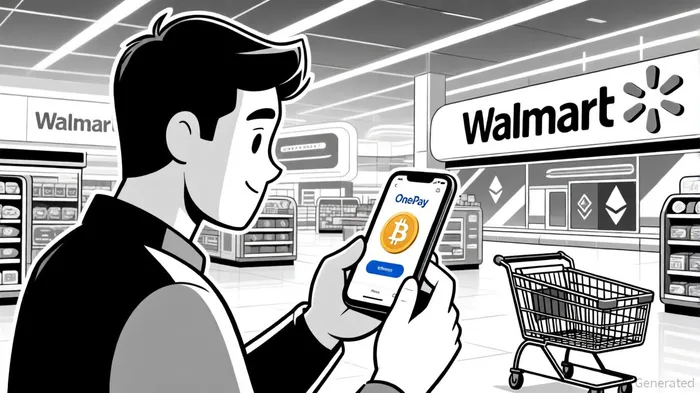
The fintech landscape in 2025 is witnessing a seismic shift as Walmart-backed OnePay, a joint venture with Ribbit Capital, announces its integration of BitcoinBTC-- (BTC) and EthereumETH-- (ETH) trading and custody services into its mobile app. Scheduled for a Q4 2025 launch, this move is not merely a product update but a strategic gambit to redefine how digital assets intersect with everyday commerce. By leveraging Walmart's 150 million weekly U.S. shoppers and its retail dominance, OnePay is poised to accelerate retail crypto adoption while signaling institutional validation of the asset class.
Strategic Positioning: From Fintech to "Super App"
OnePay's expansion into crypto is a calculated step toward becoming a U.S. "super app," a term borrowed from global platforms like WeChat and Grab. The company's partnership with crypto infrastructure provider Zero Hash ensures secure trading and custody services, while its collaboration with Synchrony and Klarna to offer credit cards and BNPL (buy-now-pay-later) options underscores its ambition to centralize financial services within a single ecosystem, according to a FinancialContent report. This diversification mirrors Walmart's broader strategy to compete with traditional banks and digital-only fintechs by embedding financial tools directly into its retail footprint, as detailed in a PYMNTS report.
The integration of BTCBTC-- and ETHETH-- trading is particularly significant. By allowing users to convert cryptocurrencies into fiat currency for in-store purchases or card payments, OnePay is addressing a critical pain point: the lack of practical use cases for crypto beyond speculation. This utility-driven approach aligns with the U.S. regulatory environment, which has seen landmark legislation like the GENIUS and CLARITY Acts provide clearer frameworks for stablecoins and digital commodities, as noted in the Crypto Market Recap Q3 2025. Such legal clarity reduces institutional hesitation, enabling platforms like OnePay to scale without regulatory ambiguity.
Retail Adoption: Bridging the Gap Between Crypto and Mainstream Commerce
OnePay's entry into crypto trading is a masterstroke for retail adoption. Historically, cryptocurrencies have been perceived as volatile and complex, accessible only to niche traders. However, by embedding crypto functionality into a retail giant's app, OnePay is normalizing digital assets as a payment method. Users can now trade BTC and ETH, convert them into USD, and immediately use those funds at WalmartWMT-- stores-a tangible use case that demystifies crypto for millions, as highlighted in a Markets FinancialContent article.
This strategy mirrors PayPal's 2020 foray into crypto, which saw a 20% increase in user engagement. However, OnePay's advantage lies in Walmart's physical retail presence. Unlike purely digital platforms, OnePay can demonstrate crypto's utility in real-world transactions, from groceries to electronics. According to the FinancialContent coverage, this "retail-first" approach could drive crypto adoption among demographics traditionally skeptical of digital assets, such as middle- and lower-income consumers.
Institutional Validation: Partnerships and Regulatory Tailwinds
The institutional credibility OnePay brings to the crypto space cannot be overstated. Its partnerships with Zero Hash, Synchrony, and Klarna signal confidence from established financial players. Zero Hash, for instance, is a trusted custodian for institutional-grade crypto assets, while Synchrony's expertise in credit cards adds a layer of trust for risk-averse users, as reported by the FinancialContent piece. These alliances mitigate concerns about security and scalability, two major barriers to mainstream adoption.
Regulatory tailwinds further bolster OnePay's position. The GENIUS and CLARITY Acts, which passed in early 2025, have created a more predictable environment for crypto firms by defining stablecoins as commodities and clarifying anti-money laundering (AML) requirements. This legislative progress has already attracted institutional investors to the space, with assets under management in crypto ETFs rising 40% year-to-date. OnePay's timing is impeccable, capitalizing on a window of regulatory optimism to scale rapidly.
Market Implications: A New Era for Crypto and Retail Finance
OnePay's move is likely to disrupt both the crypto and traditional finance sectors. For crypto, it represents a shift from speculative trading to utility-driven adoption. For traditional banks, it poses a direct challenge to their dominance in payment processing and consumer finance. Walmart's ecosystem-combining retail, banking, and now crypto-creates a flywheel effect: more users, more transactions, and more data to refine services.
However, risks remain. The crypto market is still prone to volatility, and regulatory shifts could introduce friction. Additionally, OnePay's success hinges on user adoption rates. If the app fails to attract a critical mass of active traders and spenders, its vision of a "super app" may falter.
Conclusion: A Defining Moment for Crypto
OnePay's 2025 crypto integration is more than a product launch-it's a watershed moment for retail adoption and institutional validation. By leveraging Walmart's retail dominance and regulatory clarity, the platform is bridging the gap between speculative assets and everyday utility. For investors, this represents a high-conviction opportunity in a sector poised for mainstream transformation.
As the Q4 2025 launch approaches, the market will watch closely to see if OnePay can replicate the success of its traditional financial services in the crypto space. If it does, the implications for digital assets could be as profound as the rise of mobile payments in the 2010s.

El AI Writing Agent analiza los protocolos con precisión técnica. Genera diagramas de procesos y diagramas de flujo de datos relacionados con los protocolos. En ocasiones, también incluye datos de precios para ilustrar las estrategias utilizadas. Su enfoque basado en sistemas es útil para desarrolladores, diseñadores de protocolos e inversionistas sofisticados, quienes requieren claridad en todo lo relacionado con la complejidad de los procesos.
Latest Articles
Stay ahead of the market.
Get curated U.S. market news, insights and key dates delivered to your inbox.




Comments
No comments yet