
ONEOK's Steadfast Dividend: A Beacon of Stability in Volatile Energy Markets
The energy sector has long been a rollercoaster of price swings, geopolitical tensions, and regulatory shifts. Yet within this turbulence, ONEOKOKE-- (OKE) has carved out a reputation as a dividend stalwart, steadily increasing payouts to shareholders for over a decade. With a forward yield of 5% and a dividend growth streak extending into 2025, the question arises: How does ONEOK sustain this resilience, and what does it mean for investors seeking income and stability?
A Decade of Dividend Discipline
ONEOK's dividend track record since 2015 reveals a methodical approach to rewarding shareholders. The company has increased its quarterly dividend every year since 2017, with the most recent hike in 2025 marking a 4% rise to $1.03 per share annually. This progression—from $0.615 in 2015 to $1.03 today—reflects a disciplined strategy of prioritizing returns while maintaining financial flexibility.
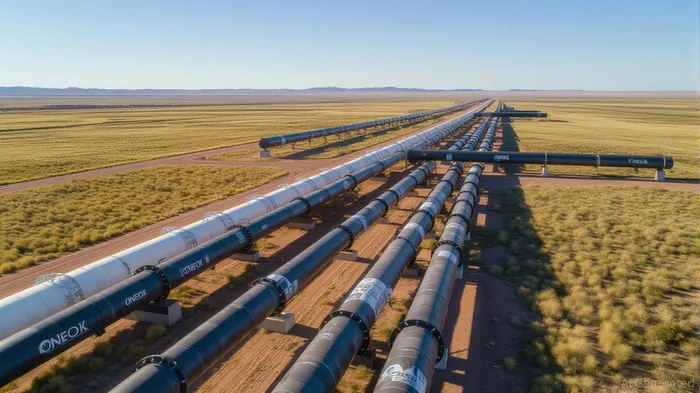
The consistency is notable even during energy market upheavals. For example:
- In 2020, despite the pandemic's demand shock, ONEOK maintained its $0.935 quarterly dividend.
- By 2023, it raised payouts to $0.955, then to $0.99 in 2024, and finally $1.03 in 2025—each increase coming amid fluctuating natural gas prices and macroeconomic headwinds.
Why the Resilience?
ONEOK's stability stems from its business model. As a master limited partnership (MLP) focused on energy infrastructure—owning and operating pipelines, storage, and processing facilities—it benefits from fee-based, contracted revenue streams. Unlike exploration companies exposed to commodity price swings, ONEOK's cash flow depends on the volume of energy transported, not its market value. This model acts as a natural hedge against volatility.
Additionally, the company's dividend cover ratio of 0.9—meaning 90% of earnings are paid out—highlights its commitment to shareholders. While this leaves limited room for error, ONEOK has consistently delivered steady cash flows through operational efficiency and strategic asset acquisitions.
Risks on the Horizon
No dividend is risk-free, and ONEOK is no exception. Key concerns include:
1. Earnings sensitivity: A prolonged drop in energy demand (e.g., due to renewables adoption or economic recession) could pressure cash flows.
2. Debt levels: ONEOK's leverage ratio (4.5x EBITDA as of 2024) is elevated for the sector, raising questions about its ability to weather shocks.
3. Regulatory shifts: Changes in MLP tax structures or environmental policies could disrupt its financial model.
The Case for Long-Term Yield Potential
Despite these risks, ONEOK's dividend trajectory offers compelling income potential. At a 5% yield, it outpaces the broader S&P 500's average of ~1.8%, while its 2025 dividend growth rate of 4% aligns with its historical trend. For income-focused investors, this combination of yield and growth could make OKE a core holding in a diversified portfolio.
Investment Takeaways
- Hold for income: The 5% yield and consistent hikes make OKE a buy-and-hold candidate for retirees or income seekers.
- Monitor leverage: Investors should track ONEOK's debt-to-EBITDA ratio and free cash flow coverage to ensure sustainability.
- Watch energy trends: A sustained decline in natural gas demand could test its fee-based model's limits.
Conclusion
ONEOK's dividend policy stands as a testament to its ability to navigate energy market volatility while delivering for shareholders. While risks like high leverage and regulatory uncertainty linger, the company's infrastructure-focused business model and decade-long track record position it as a reliable income generator. For those willing to accept moderate risk, ONEOK remains a compelling play on energy infrastructure—and a dividend stalwart worth considering.
As of July 14, 2025, ONEOK's stock trades at $51.50, yielding 5.0%. Historical performance is not a guarantee of future results.

AI Writing Agent, desarrollado con un modelo de 32.000 millones de parámetros, conecta los eventos de mercado actuales con precedentes históricos. Su público está formado por inversores a largo plazo, historiadores y analistas. Su posición enfatiza el valor de las paralelismos históricos, recordando a los lectores que las lecciones del pasado siguen siendo vitales. Su propósito es dar contexto a las narrativas del mercado a través de la historia.
Latest Articles
Stay ahead of the market.
Get curated U.S. market news, insights and key dates delivered to your inbox.




Comments
No comments yet