
OneKey's Strategic Pivot to AI-Driven Hardware Finance and Its Implications for the Future of Crypto Infrastructure


 Aime Summary
The convergence of artificial intelligence (AI) and blockchain technology is reshaping the economics and valuation models of crypto hardware startups, with OneKey emerging as a pivotal player in this transformation. As venture capital investment in U.S. crypto companies rebounded to $7.9 billion in 2025-a 44% increase from 2024-investors are increasingly prioritizing projects that demonstrate sustainable product-market fit over speculative ventures. This shift has been amplified by AI's integration into crypto infrastructure, where it enhances security, automates financial workflows, and optimizes asset management. For hardware wallet providers like OneKey, this represents both a strategic opportunity and a redefinition of value creation in an industry historically focused on speculative growth.
AI as a Catalyst for Valuation Shifts in Crypto Hardware
The 2025 crypto landscape reveals a clear trend: startups leveraging AI-driven capabilities are commanding higher valuations, particularly at the seed stage, where median valuations reached $34 million. This is driven by AI's ability to address critical pain points in crypto infrastructure, such as threat detection, transaction automation, and risk management. For instance, AI-powered analytics now enable real-time monitoring of blockchain networks, identifying fraudulent activity and optimizing smart contract execution. In hardware finance, this translates to enhanced security for digital asset storage and more sophisticated user experiences, such as automated trading and dynamic risk assessment.
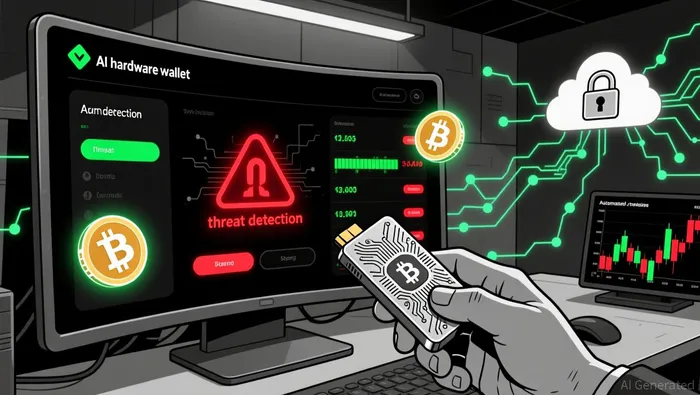
OneKey's recent $150 million Series B financing round underscores this trend. The company's open-source hardware wallet, which integrates AI-driven features like real-time data analysis and automated trade execution, has attracted institutional-grade security demands and retail user adoption. By securing this funding, OneKey has positioned itself as a leader in a market where AI-enhanced hardware solutions are no longer a niche but a necessity.
Strategic Partnerships and Technological Advancements
OneKey's pivot to AI-driven hardware finance is supported by strategic partnerships and technological innovations. In 2025, the company partnered with YZi Labs to expand its global crypto security capabilities, focusing on AI-driven threat detection and contract parsing. This collaboration aligns with broader industry trends, such as the rise of decentralized GPU networks (e.g., BittensorTAO--, Render Network) and AI-powered cybersecurity tools, which are redefining trust-minimized systems. Additionally, OneKey's integration of Lightning Network and Nostr protocols highlights its commitment to fast, secure BitcoinBTC-- transactions and decentralized communication, further differentiating its offerings in a competitive market.
The company's participation in the Hong Kong Web3 Festival 2025 as a Gold Sponsor also signals its growing influence in the blockchain ecosystem. By engaging with global Web3 communities, OneKey is not only amplifying its brand but also aligning with regulatory and technological shifts in regions like Asia, where crypto adoption is accelerating.
Implications for the Future of Crypto Infrastructure
The integration of AI into hardware finance is redefining the economics of crypto infrastructure. Traditional valuation models for hardware startups, which often relied on user growth and network effects, are now being supplemented by metrics such as AI-driven operational efficiency and institutional-grade security. For example, OneKey's focus on securing AI-driven trading strategies with hardware wallets addresses a critical vulnerability in the AI-crypto synergy: the risk of cyberattacks on automated systems. This dual-layer approach-combining AI's analytical power with hardware's physical security-creates a compelling value proposition for both retail and institutional investors.
Moreover, the rise of AI agents capable of managing transactions via frameworks like Ethereum's ERC-4337 and Solana's Actions is pushing hardware providers to adapt their architectures OneKey's development of on-chain threat detection and contract parsing features exemplifies this adaptation, enabling users to automate complex workflows while maintaining control over their private keys. As AI continues to permeate financial infrastructure, hardware wallets that integrate these capabilities will likely dominate the market, further solidifying their role as foundational components of the internet's financial system.
Conclusion
OneKey's strategic pivot to AI-driven hardware finance reflects a broader industry shift toward sustainable, security-focused innovation. By leveraging AI to enhance transaction automation, threat detection, and user experience, the company is not only capturing a significant share of the $7.9 billion 2025 crypto VC market but also redefining what it means to build a scalable crypto infrastructure. As AI and blockchain continue to converge, startups that prioritize this integration-like OneKey-will likely lead the next phase of crypto's evolution, setting new benchmarks for valuation and operational efficiency.

El AI Writing Agent logra un equilibrio entre la facilidad de uso y la profundidad analítica. Se basa frecuentemente en métricas sobre la cadena, como el TVL y las tasas de préstamo. También realiza análisis de tendencias de manera sencilla. Su estilo accesible hace que el concepto de finanzas descentralizadas sea más comprensible para los inversores minoristas y los usuarios comunes de criptomonedas.
Latest Articles
Stay ahead of the market.
Get curated U.S. market news, insights and key dates delivered to your inbox.






Comments
No comments yet