
Ondo Finance (ONDO) Faces CEO Ouster Bid Amid Founder Succession Dispute
 Aime Summary
- Kathleen Allman, estate executor of founder Nathan Allman, sued CEO Ian De Bode in Delaware to assert board control.
- De Bode rejects the lawsuit, citing strong backing from major venture capital investors and the OndoONDO-- Foundation.
- The dispute threatens Ondo Finance's planned $250-500 million acquisition and ongoing operational stability.
- Despite governance turmoil, the platform achieved $4 billion in tokenized stock trading volume amid regulatory progress.
- Future ONDO token price faces volatility due to a massive 35% supply increase scheduled for January 2027.
A corporate control battle has erupted at Ondo Finance, a leading real-world asset tokenization platform, following the sudden death of its founder. Kathleen Allman, the mother of the late Nathan Allman and personal representative of his estate, has filed a lawsuit in the Delaware Court of Chancery. Her legal action seeks to remove current CEO Ian De Bode and establish direct authority over the company's governance structure.
The dispute centers on conflicting interpretations of corporate bylaws and voting authority. Allman alleges that De Bode improperly seized control by declaring himself CEO without board approval immediately after Allman's passing in May 2026. De Bode has dismissed these allegations as meritless, asserting that he retains the confidence of key stakeholders and lead investors.
Ondo Finance operates a significant real-world asset platform, currently managing approximately $3.5 billion in assets. The platform issues blockchain tokens backed one-for-one by traditional securities, including U.S. Treasuries and equities. Its flagship products, OUSG and USDY, provide yield-bearing exposure to U.S. Treasury rates, catering to both qualified purchasers and international retail investors.
How Did The Leadership Dispute Unfold?
The conflict intensified after Kathleen Allman was formally appointed as the estate administrator in Hawaii on June 26. She exercised her voting rights to reconstitute the board, appointing herself and Nathan Allman's sister, Tahnee Towill, as directors. Subsequently, the newly formed board voted to remove De Bode from all positions, including his role as president.
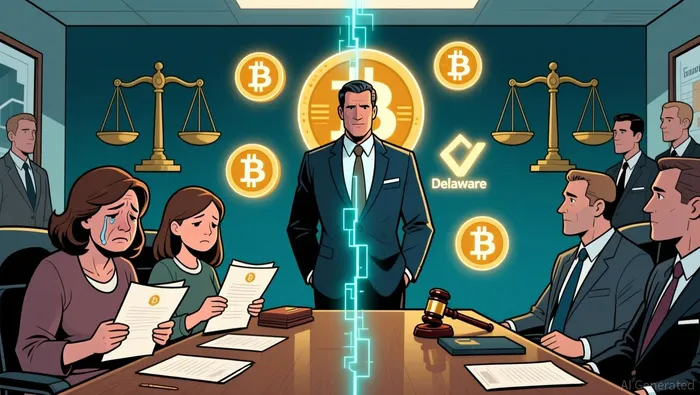
De Bode maintains that the bylaws allowed him to assume the CEO role temporarily before the probate process was complete. He argues that he acted within legal boundaries to ensure business continuity during a period of unexpected leadership vacuum. Furthermore, he claims that the company continues to enjoy robust support from major institutional backers.
The legal proceedings have introduced significant uncertainty regarding Ondo's strategic direction. The court is tasked with determining the lawful controller of the company and preserving the status quo until a final resolution is reached. This litigation exposes critical succession planning vulnerabilities inherent in founder-led crypto startups.
What Are The Strategic And Regulatory Implications?
Amidst the governance turmoil, Ondo Finance is exploring a major strategic pivot. The company is evaluating a $250-500 million acquisition, potentially of a wealth technology firm, to bridge into traditional financial distribution. This deal is expected to be funded using ONDO tokensONDO-- from the foundation's ecosystem allocation rather than cash reserves.
Regulatory positioning has strengthened considerably in 2026. Ondo Finance successfully concluded an SEC investigation without any enforcement actions, removing a significant regulatory overhang. Additionally, its subsidiary, Oasis Pro Markets, received FINRA authorization to offer tokenized stocks and ETFs to U.S. investors.
These regulatory milestones have driven substantial growth in the platform's ecosystem. Ondo Perps, a derivatives platform offering leveraged exposure to tokenized stocks, has recorded trading volumes exceeding $4 billion. The platform's ability to use tokenized equities as collateral has positioned it as a competitive on-chain prime brokerage.
How Does The Governance Dispute Affect Token Economics?
The ONDO token faces headwinds from both corporate governance risks and future supply dynamics. Over 10 million ONDO tokens were recently transferred to exchanges, sparking speculation about insider trading ahead of the lawsuit disclosure. This selling pressure contributed to a notable short-term price decline, highlighting market sensitivity to leadership instability.
Structurally, the ONDO token currently does not capture any protocol revenue, relying primarily on governance utility. Investors are closely watching a proposed fee switch expected in late 2026, which would route platform revenue to token holders. However, the immediate focus remains on resolving the executive power struggle.
A more looming threat to the token's valuation is a significant supply expansion. A token unlock scheduled for January 2027 will increase the circulating supply by approximately 35%, adding 1.71 billion tokens to the market. If demand does not expand proportionally alongside this new supply, intense price pressure could ensue.
Despite these challenges, Ondo Finance remains heavily backed by prominent venture capital firms, including Founders Fund, Coinbase Ventures, and Tiger Global. The outcome of the Delaware court case will likely set a precedent for corporate governance in the crypto sector, particularly regarding founder succession and board authority.
Investors are currently reassessing the execution risks associated with Ondo's ambitious acquisition plans. The diversion of management attention to legal battles may delay critical strategic decisions and partnerships. Meanwhile, the broader crypto market remains flat, leaving Ondo's performance heavily dependent on the resolution of its internal governance crisis.

Blending traditional trading wisdom with cutting-edge cryptocurrency insights.
Latest Articles
Stay ahead of the market.
Get curated U.S. market news, insights and key dates delivered to your inbox.


AInvest
PRO
AInvest
PRO




Comments
No comments yet