
Ondo Expands Tokenized Asset Offerings With Franklin Templeton Partnership
 Aime Summary
Ondo Finance partners with Franklin Templeton to issue tokenized versions of traditional investment products, enabling 24/7 access through blockchain and bypassing traditional brokerage infrastructure according to a partnership announcement.
The platform now offers over 250 tokenized assets, including U.S. Treasuries, stocks, and ETFs, with $620 million in total value locked and $12 billion in trading volume since September 2025 according to platform data.
Tokenized assets on OndoONDO-- represent a shift in market accessibility and settlement efficiency, though regulatory clarity in the U.S. and cross-border compliance remain key limitations as reported.
Ondo Finance is bridging traditional finance and blockchain by tokenizing real-world assets like stocks, ETFs, and U.S. Treasuries. This allows investors to access these assets through digital wallets and trade around the clock, with reduced reliance on intermediaries according to the partnership announcement.
The partnership with Franklin Templeton expands Ondo's offerings to include tokenized ETFs, with initial availability in Europe, Asia-Pacific, and Latin America. The initiative aims to test a new distribution model for traditional financial products as detailed in the announcement.
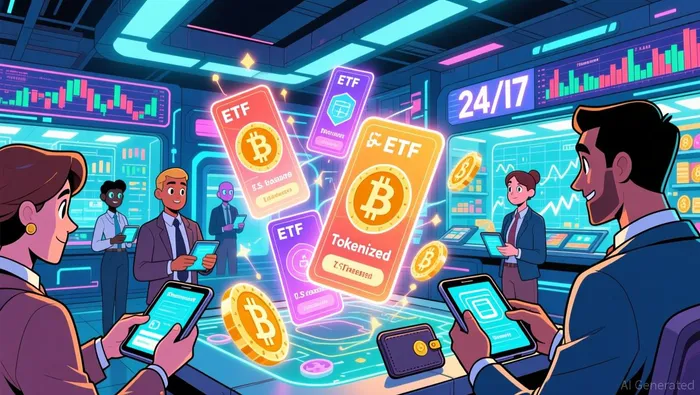
Ondo's platform has seen strong growth in total value locked and trading volume, driven by institutional backing and regulatory approvals in 30 European markets. These factors support its credibility and scalability in the tokenized asset space according to market analysis.
How Does Tokenization Affect Traditional Financial Access?
Tokenization reduces reliance on traditional brokerage systems by allowing direct ownership through digital wallets. This model enables 24/7 trading and eliminates time zone and operational hour limitations as described in the report.
For investors, this means greater accessibility and flexibility. Tokenized ETFs and stocks can be traded, held, and used as collateral in DeFi protocols, enhancing their utility beyond traditional investment scenarios according to industry analysis.
However, regulatory frameworks are still evolving, particularly in the U.S., where availability of these products is pending further clarity. This creates uncertainty for broader adoption and market expansion as noted in market reports.
What Are the Key Market Implications of Ondo's Model?
Ondo's model challenges traditional financial gatekeepers by enabling direct access to assets via blockchain. This could disrupt the role of banks and brokers in distributing financial products according to industry analysis.
The shift toward tokenized assets is supported by institutional partnerships and growing demand for faster, more efficient settlement systems. For example, tokenized U.S. Treasuries now represent $11 billion in on-chain value according to market data.
As more firms enter the tokenized asset space, competition is increasing. Ondo's dominance in market share—over 60% in tokenized equities—highlights its leadership position but also sets a high bar for new entrants according to market research.
What Risks and Limitations Exist for Tokenized Securities?
Regulatory challenges, particularly in the U.S., are a major limitation. Unlike traditional markets, tokenized securities move across wallets and borders, raising questions about compliance, taxation, and cross-border treatment as reported.
Another challenge is market adoption. While Ondo has secured over 60,000 users, broader acceptance will depend on regulatory support and investor education according to user data.
Competition is also intensifying, with firms like BlackRockBLK-- and Mastercard exploring similar strategies. Ondo's success will depend on maintaining its first-mover advantage and adapting to regulatory and market changes as noted in industry analysis.

Blending traditional trading wisdom with cutting-edge cryptocurrency insights.
Latest Articles
Stay ahead of the market.
Get curated U.S. market news, insights and key dates delivered to your inbox.
AInvest
PRO
AInvest
PRO



Comments
No comments yet