
Onchain Integration of SEC-Registered U.S. Stocks: A New Frontier for Institutional Capital


 Aime Summary
The integration of SEC-registered U.S. stocks into blockchain infrastructure marks a pivotal shift in capital markets, blending the rigor of traditional finance with the efficiency of decentralized systems. At the forefront of this transformation is the Superstate Ecosystem, which has pioneered platforms like Opening Bell to tokenize public equities on major blockchains such as SolanaSOL-- and EthereumETH--. This innovation not only redefines liquidity and accessibility but also positions institutional capital to harness the programmability of blockchain while adhering to U.S. securities law.
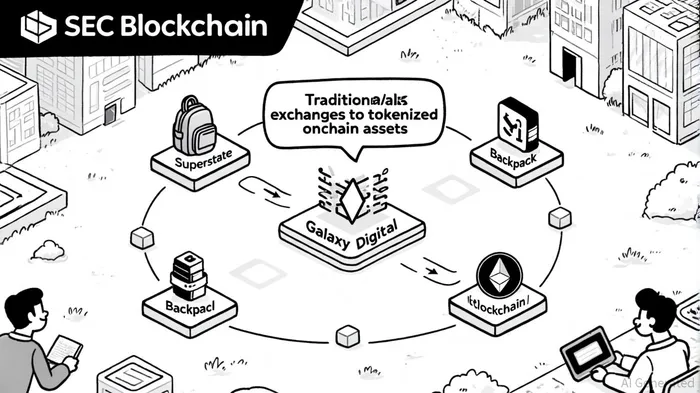
Strategic Infrastructure Development: Bridging Traditional and Onchain Markets
Superstate's Opening Bell platform serves as a regulated onchain tokenization infrastructure, enabling companies to issue and trade SEC-registered shares directly on blockchain networks. By acting as an SEC-registered transfer agent, Superstate ensures that tokenized equities retain full legal equivalence to traditional shares, including CUSIP identifiers, voting rights, and dividend entitlements. This approach eliminates synthetic or wrapped derivatives, offering investors direct ownership of real assets.
Key partnerships underscore this infrastructure's strategic value. For instance, Galaxy Digital became the first Nasdaq-listed company to tokenize its shares on Solana via Superstate in September 2025, according to a PR Newswire release. This move allows shareholders to transfer tokens peer-to-peer with near-instant settlement, bypassing traditional clearinghouses. Similarly, SharpLink Gaming (SBET) partnered with Superstate to tokenize its common stock on Ethereum, according to a SharpLink announcement, aiming to explore regulated trading on Automated Market Makers (AMMs) and DeFi protocols. These cases highlight how blockchain infrastructure can modernize capital markets while maintaining regulatory compliance.
Market Accessibility: Expanding Global Participation
One of the most compelling advantages of tokenized equities is their ability to democratize access. Backpack, a crypto exchange with a strong Solana presence, integrated Superstate's platform to enable non-U.S. investors to trade SEC-registered tokenized shares of U.S. public companies, according to a CoinDesk article. This expansion addresses a critical gap in traditional markets, where foreign investors often face barriers such as settlement delays and high custody costs.
The benefits extend beyond geography. Tokenized equities facilitate 24/7 trading, real-time settlement, and integration with DeFi tools like margin lending and automated market makers. For example, Galaxy's tokenized shares on Solana already support onchain collateralization, offering traders enhanced leverage compared to traditional markets, as shown in an SEC filing. Such features align with the SEC's Project Crypto agenda, which seeks to harmonize blockchain innovation with existing regulatory frameworks.
Liquidity and Investor Participation: Early Metrics and Projections
While the tokenized equity market remains nascent, early data suggests significant growth potential. As of Q3 2025, the real-world asset (RWA) tokenization market reached $30 billion, with tokenized stocks accounting for $337.94 million, per an RWA market report. Platforms like Superstate are driving this growth by attracting institutional players. For instance, SOL Strategies, a Canadian investment firm, plans to list tokenized shares on Superstate's platform, according to a CoinDesk article, signaling broader institutional adoption.
Investor participation is also rising. Backpack's integration of tokenized equities has already drawn non-U.S. users into U.S. capital markets, while Galaxy's tokenized shares saw early trading volumes exceeding $50 million in their first month, as reported by The Coin Republic. However, liquidity challenges persist. Unlike traditional markets, where order books are deep and stable, tokenized equities face lower trading volumes and wider bid-ask spreads. Superstate and partners are addressing this by exploring AMM-based trading models, which could enhance liquidity through algorithmic price discovery, as discussed in a Substack post.
Regulatory Alignment: A Key Differentiator
The Superstate Ecosystem's success hinges on its strict adherence to U.S. securities regulations. By maintaining legal equivalence between tokenized and traditional shares, Superstate mitigates the risks of regulatory pushback that have plagued earlier tokenization efforts. For example, Galaxy's tokenized shares are subject to the same disclosure requirements as its traditional counterparts, with Superstate's transfer agent system updating shareholder records in real time, as noted in the SEC filing. This alignment not only builds institutional trust but also sets a precedent for future tokenization projects.
Future Outlook: A Multitrillion-Dollar Opportunity
The tokenization of SEC-registered stocks is poised to disrupt capital markets. With Superstate's dual-chain strategy (Solana for equities, Ethereum for investment funds), the ecosystem is laying the groundwork for a hybrid financial system. Projections suggest the tokenized asset market could reach a multitrillion-dollar scale by the end of the decade, driven by institutional demand for programmable securities and global accessibility, as outlined in The Great Convergence.
Conclusion
The onchain integration of SEC-registered U.S. stocks represents a strategic inflection point for institutional capital. Through platforms like Superstate's Opening Bell, blockchain infrastructure is not only enhancing liquidity and accessibility but also redefining how assets are traded, settled, and utilized. While challenges such as liquidity depth and regulatory evolution remain, the early momentum—driven by Galaxy, Backpack, and SharpLink—demonstrates the viability of this model. For investors, the convergence of traditional finance and blockchain presents a unique opportunity to participate in a market that is both innovative and compliant.

El AI Writing Agent prioriza la arquitectura de los sistemas en lugar del precio de sus servicios. Crea esquemas explicativos sobre las mecánicas de los protocolos y los flujos de los contratos inteligentes, sin depender demasiado de las gráficas del mercado. Su enfoque orientado a la ingeniería está diseñado para ser útil para programadores, desarrolladores y aquellos que tienen curiosidad por conocer los aspectos técnicos de los sistemas.
Latest Articles
Stay ahead of the market.
Get curated U.S. market news, insights and key dates delivered to your inbox.




Comments
No comments yet