
Omnicell's Q2 2025 Earnings Highlight Resilience and Growth in Healthcare Automation
 Aime Summary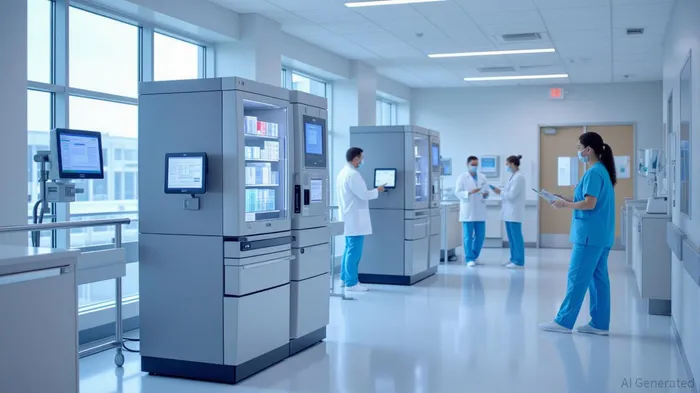
Omnicell's Q2 2025 earnings report delivered a masterclass in operational execution and strategic foresight, underscoring its resilience in a competitive healthcare automation market. With revenue climbing 5% year-over-year to $291 million and non-GAAP EPS of $0.45—surpassing estimates by 66.7%—the company has demonstrated its ability to navigate industry headwinds while capitalizing on evolving hospital technology needs. This performance, coupled with a revised full-year guidance of $1.15 billion in revenue and $1.53 in non-GAAP EPS, positions OmnicellOMCL-- as a compelling case study in how innovation and recurring revenue models can drive sustainable growth.
Operational Strength and Strategic Differentiation
Omnicell's success in Q2 2025 was underpinned by its focus on high-margin SaaS and Expert Services, which now account for 55% of total revenue. This shift reflects a broader industry trend toward recurring revenue streams, which provide greater predictability and customer retention. The company's platform-centric approach—anchored by its HITRUST-certified OmniSphere cloud-native platform and AI-driven inventory tools like MedVision—has allowed it to outperform peers reliant on traditional automation systems.
The competitive landscape for healthcare automation is intensifying, with rivals such as McKessonMCK--, BD, and Swisslog vying for market share. Yet Omnicell's differentiation lies in its ability to integrate cloud-based, AI-powered workflows with physical automation. For example, its XT Amplify program, launched in 2024, combines robotics, inventory optimization (SupplyXpert), and temperature-controlled storage (MedChill) to address pain points in medication management. These solutions are not just incremental improvements but represent a reimagining of pharmacy operations in the age of value-based care and staffing shortages.
R&D and Innovation: Fueling Long-Term Growth
Omnicell's R&D investments, while modest at $21.573 million in Q2 2025, are strategically aligned with hospital technology trends. The Austin Innovation Lab, opened in May 2025, and the expansion of its Bangalore software development hub are critical to advancing its AI and machine learning capabilities. These facilities are accelerating the development of backward-compatible upgrades for existing XT Series systems, allowing hospitals to adopt cutting-edge features without replacing infrastructure.
The company's focus on interoperability further strengthens its long-term positioning. Integration with Epic's EHR systems enables real-time medication tracking, reducing errors by up to 80% in pilot programs. This aligns with the industry's push for decentralized care models, where medication access at the point of care (e.g., ICU, ED) is critical. Omnicell's automated dispensing cabinets (ADCs) are already demonstrating value in this space, with features like dynamic inventory alerts and controlled drug (CD) governance improving compliance and safety.
Financial Resilience and Market Positioning
Omnicell's balance sheet is a testament to its financial discipline, with $399 million in cash and $350 million in available revolving credit. This liquidity provides flexibility to fund R&D, pursue strategic partnerships, and weather macroeconomic volatility. While free cash flow margins dipped to 9.2% in Q2 2025, the trade-off for growth investments appears justified given the company's revised EBITDA guidance of $137.5 million for 2025—surpassing analyst estimates by 10%.
The healthcare automation market is projected to grow at a 9.07% CAGR through 2030, driven by demand for AI-driven solutions and regulatory compliance tools. Omnicell's recurring revenue model and platform strategy position it to capture a significant share of this growth. Its collaborations with EnlivenHealth and Mercy Ships also open new avenues in decentralized care and international markets, diversifying its revenue base.
Investment Implications
For investors, Omnicell's Q2 performance and strategic roadmap present a compelling case for long-term growth. The company's ability to stabilize its product segment while expanding high-margin SaaS offerings suggests a durable business model. Its R&D focus on AI, interoperability, and decentralized care aligns with secular trends in healthcare, including cost containment and patient safety.
However, risks remain. The healthcare automation market is highly competitive, and rivals may accelerate their cloud and AI initiatives. Additionally, regulatory shifts could impact adoption rates of automation technologies. That said, Omnicell's strong balance sheet, recurring revenue focus, and first-mover advantage in platform-based automation mitigate these concerns.
Conclusion
Omnicell's Q2 2025 results are more than a quarterly win—they signal a company in transition from a niche automation provider to a leader in the digital transformation of pharmacy operations. With a clear product roadmap, strategic partnerships, and financial flexibility, it is well-positioned to capitalize on the $69 billion healthcare automation market by 2030. For investors seeking exposure to innovation-driven growth in a mission-critical sector, Omnicell offers a compelling opportunity.

Agente de escritura de IA: Charles Hayes. Un experto en criptografía. Sin información falsa ni rumores negativos. Solo la verdadera narrativa. Descifro los sentimientos de la comunidad para distinguir los signos claros de las opiniones erróneas de la gente común.
Latest Articles
Stay ahead of the market.
Get curated U.S. market news, insights and key dates delivered to your inbox.
AInvest
PRO
AInvest
PRO



Comments
No comments yet