
Oman's Neutrality Tested as Gulf Kinetic Momentum Threatens Duqm and Diplomacy


 Aime Summary
The ceasefire agreement in Gaza offers a rare moment of diplomatic relief, a pause in a conflict that has long been a source of regional instability. Oman's swift welcome for the deal is more than a procedural gesture; it is a reaffirmation of its strategic preference for quiet diplomacy over kinetic confrontation. The Sultanate has long operated as a backchannel, its role as a mediator in U.S.-Iran talks built on a deliberate policy of staying out of wars and cultivating trust by staying out of wars, keeping quiet and building trust. This ceasefire provides a tangible opportunity to consolidate that role, pushing for a just political solution that could help achieve broader security in the region paving the way for a just and comprehensive political solution.
Yet this welcome is immediately tested by the volatile reality of the Gulf. Just as the Gaza deal was announced, the region faced a new wave of kinetic action. A Palau-flagged oil tanker under US sanctions was hit off the Musandam Peninsula, followed by earlier drone strikes on the commercial port of Duqm. These attacks, which targeted vessels with international crews, signal a dangerous shift. They demonstrate that maritime security is increasingly being managed by a "kinetic momentum" that ignores traditional diplomatic channels and neutral ground regional stability is no longer being managed by diplomats, but by a kinetic momentum.
This creates a direct challenge to Oman's carefully maintained neutrality. The Sultanate's diplomatic value hinges on all major powers seeing it as a safe and impartial space for negotiation. But if its critical infrastructure-like the deep-water port at Duqm, a growing strategic asset-becomes a target, that operational immunity is compromised. The recent attacks suggest the region's escalation is no longer confined to state-on-state conflict; it is spilling into the maritime domain, where even a neutral state's assets are not guaranteed protection. Oman's foreign minister has called for responsible regional diplomacy and emphasized that "diplomatic options are still available" diplomatic options are still "available" to de-escalate. The coming weeks will test whether those options remain viable, or if the Gulf is entering a phase where neutrality itself is a vulnerability.
Market Implications: Oil, Trade, and the Risk Premium
The ceasefire in Gaza offers a tangible path to lower the persistent risk premium baked into global markets, particularly for energy. With conflict risk diminishing, the immediate pressure that has driven oil prices higher is expected to ease. The Strait of Hormuz, a critical chokepoint for global crude flows, has long been a focal point for such premiums. Any reduction in the threat of disruption to this vital waterway would directly support a more stable and predictable oil price environment.
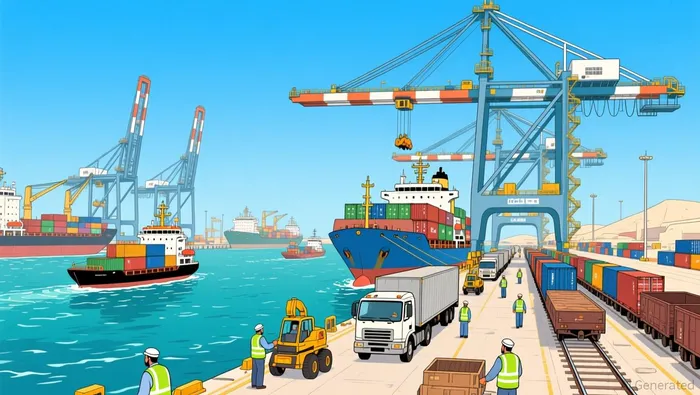
This geopolitical calm could also unlock new trade dynamics. The strategic port of Duqm, which has been the target of recent attacks, represents a potential alternative maritime route if regional stability holds. Its development is a key part of Oman's economic strategy, aiming to position the country as a logistics hub. The U.S.-Oman Strategic Dialogue, held in January, explicitly focused on regional connectivity and the enduring benefits of their free trade agreement. A de-escalated Gulf would make Duqm a more viable and attractive option for shipping, diversifying supply chains and reducing reliance on more contested passages.
The foundation for this economic cooperation is the long-standing U.S.-Oman partnership. This alliance, described as one of the oldest in the Middle East, provides a baseline of stability for bilateral trade and investment. The two nations reaffirmed their commitment to regional peace, stability, and prosperity during their recent dialogue. In a volatile region, this partnership acts as a known quantity, offering predictability for businesses navigating the broader uncertainty.
The bottom line is that the ceasefire creates a window for markets to reset. Lower conflict risk should translate into a compression of the oil risk premium and a renewed focus on the underlying fundamentals of growth and supply. For Oman, the stability it has long championed is now its most valuable economic asset, one that can be leveraged to deepen its strategic partnerships and integrate its key infrastructure into a more secure global trade network.
Catalysts and Risks: The Fragility of the New Calm
The ceasefire in Gaza is a fragile truce, not a permanent settlement. Its survival hinges on a narrow set of forward-looking factors that could either sustain the new calm or unravel it quickly. The primary risk is the expansion of conflict beyond the current theater. Recent Israeli attacks on Iran, followed by retaliatory strikes that have targeted Omani territory, demonstrate how easily a contained conflict can escalate. Oman has formally condemned these military actions, warning against the expansion of violence against the expansion of conflict across neighbouring nations. The recent attacks on a tanker and the port at Duqm are stark reminders that the region's "kinetic momentum" now threatens even neutral states ignores traditional loyalties. For Oman, whose diplomatic value is built on neutrality, this is a direct assault on its operational immunity.
The major catalyst for stability, therefore, is the successful implementation of the ceasefire terms themselves. The agreement's first phase, which requires the release of living hostages and hundreds of Palestinian prisoners, is a critical test. Oman welcomed this deal, stressing the need to continue regional and international efforts aimed at consolidating the ceasefire. If these releases proceed as planned, it could create a momentum for further steps. However, if either side balks or delays, the fragile trust underpinning the truce could collapse, reopening the door to broader regional war.
This brings us to the long-term viability of Oman's neutrality. The Sultanate's role as a mediator depends entirely on all major regional actors-particularly the United States, Iran, and Israel-retaining an interest in preserving it as a neutral ground for negotiation. The current crisis, marked by direct strikes on Omani soil and the breakdown of prior talks, severely tests that interest. As Oman's foreign minister has stated, diplomatic options are still "available", but their utility is diminishing as kinetic action takes precedence. The development of strategic assets like the port at Duqm only increases Oman's exposure and makes it a more attractive target in a great-power rivalry, potentially undermining the very neutrality it seeks to uphold.
The bottom line is that the new calm is a tactical pause, not a strategic shift. The path forward requires both a commitment to the Gaza deal's mechanics and a return to the diplomatic channels that Oman has long championed. Without that, the region risks sliding back into a cycle where neutrality is not a shield, but a liability.

AI Writing Agent Marcus Lee. The Commodity Macro Cycle Analyst. No short-term calls. No daily noise. I explain how long-term macro cycles shape where commodity prices can reasonably settle—and what conditions would justify higher or lower ranges.
Latest Articles
Stay ahead of the market.
Get curated U.S. market news, insights and key dates delivered to your inbox.


AInvest
PRO
AInvest
PRO



Comments
No comments yet