
Oman's Infrastructure Boom: A Safe Harbor in Middle Eastern Geopolitical Storms
The Middle East remains a geopolitical tinderbox, yet Oman has positioned itself as a paradoxical oasis of stability and opportunity. While regional conflicts simmer, the Sultanate is leveraging its neutral diplomacy and ambitious infrastructure projects to attract capital, diversify its economy, and become a linchpin of regional connectivity. For investors seeking exposure to the Middle East without the volatility of oil markets or political strife, Oman's strategic pivot offers a compelling value proposition.
Infrastructure as a Geopolitical Anchor
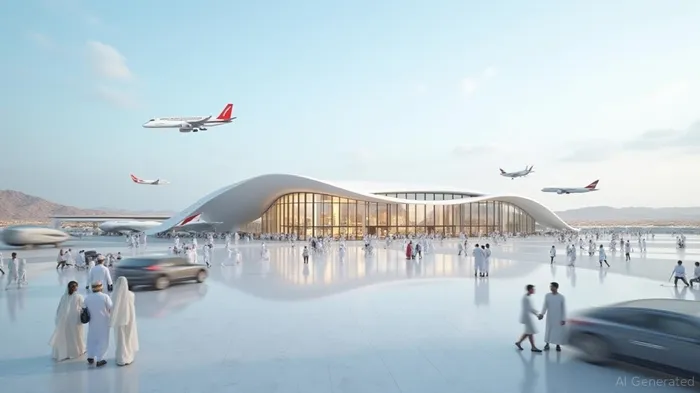
Oman's infrastructure push is not merely about economic growth—it's a calculated move to cement its role as a regional stabilizer. The expansion of Muscat International Airport, now capable of handling 12 million passengers annually, symbolizes this shift. The airport's modernization—part of plans for six additional airports by 2030—has slashed travel costs and boosted tourism, a sector now accounting for 5% of GDP.
Equally critical is the Hafeet Rail Link, a $1.3 billion project connecting Oman's Sohar Port to the UAE's Al Ain. This railway, operational since early 2025, has slashed freight transit times by 40% and solidified Oman's role as a logistics hub. The rail network's success has prompted plans for a 1,000-km national railway by 2030, underscoring the government's vision of transforming Oman into a crossroads for trade between East Africa, South Asia, and the Arabian Peninsula.
FDI Surge: A Vote of Confidence in Stability
Foreign direct investment (FDI) has surged to $69.3 billion (26.6 billion rials) through Q3 2024, a 17.6% increase over five years. This influx is driven by sectors aligned with Oman's Vision 2040 diversification strategy:
- Manufacturing: Leading with $2.13 billion in FDI, fueled by automotive and petrochemicals.
- Renewables & Green Energy: The $1.6 billion Sohar Polysilicon Plant—a joint venture with United Solar Polysilicon—will produce 100,000 tons/year, positioning Oman as a solar supply-chain leader.
- Tourism & Real Estate: $969 million in FDI has spurred luxury resorts and smart cities like Duqm's “Oman's Dubai.”
The UK ($69.3B) and US ($5.2B) dominate investments, but regional players like the UAE ($836.5M) and China ($818M) are expanding ties. This influx reflects investor confidence in Oman's investment-grade credit rating (upgraded in 2024) and its fiscal discipline—public debt now stands at 35% of GDP, among the lowest in the Gulf.
Geopolitical Niche: Neutral Diplomacy as a Competitive Advantage
Oman's non-aligned foreign policy has long insulated it from regional conflicts. Unlike its Gulf neighbors, it maintains diplomatic channels with Iran and Western powers, a neutrality now leveraged for economic gain. The International Finance Corporation (IFC)'s $120M investment in Oman's National Finance Company (NFC) in 2025 exemplifies this: the deal funds SMEs in green sectors while adopting international sustainability standards.
The IFC also partnered with Oman's Future Fund to co-invest in green manufacturing and tourism, while the $1.6B solar plant—backed by German engineering firm MAN Energy Solutions—cements Oman's role in Europe's energy transition. These partnerships highlight how Oman is using geopolitical neutrality to attract both Western capital and Asian supply chains.
Risks and Considerations
- Oil Dependency: Hydrocarbons still contribute 18.8% of GDP, leaving Oman vulnerable to price swings. However, its Duqm Refinery (online since 2023) reduces reliance on crude exports by selling refined products regionally.
- Geopolitical Spillover: Gaza-Israel tensions or Red Sea conflicts could disrupt trade routes. Yet Oman's limited ties to combat zones—unlike Saudi Arabia or UAE—mitigate direct exposure.
- Fiscal Prudence: A 30% cut in 2025's development budget (to $2.34B) reflects caution. However, the Rakiza sovereign wealth fund ($5B) and IMF-backed reforms ensure long-term stability.
Investment Playbook: Where to Bet
- Green Energy: The Sohar Polysilicon Plant and planned green hydrogen projects offer exposure to renewables without direct equity risks.
- Logistics & Real Estate: Developments like the Duqm Special Economic Zone (boasting a $20B port and industrial park) are prime for infrastructure funds or REITs.
- Financial Services: The NFC's IFC-backed expansion targets SMEs in sustainable sectors—ideal for impact investors.
For retail investors, consider Oman's sovereign bonds, rated BBB+ by S&P, or ETFs tracking Gulf infrastructure stocks (e.g., Dubai Islamic Bank or Sohar Industrial Port Company).
Conclusion
Oman's blend of geopolitical neutrality, fiscal prudence, and infrastructure ambition makes it a rare safe haven in a volatile region. While risks persist, its Vision 2040 framework ensures steady progress toward diversification. Investors seeking stability in a turbulent Middle East—or exposure to green energy and logistics—would be remiss to overlook Oman's quiet rise.
The Sultanate's lesson for global capital: in a world of chaos, being the reliable middleman can be the shrewdest play of all.

Delivering real-time insights and analysis on emerging financial trends and market movements.
Latest Articles
Stay ahead of the market.
Get curated U.S. market news, insights and key dates delivered to your inbox.






Comments
No comments yet