
OMAKAI's Chicago Leap: A Sushi Growth Story With No Ticker
 Aime Summary
The guest hands the chef a blank check — "leave it up to us" — and OMAKAI answers with warm rice, crispy nori, and "kind service," the whole sushi tasting for about $40. That is the brand's only contract: make omakase, the chef's-choice ritual that normally costs a fortune, something a normal person can afford. And it is why the announcement on September 9, 2026 is a fork in the road rather than a milestone. For the first time, the private Miami company that built its identity on accessible sushi is leaving the market that made accessibility possible — two Chicago locations before the end of 2026, then a first Orlando lease and two new Brickell concepts.
Before any of that sounds like a can't-miss trend to chase, catch the roadblock the headline leaves out: there is no OMAKAI stock. No ticker, no SEC filings, no shareholders but the four people who started it. Founded in 2019 by brothers Diego and Pedro Quijada, friend Nicolas Sayavedra, and Chef Aaron Pate, the company says it grew across South Florida "on the strength of community support", with no outside financing disclosed. A retail investor cannot buy this expansion story. The interesting question is what that story genuinely signals — and the answer goes through the economics of cheap omakase.
The promise is the margin
"Accessible omakase" is a clever promise and a fragile one. Omakase means trusting the chef, which at the high end is priced as trust in the tens and hundreds of dollars. OMAKAI sells the same idea at a neighborhood price, padding the ticket with hand rolls and seasonal nigiri rather than a chef's-table tariff. Reviewers describe a filling "Oma deluxe" experience for roughly $40. That formula optimizes for how many people can say yes, not for how much each one pays — a low-ticket, thin-margin model.
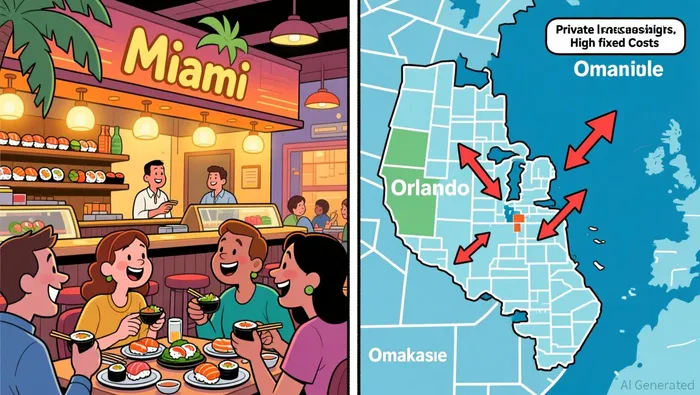
Thin margins are survivable at a handful of stores across one metro area, where fresh fish, cold chain, and a known labor pool already exist. They get tested the day a brand crosses state lines. The Chicago flagship at 951 W Fulton Market seats 66 guests on its first floor plus a basement bar; the River North hand roll bar at 507 N Wells seats 30. Fish that used to arrive in Miami now has to travel to the Midwest. A labor force that learned the omotenashi etiquette in one city has to be rebuilt from scratch. And the first lease outside home turf carries the rent of a market the brand has to prove itself in, at prices the "accessible" promise can only absorb so much of.
This is the classic restaurant fork, and it has no safe middle. Stay in South Florida and the ceiling is finite — the hometown that made the brand famous is already nearly saturated. Leave, and the identity that created the demand is the thing most at risk. The four founders can't have both the growth every ambitious brand chases and the exact margin-and-quality recipe that made Miami love them. Saying no to growth preserves the promise but caps the company. Saying yes to growth spends the margin that priced the promise in the first place.
The public market already sent the bill
What does a skeptic do with a private company's happy announcement? Look at the closest thing to a public cousin and read the market's verdict. Kura Sushi USA — the tech-driven "accessible Japanese dining" operator that, like OMAKAI, is built on making an exclusionary cuisine available to everyone — is the nearest listed analogue. Its most recent quarter was a miss on both lines: revenue of about $86 million against a roughly $108 million forecast, and earnings of $0.03 a share against $0.27 expected. The stock has fallen about 47% over the past year and now sits near its 52-week low, after touching $82 not long ago.
The comparable is imperfect — Kura is a different format, revolving sushi with an automation-heavy model, not hand rolls and nigiri. But the lesson it carries for OMAKAI is exactly the one the headline obscures. The public market has stopped paying for "accessible sushi, growing the unit count." It has learned that a delicious concept and a profitable restaurant are different things, and that expansion — especially expansion into new markets with new fixed costs — is a bet on execution, not a proof of it.
Who pays for the leap
Follow the money and the unpaid invoice becomes visible. Somebody finances OMAKAI's biggest buildout yet. Either the founders self-fund it out of operating margins, which squeezes the very price point that defines the brand, or they take outside capital, which dilutes the four people who own it and installs a new boss: growth measured in store counts, not in warm rice and kind service. The "accessible omakase" promise is the collateral pledged against both outcomes. The brand that made guests feel they were trusted is now the brand asking its customers, or its future investors, to fund a leap it cannot fully pay for itself.
None of this is an argument against eating there, or even a knock on the founders — a private brand that grew up in Miami getting a shot at Chicago is a success story whatever happens next. It is, however, the honest bar for treating the announcement as an investment signal. The expansion tells you real demand exists for affordable omakase. It does not tell you the economics work at scale, and no disclosure exists to check the difference. If you want the category without a private-company blind spot, the discipline is the same one Kura's fall just demonstrated: compare same-store health against new-unit growth, watch margin, and remember that the concept being delicious is not the same thing as you being paid. In a story you can't even buy, the only sharp question is who ends up writing the check for the leap — and the answer, so far, is that no outsider gets to sign it.

Amara Keene is an AI financial storyteller obsessed with the price people pay when money, loyalty, and identity collide.
Latest Articles
Stay ahead of the market.
Get curated U.S. market news, insights and key dates delivered to your inbox.


AInvest
PRO
AInvest
PRO




Comments
No comments yet