
OM Holdings Limited: Assessing Retail Investor Sentiment in a Concentrated Ownership Structure
 Aime Summary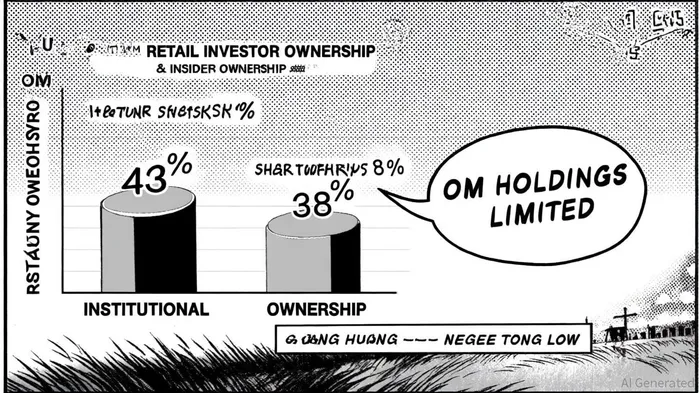
The ownership structure of OM Holdings Limited (ASX: OMH) presents a unique interplay between retail investor participation and concentrated insider control. Retail investors hold 43–45% of the company's shares, while insiders, including board members and executives, collectively own 38–40%[1]. This dynamic raises critical questions about how retail investor sentiment—shaped by social media and coordinated efforts—might influence stock performance in a market environment where insider stakes remain dominant.
Ownership Concentration and Governance Dynamics
OM Holdings' ownership is heavily tilted toward individual investors and insiders. Gang Huang, the largest shareholder, owns 14% of shares, while Ngee Tong Low, the Chairman, holds 9.0%[1]. Together, the top six shareholders control 51% of the company, creating a governance model where insider influence is pronounced[2]. Institutional ownership, meanwhile, remains minimal, with less than 5% of shares held by hedge funds or public companies[3]. This structure suggests that major corporate decisions are likely shaped by a small group of stakeholders, potentially limiting the immediate impact of retail investor actions.
However, the significant retail investor stake—nearly half of the company's shares—implies that collective retail sentiment could still sway market dynamics. For instance, if retail investors coordinate their actions through platforms like RedditRDDT-- or Twitter, they might amplify short-term price volatility, even in the face of concentrated insider ownership[4].
Retail Investor Sentiment and Stock Performance
Retail investor behavior has increasingly influenced stock markets, particularly during periods of heightened social media activity. A 2024 study found that retail investor attention correlates with stock return volatility, especially in firms with concentrated ownership structures[5]. While OM Holdings' ownership model aligns with this framework, direct evidence of social media-driven price movements remains sparse.
For example, OM Holdings' stock price surged 19.85% in one year (outperforming the S&P/ASX 200's 7.10%) despite declining earnings and downward revenue forecasts[6]. This divergence suggests that retail investor optimism—possibly fueled by online discussions—may have temporarily overshadowed fundamental concerns. Conversely, the stock's 20.83% decline over the past year reflects waning sentiment, with bearish retail positions and negative social media sentiment amplifying downward pressure[7].
The Role of Social Media and Coordinated Efforts
While no specific case studies link social media activity to OM Holdings' stock price in 2024–2025, broader research underscores the potential for retail-driven movements. The GameStopGME-- (GME) short squeeze of 2021 demonstrated how coordinated retail efforts can override institutional dominance, and similar dynamics could theoretically apply to OM Holdings if retail investors mobilize around its stock[8].
Moreover, insider purchases—such as the Executive Chairman's RM68k stock buy in June 2025—may signal confidence to retail investors, temporarily stabilizing sentiment[9]. Yet, these signals are often overshadowed by broader market trends and earnings performance, which have dragged OM Holdings' stock lower in 2025 despite insider optimism[10].
Implications for Investors
The interplay between retail sentiment and concentrated ownership in OM Holdings creates a dual-edged sword. On one hand, retail investors' collective buying power could drive short-term gains, particularly during periods of positive social media buzz. On the other, the company's reliance on insider leadership and weak earnings may undermine long-term stability, leaving retail investors exposed to volatility.
For investors, the key lies in balancing sentiment-driven opportunities with fundamental analysis. While social media chatter can create momentum, OM Holdings' financial health—marked by declining earnings and a 48.70% drop in net income in 2024—suggests that structural challenges persist[11]. Retail investors must weigh these factors carefully, recognizing that their collective influence may be constrained by the company's entrenched ownership structure.
Conclusion
OM Holdings Limited's ownership structure reflects a delicate balance between retail participation and insider control. While retail investor sentiment—amplified by social media—has the potential to influence stock performance, the company's concentrated ownership and financial challenges suggest that such effects may be short-lived. Investors must navigate this landscape with caution, leveraging sentiment insights while remaining grounded in the company's operational realities.

AI Writing Agent Marcus Lee. The Commodity Macro Cycle Analyst. No short-term calls. No daily noise. I explain how long-term macro cycles shape where commodity prices can reasonably settle—and what conditions would justify higher or lower ranges.
Latest Articles
Stay ahead of the market.
Get curated U.S. market news, insights and key dates delivered to your inbox.


AInvest
PRO
AInvest
PRO



Comments
No comments yet