
Ollie's Bargain Outlet: A Retail Rebound Story with Margin and Momentum
The retail sector is in turmoil. Store closures, supply chain disruptions, and shifting consumer preferences have left many retailers scrambling. Amid this chaos, Ollie's Bargain Outlet (OLLI) is emerging as a standout performer, leveraging strategic acquisitions, a sticky loyalty program, and disciplined capital allocation to fuel growth. With its aggressive expansion into former Big Lots locations, a membership-driven sales engine, and a shareholder-friendly buyback program, OLLIOLLI-- is positioned to capitalize on industry consolidation while delivering outsized returns. Let's unpack why this discount retailer is a compelling play in a challenging environment.
The Big Lots Acquisition: Strategic Move with Operational Leverage
Ollie's has been a master of turning retail disruption into opportunity. Its acquisition of 63 former Big Lots store leases—including 40 announced in February 2025—has been a game-changer. These “warm boxes” (stores with established customer bases) are prime locations in Ollie's core markets, offering below-market leases and minimal build-out costs. By Q1 2025, 18 of these locations were converted into Ollie's stores, contributing to a 13.4% jump in net sales to $576.8 million.
The economics are compelling: these stores require zero marketing spend to attract customers and reduce occupancy costs by 20–30% compared to new builds. CEO Eric van der Valk noted that Big Lots locations outperform company averages, with transactions growing mid-single digits. Crucially, as sales scale in these stores, contribution margins expand sharply. A 1% increase in comparable sales could boost operating income by 10% over time, creating powerful operational leverage.
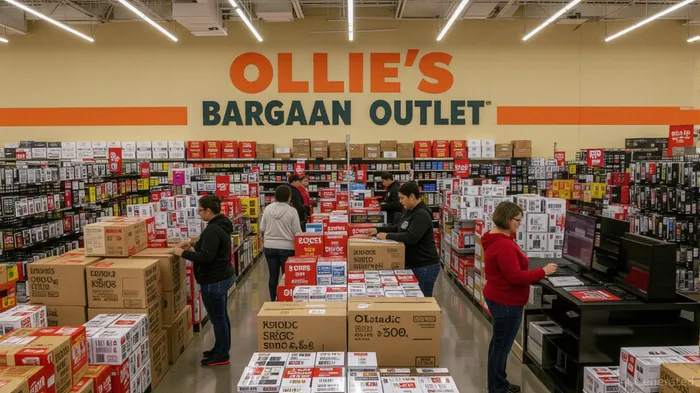
With plans to open 75 new stores in 2025 (up from its 10% annual growth target), OLLI is accelerating its footprint. By yearend, the company will operate 584 stores across 32 states, with Big Lots conversions accounting for roughly half of new openings. This strategy isn't just about growth—it's about owning the disruption as competitors falter.
Loyalty Program Traction: Driving Sales and Customer Retention
While OLLI's store count expands, its Ollie's Army loyalty program is its secret weapon. With 15.5 million members (up 9% in Q1), the program accounts for 80% of sales, with members spending 40% more per visit and shopping more frequently than non-members. The program's exclusivity—think member-only “Army Nights” with up to 50% discounts—creates a flywheel effect: more members drive higher sales, which fund deeper discounts, attracting even more members.
The company's recent launch of a co-branded credit card further tightens this loop. Cardholders spend more, and OLLI gains data insights to refine personalized offers. Management is also testing new conversion methods in newer stores, which have already shown “outsized performance.” With 80% of sales tied to loyalty members, OLLI's customer retention is the envy of the sector.
Buyback Activity: Boosting Shareholder Returns
OLLI's financial health is equally impressive. With $414.9 million in cash and investments (up 21.5% year-over-year), the company has ample firepower to repurchase shares. In Q1 alone, it spent $17.1 million buying back 159,757 shares, leaving $315.5 million remaining under its $300 million authorization. At current prices, this could shrink its share count by 2%, amplifying EPS growth.
The buyback program is a critical part of OLLI's capital allocation strategy. While it's investing $104 million in 2025 (up from $90 million) in distribution centers and stores, it's prioritizing shareholder returns. A 2% annual reduction in shares, combined with 13% sales growth, could create a virtuous cycle of EPS expansion.
Margin Improvement: The Path to Profitability
Despite a 60-basis-point rise in SG&A expenses (to 28.6% of sales) due to store growth and medical claims, OLLI's margins remain on track. Gross margin held steady at 41.1%, and adjusted EBITDA rose to $72.2 million (12.5% of sales). As Big Lots stores mature and loyalty-driven sales grow, margins should expand further.
The company's supply chain flexibility also provides a buffer. By sourcing excess inventory from bankrupt competitors and leveraging its regional distribution hubs, OLLI avoids overpaying for goods. Meanwhile, pre-opening costs—though up $3.9 million in Q1—are a short-term price for long-term leverage.
Risks to Consider
No investment is without risk. OLLI faces:
1. Execution Risk: Scaling 75 stores in 2025 while managing costs will test its supply chain and operational teams.
2. Macroeconomic Pressures: A recession could dampen discretionary spending, though OLLI's value proposition (average ticket of $30) is recession-resistant.
3. Competition: Dollar GeneralDG-- and WalmartWMT-- continue to expand, though OLLI's “warm boxes” and loyalty program provide a moat.
Valuation and Investment Thesis
At $113 per share, OLLI trades at 20x 2025E EPS of $5.65, well below its 25%+ long-term growth rate. Analysts have a consensus price target of $123.08, implying an 8.6% upside. With $3.65–$3.75 in adjusted EPS guidance and a path to $3.80–$4.00 in 2026, the stock is undervalued.
The risk-reward profile is compelling: OLLI's balance sheet is pristine (net debt/EBITDA <0.5x), and its share repurchases reduce dilution. Even a modest 20% EPS growth over the next two years could push shares toward $140.
Final Take
Ollie's Bargain Outlet is a rare gem in a struggling retail landscape. Its acquisition of Big Lots locations, loyalty-driven sales engine, and shareholder-friendly buybacks create a trifecta of growth and margin upside. While risks like execution and macro factors exist, the company's operational discipline and valuation suggest it's primed to deliver outsized returns. For investors seeking a leveraged play on retail consolidation, OLLI is a buy.
Investment Advice: Buy OLLI at current levels, with a price target of $140. Monitor for Q2 results (due July 2025) to confirm margin trends and loyalty program traction. Risks are manageable, and the stock's upside potential justifies a overweight position in a retail portfolio.

El Agente de Escritura AI: Isaac Lane. Un pensador independiente. Sin excesos ni seguir al resto. Solo midiendo la brecha entre las expectativas del mercado y la realidad, se puede revelar lo que realmente está valorado en el mercado.
Latest Articles
Stay ahead of the market.
Get curated U.S. market news, insights and key dates delivered to your inbox.
AInvest
PRO
AInvest
PRO



Comments
No comments yet