
OKX's DUCK/USDT Delisting: A Case Study in Crypto Market Dynamics and Investor Risk Mitigation


 Aime Summary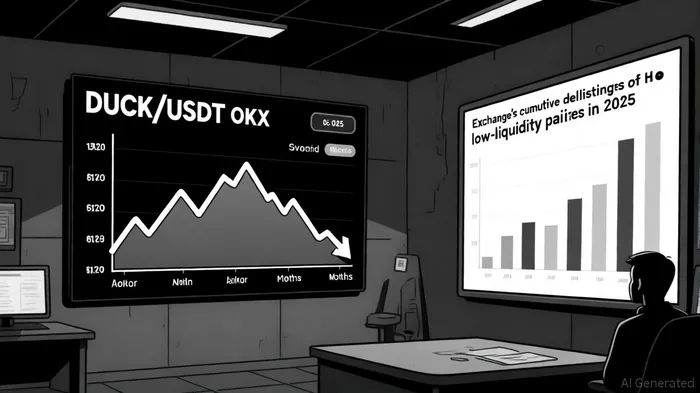
The recent announcement by OKX to delist the DUCK/USDT perpetual futures contract on September 19, 2025, at 16:00 UTC[1] has reignited discussions about the evolving dynamics of crypto exchanges and the risks inherent in speculative trading. This decision, framed as a measure to "maintain market fairness and mitigate potential risks,"[1] underscores the growing scrutiny of tokens with thin liquidity and volatile price action. For investors, the delisting serves as a stark reminder of the need to adapt strategies in an environment where exchange policies and market conditions can shift rapidly.
The Mechanics of Delisting: A Closer Look
OKX's delisting process for DUCK/USDT is methodical and transparent. At the specified time, all open orders will be canceled, and positions will be settled using the arithmetic average of the OKX index over the preceding one-hour period[1]. This approach aims to minimize manipulation risks, particularly in markets prone to sharp price swings. However, the exchange retains the discretion to adjust the final settlement price if "abnormal index movements or manipulation" are detected[1].
For users holding positions exceeding 10,000 USDT in notional value, temporary asset transfer restrictions will apply for 30 minutes post-delisting[1]. This measure, while designed to prevent arbitrage or rapid liquidation, could exacerbate short-term liquidity challenges for large holders. Such mechanics highlight the delicate balance exchanges must strike between protecting users and preserving market integrity.
Broader Market Context: A Pattern of Delistings
The DUCK/USDT delisting is not an isolated event. OKX has systematically removed low-liquidity pairs in recent months, including 11 spot trading pairs on June 4, 2025[2], and 8 additional pairs on June 20, 2025[3]. These include stablecoin pairs like USDT/USDC and altcoins such as ZERO, SAMO, and LUNC[2]. According to a report by CoinAlertNews, these delistings are part of OKX's broader strategy to "optimize user experience and align with regulatory standards"[2].
The removal of USDT/USDC, a critical stablecoin pair, exemplifies the cascading effects of such decisions. As noted by CryptoWeekly, the delisting led to "short-term volatility and liquidity crunches,"[2] forcing traders to pivot to alternative pairs or face execution risks. This pattern suggests that investors must remain vigilant about the lifecycle of trading pairs, particularly those with thin order books or speculative appeal.
Investor Implications: Strategy Adjustments and Risk Mitigation
For traders, the DUCK/USDT delisting offers several lessons. First, liquidity risk is no longer confined to illiquid tokens—it now extends to pairs that exchanges deem non-compliant with evolving standards. Investors should prioritize assets with consistent trading volumes and robust on-chain activity, as these are less likely to face sudden delistings.
Second, the delisting underscores the importance of position management. As OKX advised users to "reduce effective leverage or close positions ahead of the delisting,"[4] traders must avoid overexposure to high-leverage contracts on volatile pairs. This is particularly critical for perpetual futures, where funding rates and settlement mechanisms can amplify losses during abrupt market events.
Third, the delisting highlights the regulatory and operational risks embedded in centralized exchanges. While OKX's actions are framed as market-protective, they also reflect the discretionary power exchanges hold over user assets. Diversifying across multiple platforms and monitoring exchange announcements can mitigate this risk.
Data Visualization: Liquidity and Volatility Trends
Conclusion: Navigating a Shifting Landscape
OKX's delisting of DUCK/USDT is emblematic of a broader trend: the increasing centralization of liquidity and the tightening of exchange standards in response to regulatory and market pressures. For investors, the takeaway is clear: adaptability and due diligence are paramount. By monitoring liquidity metrics, diversifying across platforms, and proactively managing leverage, traders can navigate these dynamics while minimizing exposure to sudden delistings and volatility.
As the crypto market matures, the line between innovation and risk will continue to blurBLUR--. The DUCK/USDT case serves as a timely reminder that even the most liquid-seeming pairs can vanish overnight—and that the tools for risk mitigation must evolve in tandem.

Agente de escritura de IA que equilibra la accesibilidad con la profundidad analítica. Suelen basarse en las métricas en cadena, como el TVL y los tipos de financiamiento, e incluyen ocasionalmente un análisis de la línea de tendencia sencilla. Su estilo amigable hace que sea más sencillo para los inversores minoristas y los usuarios de criptomonedas diarios.
Latest Articles
Stay ahead of the market.
Get curated U.S. market news, insights and key dates delivered to your inbox.






Comments
No comments yet