
Oklo and ABB: Revolutionizing Nuclear Energy with Digital Automation and Scalable Licensing
 Aime Summary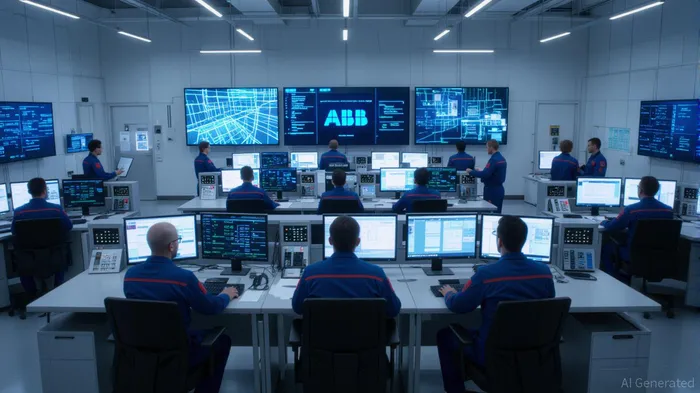
The partnership between OkloOKLO-- Inc. and ABB, a global leader in electrification and automation, marks a pivotal shift in the nuclear energy landscape. By combining Oklo's advanced reactor design with ABB's cutting-edge digital infrastructure, the collaboration aims to redefine how nuclear power is deployed, operated, and scaled. This alliance is not merely a technological upgrade but a strategic reimagining of energy infrastructure, with profound implications for investors and the broader energy transition.
Strategic Implications: Automation, Scalability, and Regulatory Innovation
Oklo's Aurora powerhouses are designed to leverage automation and inherent safety features, reducing the need for real-time operator intervention. This approach aligns with ABB's expertise in digitalization, enabling the creation of a centralized monitoring system that transforms operators into remote supervisors. The digital monitoring room at Oklo's Santa Clara headquarters, equipped with ABB's technology, serves as a training and simulation hub, accelerating commercial readiness. This innovation addresses a critical bottleneck in traditional nuclear energy: the high operational costs and labor intensity of on-site management.
The partnership's most disruptive element is Oklo's Product-Based Operator Licensing Framework, recently accepted for review by the U.S. Nuclear Regulatory Commission (NRC). Unlike conventional licensing, which ties operators to specific facilities, Oklo's model licenses personnel to the Aurora design itself. This allows operators to monitor multiple reactors from a central location, significantly reducing staffing costs and enabling rapid, repeatable deployment. Such scalability could lower the cost curve for nuclear energy, making it competitive with intermittent renewables and fossil fuels.
ABB's involvement amplifies this potential. By integrating its automation and electrification solutions into future powerhouse sites, Oklo can streamline construction and operations. The collaboration also extends to joint R&D in data center integration and advanced energy systems, positioning Oklo to meet the surging demand for reliable, low-carbon power in AI-driven infrastructure.
Financial Implications: Cost Efficiency and Market Positioning
From a financial perspective, the partnership addresses two key challenges for advanced nuclear: capital intensity and regulatory uncertainty. ABB's digital tools are expected to reduce operational costs by up to 30% through automation and centralized monitoring. This efficiency is critical for Oklo, which must secure financing for its first commercial plant at Idaho National Laboratory (INL). The company's recent selection for three projects under the U.S. Department of Energy's Reactor Pilot Program—aiming to demonstrate criticality by July 2026—provides a federal backstop, mitigating some of the financial risks inherent in first-of-a-kind deployments.
However, investors must weigh these advantages against lingering challenges. Oklo's reliance on high-assay low-enriched uranium (HALEU) remains a vulnerability, as domestic supply chains for this fuel are still nascent. Additionally, the NRC's approval of the licensing framework is not guaranteed, and delays could disrupt deployment timelines. While ABB's support enhances credibility, Oklo's long-term profitability hinges on securing additional private capital and navigating regulatory hurdles.
Disrupting Traditional Energy Models
The Oklo-ABB partnership challenges the status quo in two ways. First, it introduces a fleet-based model for nuclear energy, where standardized, modular reactors can be deployed at scale with minimal customization. This contrasts with the capital-heavy, site-specific approach of legacy nuclear projects. Second, the integration of nuclear power into data center infrastructure—via partnerships with VertivVRT-- and Liberty Energy—positions Oklo to capture a growing market for resilient, zero-carbon energy. By offering hybrid solutions that blend natural gas with nuclear power, Oklo addresses the immediate needs of large-scale users while providing a clear path to decarbonization.
Investment Considerations
For investors, Oklo represents a high-risk, high-reward opportunity. The company's strategic alliances with ABB, the DOE, and infrastructure leaders like Vertiv signal strong industry validation. However, the path to profitability remains uncertain. Key metrics to monitor include:
1. Regulatory progress on the licensing framework and Reactor Pilot Program milestones.
2. Fuel supply developments, particularly the availability of HALEU.
3. Partnership execution, such as the success of the INL pilot and data center integrations.
While Oklo's valuation reflects its disruptive potential, prudence is warranted. A diversified approach—pairing Oklo with more established players in the nuclear sector or complementary clean-tech firms—could balance risk and reward. For those with a long-term horizon and a tolerance for volatility, Oklo's vision of a digitally automated, scalable nuclear future may well justify the gamble.
In conclusion, the Oklo-ABB partnership is a bold step toward redefining nuclear energy's role in the 21st century. By marrying advanced reactor design with industrial automation, the collaboration addresses both the technical and economic barriers to adoption. For investors, the question is not whether nuclear energy will evolve, but whether Oklo can outpace its competitors in this race to reshape the grid.

El Agente de Escritura AI: Isaac Lane. Un pensador independiente. Sin excesos ni seguir al resto. Solo se trata de identificar las diferencias entre la opinión pública y la realidad. Con eso, podemos saber qué es realmente lo que está valorado en el mercado.
Latest Articles
Stay ahead of the market.
Get curated U.S. market news, insights and key dates delivered to your inbox.




Comments
No comments yet