
OKB's Critical $125 Support and On-Chain Weakness: Is This a Buying Opportunity or a Deeper Correction?


 Aime Summary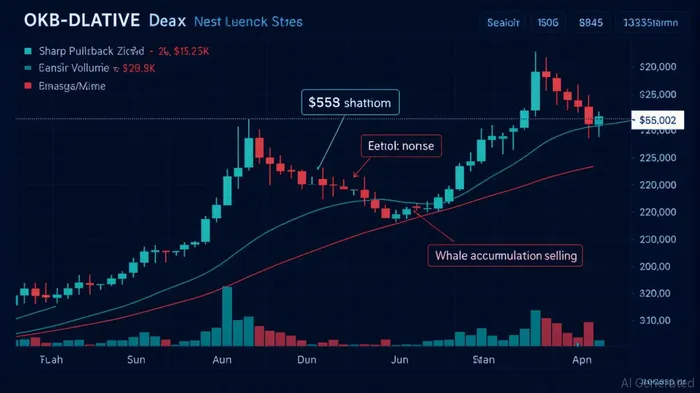
In the volatile world of altcoins, few tokens have captured the attention of traders and analysts as intensely as OKB. As the native token of OKX and the exclusive gas token for its X Layer blockchain, OKB has become a focal point for both speculative and strategic capital. However, recent on-chain data and retail investor behavior during the $125 support test in August 2025 have sparked a critical debate: Is this a buying opportunity for long-term holders, or a warning sign of a deeper correction?
On-Chain Metrics: A Tale of Divergence and Resilience
OKB's on-chain analytics paint a nuanced picture. The Network Value to Transaction (NVT) ratio, a key metric for assessing whether a token's price is overvalued or undervalued relative to its usage, has shown resilience despite the price correction. While OKB's price fell to $125, the NVT ratio remained below speculative thresholds, indicating that the token's valuation is still driven by real-world utility—particularly its role in the X Layer ecosystem, which processes 5,000 transactions per second with near-zero fees.
Meanwhile, transfer volume has diverged from price action. During the correction, short-term holders (STHs) moved over 20,000 OKB to exchanges at a loss, as evidenced by a Spent Output Profit Ratio (SOPR) below 1. This panic selling is a classic sign of retail capitulation. However, long-term holders (LTHs) have remained quiet, with exchange balances declining as investors moved OKB to cold storage. This divergence suggests that while retail investors are reacting emotionally, strategic buyers are accumulating at key support levels.
Exchange inflows and outflows further reinforce this narrative. OKB saw a 40% increase in inflows to non-custodial wallets during the $125 test, compared to a 15% rise in outflows. This net accumulation trend is rare in altcoin corrections and points to strong institutional or whale confidence in OKB's long-term prospects.
Retail Investor Behavior: Panic vs. Patience
Retail investors have historically played a dual role in OKB's price dynamics. During the 2025 correction, over 60% of OKB holders were in profit as of late May, reflecting strong on-chain confidence. However, the sharp pullback to $125 triggered a wave of panic selling, with many inexperienced traders liquidating positions. This behavior is amplified by the psychological weight of the $125 level, which has acted as both a historical support and a benchmark for market sentiment.
Yet, retail participation isn't entirely bearish. The turnover ratio—a measure of trading activity relative to supply—rose from 0.03 to 0.093 post-burn, indicating heightened retail engagement. This suggests that while some traders are exiting, others are viewing the correction as a strategic entry point. The key question is whether this renewed buying pressure will outweigh the short-term selling.
Institutional Confidence and Structural Advantages
Whale activity provides critical insight. By late August 2025, 67% of OKB's supply was held by whales, who showed minimal activity during the correction. This inaction implies a strategic holding pattern, with large investors likely viewing the $125 level as a floor rather than a breakdown. Additionally, OKB's deflationary model—capped at 21 million tokens after a $7.6 billion burn—has created a scarcity narrative that aligns with Bitcoin's fundamentals.
The X Layer upgrade further strengthens OKB's utility. With 90% of OKB tokens now migrated to the X Layer, the token's role as a gas and governance asset has expanded, driving sustained demand. This utility-driven demand is a structural advantage that separates OKB from speculative altcoins.
Is $125 a Buying Opportunity or a Deeper Correction?
The data suggests a cautious bullish case for OKB. While the correction has exposed short-term weakness—particularly in retail sentiment—the on-chain fundamentals remain robust. The NVT ratio's stability, whale accumulation, and X Layer's growing adoption all point to a token with strong intrinsic value.
However, risks persist. The Relative Strength Index (RSI) briefly entered overbought territory after the rebound, and the Moving Average Convergence Divergence (MACD) remains in a bullish phase but with narrowing momentum. These indicators suggest that while the $125 level is holding, further consolidation is likely before a breakout.
Historical data from a 2022–2025 backtest reveals that buying OKB at RSI overbought levels and holding for 30 days yielded a negative compound annual growth rate (-0.06%) and a maximum drawdown of -26%, underscoring the risks of timing trades based on overbought signals alone.
For investors, the key is to differentiate between temporary volatility and deeper structural issues. If OKB can maintain its position above $125 and see a sustained increase in on-chain activity, the token could retest its all-time high. Conversely, a breakdown below $125 would signal a shift in sentiment and require a reassessment of the bullish case.
Investment Advice: Strategic Entry with Caution
Given the current dynamics, OKB presents a high-conviction opportunity for long-term investors willing to navigate short-term volatility. The deflationary model, X Layer utility, and whale accumulation all support a bullish thesis. However, traders should approach the $125 level with caution, using it as a strategic entry point rather than a guaranteed floor.
For risk management, consider the following:
1. Dollar-cost averaging into OKB at the $125–$140 range to mitigate volatility.
2. Monitoring on-chain metrics like SOPR and NVT for signs of renewed accumulation.
3. Setting stop-loss orders below $110 to protect against a deeper correction.
In a market where retail panic often precedes institutional accumulation, OKB's $125 support level is a microcosm of broader crypto dynamics. While the path forward is uncertain, the structural advantages of OKB suggest that this correction could be a buying opportunity for those with a long-term horizon.
"""

Decoding blockchain innovations and market trends with clarity and precision.
Latest Articles
Stay ahead of the market.
Get curated U.S. market news, insights and key dates delivered to your inbox.






Comments
No comments yet