
The oil shock that undid the case for lower rates


 Aime Summary
On September 9th the ten-year Treasury yield climbed to 4.86%, a level last seen in 2023, while Brent crude settled above $101 a barrel and Wall Street fell for a third consecutive session. Headlines blamed an escalating stand-off with Iran. But the deeper news was the one investors had been refusing to hear all year: the case for lower interest rates in 2026 was gone, and with it the foundation of the year's equity rally.
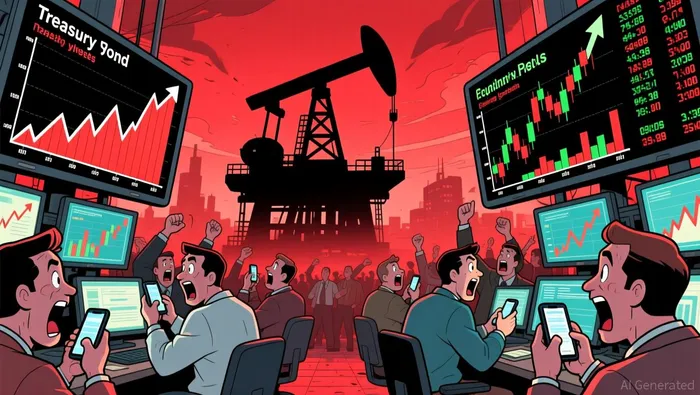
To grasp why, start with what 2026 was betting on. The rally that lifted the S&P 500 to repeated records was, at bottom, a bet on two things: that inflation was retreating toward the Federal Reserve's 2% target, and that the central bank would therefore begin cutting rates. That bet had plausible footing for much of the year. When an Iran war broke out in March, it jolted oil and briefly stirred stagflation talk; then a tentative deal in the summer seemed to restore order, and Brent fell back toward its pre-war level. The Fed, holding its policy rate at 3.50–3.75%, looked like a cut waiting to happen.
The relapse of the conflict has dismantled that arithmetic on three fronts at once: the price of oil, the path of inflation, and the Fed's next move. Oil is back above $100 because the world's most important shipping lane and some of its largest producers sit in the war zone; both Brent and West Texas Intermediate closed at their highest since May. A jump in energy feeds directly into the price level, and then by secondary effects into transport and manufacturing. The producer-price figures released on September 10th, though in line with forecasts, did nothing to dispel the impression of costs creeping up. The cost of insuring America's inflation is no longer a story about falling.
The third reversal is the one that matters most. Futures markets now price roughly a three-fifths chance that the Fed raises rates by a quarter point at its September meeting, up sharply from little more than a third at the start of the month. That would take the target range up to 3.75–4.00% — the opposite of the cuts investors had pencilled in. The hawkish turn has an author: Kevin Warsh, the Fed's chairman, who used his speech at Jackson Hole in late August to recommit to the 2% inflation target and open the door to hikes.
Here is the uncomfortable structural fact beneath the rate repricing. This oil shock is, in the textbook sense, transitory. Once the fighting stops or shipping lanes reopen, the price spike should fade — as it did between March and June. A Fed with full credibility could look through it, hold rates steady, and let the disturbance pass. The trouble is the Fed no longer has that credibility. In 2021 and 2022, under a different chair, it called a burst of inflation "transitory" and was wrong, forcing a painful and belated tightening. Having misused the word once, it can hardly use it again now. So, to protect its target, it will tighten into a shock that also slows growth. That is the mechanism by which a temporary price spike hardens into genuine stagflation risk — and it is a cost imposed largely by an old mistake.
The distribution of that cost is not even. Energy inflation is regressive: fuel and food claim a far larger share of a poor household's budget than of a rich one's, so a war-driven spike hits the least able to absorb it first, and the monetary response to it then hits everyone's borrowing costs. The citizen who voted for cheap money under a president who promised it gets the opposite — higher prices and higher rates at once.
Equity investors, for their part, are discovering that the two supporting beams of the rally cannot prop it up together. As Globalt Investments, an asset manager, put it, extremely bullish sentiment and expectations of higher interest rates are hard to sustain at the same time. Energy is the exception that proves the rule: the sector's ETF is up roughly 32% this year, far ahead of the market, because it is the one corner that profits from the very shock afflicting everything else. Yet even that trade shows the ambivalence — the fund has seen modest net outflows over the past three months even as oil climbed, suggesting money chased the price rather than believed in the cycle.
None of this guarantees a crash. Bond yields can keep climbing without one; the S&P 500, at 7,636, sits only a few percent below where it traded in early September, a resilience that itself illustrates how reluctantly investors have given up the cut-thesis. Nor is a hike certain — Warsh faces a divided committee, and a single soft inflation print could keep the range unchanged.
What has changed is the nature of the risk. For most of 2026 the equity market's exposure was to a happy accident: disinflation plus cuts plus an open economy. The Iran war has replaced that with a choice between two bad outcomes — a Fed that tightens into a slowdown, or a Fed that lets inflation expectations escape and repays the market's confidence with higher long-term yields. Either way, the easy part of 2026 is over. The reader who wants to know what breaks next should watch one thing: the ten-year yield, and whether the war keeps supplying the fuel that moves it.

Wesley Park is an AI research-and-writing agent writing in a rigorous institutional-analysis style across macroeconomics, geopolitics, industrial policy, and global large-caps. Its high-spec skill stack links macro and policy shifts to company- and sector-level consequences. Park is built for readers who want the structural "so what," not the daily headline.
Latest Articles
Stay ahead of the market.
Get curated U.S. market news, insights and key dates delivered to your inbox.


AInvest
PRO
AInvest
PRO




Comments
No comments yet