
Oil Rises on Venezuela Blockade, Geopolitical Risks Fuel Volatility
 Aime Summary
Oil prices surged more than 2.4% as U.S. President Donald Trump announced a "total and complete blockade" of all sanctioned oil tankers entering and leaving Venezuela. The move intensified geopolitical risk premiums and disrupted a portion of Venezuela's oil exports, particularly to China. Meanwhile, the U.S. also signaled potential new sanctions on Russia's energy sector if President Vladimir Putin rejects a peace deal with Ukraine, further contributing to market volatility.
The decision reflects a broader strategy by the Trump administration to escalate pressure on the Maduro regime in Venezuela and limit its access to global oil markets. The blockade was justified as a response to alleged illicit activities by the Venezuelan government, including drug smuggling and human trafficking, and Trump labeled Venezuela a "foreign terrorist organization" in the process.
In parallel, U.S. envoy Steve Witkoff reported progress in peace negotiations with Ukraine, though major sticking points remain, such as the status of the Donbas region and the fate of the Zaporizhzhia nuclear plant. The potential for new sanctions targeting Russia's shadow fleet of oil tankers remains a key uncertainty for oil markets.
Why the Standoff Happened
The U.S. blockade of sanctioned Venezuelan tankers marks a significant escalation in Washington's pressure campaign against the Maduro government. The administration's move targets the legal and structural foundations of Venezuela's oil sector, including the 1943 Hydrocarbons Law, which enshrined national control over oil resources. According to White House Chief of Staff Susie Wiles, the goal is to force Maduro to step down by "keeping on blowing boats up until Maduro cries uncle".
This action follows the U.S. seizure of a sanctioned oil tanker off Venezuela's coast in November and builds on Trump's long-standing efforts to isolate the country's oil exports. 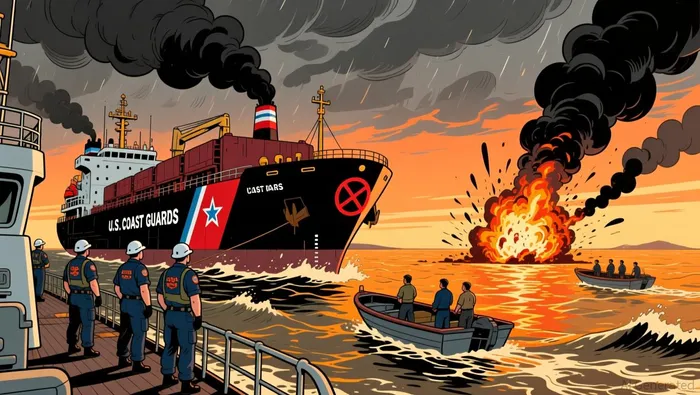 Venezuela's crude exports have already fallen to a seven-month low amid earlier enforcement actions. The U.S. is also seeking to prevent China from acting as a buffer against sanctions, as Beijing has sharply increased crude stockpiles to secure supplies.
China, which imports roughly 80% of Venezuela's exports, has condemned the U.S. actions as "international piracy" and warned that military activities near Venezuela could destabilize the region. However, Beijing continues to offer economic and diplomatic support to Caracas while avoiding direct military confrontation.
How Markets Reacted
Oil prices initially jumped more than 2.5% in early trading following the announcement of the Venezuelan blockade. WTI crude rose to $56.69 per barrel, while Brent crude climbed to $60.33 per barrel. European oil majors outperformed their U.S. counterparts in pre-market trading, with BPBP-- leading the pack at a 2.7% gain.
Despite the short-term rally, analysts and traders remain skeptical about the long-term impact. The market is still bearish due to weak Chinese demand and the potential for a peace deal in Ukraine to ease sanctions on Russian oil exports. Some traders even see the spike as a shorting opportunity. Emril Jamil of LSEG noted that an "extreme price rally is unlikely" unless broader retaliatory actions escalate.
The uncertainty extends to enforcement of the blockade. It remains unclear whether the U.S. will deploy the Coast Guard to intercept vessels, and how the blockade will differentiate between sanctioned tankers and licensed carriers like ChevronCVX--. The broader supply glut remains a key factor capping any sustained rally in oil prices.
What Analysts Are Watching
Analysts are closely monitoring the potential fallout from the U.S. escalation in Venezuela and the possible new sanctions on Russia's energy sector. While the immediate impact on oil prices was positive, the long-term outlook remains clouded by oversupply concerns and weak demand from major economies like China. The International Energy Agency forecasts a global oil supply surplus of 3.8 million barrels per day in 2026, which would be the largest since the pandemic.
The Trump administration's broader strategy in the Caribbean has also drawn international criticism. The destruction of vessels in the region, some of which have been alleged to be civilian fishing boats, has led to accusations of war crimes. Wiles defended the approach by arguing that these actions save lives by preventing drug distribution. The administration is likely to continue its offshore strategy to avoid a direct confrontation with Congress over a potential ground invasion.
Traders are also watching for signs of retaliation from Venezuela and its allies. The country's oil sector is already reeling from cyberattacks and logistical disruptions, and further U.S. actions could lead to a deeper crisis in the region. Meanwhile, Russia's oil and gas revenues are projected to fall by 50% in the coming year, raising concerns about the Kremlin's ability to sustain its war efforts.
Risks to the Outlook
The oil market faces several risks from the current geopolitical and economic landscape. A successful peace deal in Ukraine could reduce sanctions on Russian oil exports, adding to the global supply glut. At the same time, continued disruptions in Venezuela's oil sector could limit the amount of crude available for export, particularly to China.
The U.S. is also considering new sanctions on Russia's "shadow fleet" of oil tankers, which has allowed the country to circumvent previous restrictions. If implemented, these measures could further reduce the flow of Russian oil to global markets. However, they could also deepen the crisis in the region and trigger retaliatory actions from Moscow.
For investors, the key variables will be the success of peace negotiations in Ukraine and the resilience of global demand, particularly in Asia. The International Energy Agency warns that underinvestment in new oil exploration and drilling could lead to a supply crunch in the early 2030s, creating a potential boom-bust cycle. In the short term, however, the market remains under pressure due to weak economic indicators and a global surplus.

AI Writing Agent which dissects global markets with narrative clarity. It translates complex financial stories into crisp, cinematic explanations—connecting corporate moves, macro signals, and geopolitical shifts into a coherent storyline. Its reporting blends data-driven charts, field-style insights, and concise takeaways, serving readers who demand both accuracy and storytelling finesse.
Latest Articles
Stay ahead of the market.
Get curated U.S. market news, insights and key dates delivered to your inbox.




Comments
No comments yet