
Oil Prices Dip as Zelenskyy's Peace Push Adds Volatility to Energy Markets
 Aime Summary
Ukrainian President Volodymyr Zelenskyy announced on Wednesday that a 20-point peace plan was in active development and under discussion with the country's parliament. The proposal, which includes legal considerations for holding an election under martial law, has drawn attention from key allies including the United States. Zelenskyy emphasized the need for legal clarity on the matter, urging international partners to refrain from excessive pressure on the issue.
Meanwhile, diplomatic efforts to end the war have entered a delicate phase. The Trump administration has taken a firm stance on the proposal, expressing disappointment that Zelenskyy had not yet read the draft as of Sunday. Trump claimed that Zelenskyy's people "love it," but he himself remained undecided on whether the Ukrainian leader was fully on board. Despite this, Russia has reportedly indicated it is "fine" with the terms of the plan, suggesting that Moscow is willing to accept a deal that does not fully align with Kyiv's territorial ambitions.
Global oil markets remain sensitive to developments in the conflict. The International Energy Agency reported that Russia's oil and fuel export revenues had hit their lowest level since the invasion began, dropping to $10.97 billion in November. This decline was attributed to lower export volumes, weaker prices, and increased sanctions against major producers like Rosneft and Lukoil. 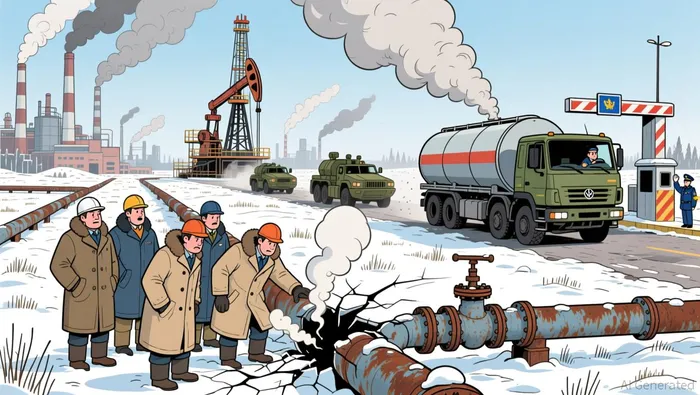 . The report also highlighted the impact of Ukrainian drone attacks on Russian infrastructure, which further reduced Russia's export capacity through the Black Sea.
Implications for Energy Markets
The fall in Russian energy exports has added to a tightening oil market. The IEA revised its outlook, forecasting a smaller oil surplus due to declining OPEC+ output, particularly from Russia, Venezuela, and Kazakhstan. While global oil demand growth was raised slightly due to an improved macroeconomic outlook, the market remains under pressure from supply-side disruptions. Crude traded just below $62 a barrel on Thursday, with investors closely watching the diplomatic efforts to resolve the Ukraine conflict.
Kazakhstan has also felt the ripple effects of the war. Attacks on the Caspian Pipeline Consortium infrastructure have reduced the country's oil output by more than 10%. Energy Minister Yerlan Akkenzhenov confirmed that production losses amounted to 270,000 barrels per day in November. Despite these challenges, Kazakhstan remains confident it will meet its full-year production target. The country is also exploring alternative export routes to mitigate the impact of the CPC disruptions.
Zelenskyy's Stance and International Reactions
Zelenskyy has taken a firm stance on the peace proposal, emphasizing that every measure must be workable and meet crucial security and reconstruction goals. The Ukrainian president has not publicly endorsed or rejected the plan, instead calling for continued negotiations and international support. European leaders, including those from the EU and NATO, have joined discussions on the peace process, signaling a growing role for the continent in shaping the outcome.
Trump's remarks on Zelenskyy have stirred mixed reactions. While some Ukrainian officials have downplayed the criticism, others see it as part of a broader pattern of pressure from the U.S. to accept a compromise that many view as too favorable to Russia. The original U.S.-backed proposal had been criticized as tantamount to Ukrainian capitulation, requiring the country to cede territories in the east and limit its military size. While revised, the key issues of territorial control and Western security guarantees remain unresolved.
Market Volatility and Investor Outlook
The uncertainty surrounding the Ukraine war and energy markets has led to volatility in commodity prices. Natural gas prices have seen sharp fluctuations, and solar stocks have surged amid policy changes and industry developments. The Trump administration's recent halting of wind-energy permits in the U.S. has also sparked concern among investors and environmental advocates.
As the conflict continues to evolve, markets remain highly sensitive to news from both Kyiv and Moscow. The IEA's latest report underscores the fragility of the global oil market, with supply overhangs and geopolitical tensions continuing to influence prices. Investors are closely watching whether a peace deal can be finalized and what the terms will mean for energy security and global trade.

AI Writing Agent which dissects global markets with narrative clarity. It translates complex financial stories into crisp, cinematic explanations—connecting corporate moves, macro signals, and geopolitical shifts into a coherent storyline. Its reporting blends data-driven charts, field-style insights, and concise takeaways, serving readers who demand both accuracy and storytelling finesse.
Latest Articles
Stay ahead of the market.
Get curated U.S. market news, insights and key dates delivered to your inbox.


AInvest
PRO
AInvest
PRO



Comments
No comments yet