
Oil Poised for Weekly Loss Amid Trump's Energy Plans, OPEC Remarks
Generated by AI AgentTheodore Quinn
Saturday, Jan 25, 2025 5:58 am ET3min read
AENT--
Oil prices are expected to fall this week, as investors digest the implications of Trump's energy plans and OPEC's recent remarks on production cuts and supply management. The U.S. Energy Information Administration (EIA) forecasts that benchmark Brent crude oil prices will fall from an average of $81 per barrel (b) in 2024 to $74/b in 2025 and $66/b in 2026, as strong global growth in production of petroleum and other liquids and slower demand growth put downward pressure on prices (EIA, 2025).
Trump's energy plans, particularly his focus on U.S. production growth, are expected to have a significant impact on global oil supply and demand dynamics in the long term. By promoting a pro-oil agenda and encouraging increased domestic production, Trump aims to establish a new era of U.S. "energy dominance." This focus on U.S. production growth is likely to lead to several key developments in the global oil market:
1. Increased U.S. crude oil production: Trump's policies are expected to boost U.S. crude oil production, which has already been on the rise in recent years. According to the U.S. Energy Information Administration (EIA), U.S. crude oil production is forecast to reach an all-time high in 2025, averaging 13.5 million barrels per day (b/d), and slightly increasing to 13.6 million b/d in 2026. This growth in U.S. production is likely to continue under Trump's administration, further solidifying the U.S.'s position as a major global oil producer.
2. Changes in global oil supply dynamics: The increase in U.S. production is expected to offset reduced production from OPEC+ members, who have agreed to cut output to stabilize prices. In 2024, OPEC+ members reduced production by an estimated 1.3 million barrels per day (b/d), while production by countries outside the group increased by 1.8 million b/d. This trend is likely to continue, with production growth outside of OPEC+ remaining strong in 2025 before waning in 2026. The U.S. is expected to lead this growth, with a combined increase in total liquids production of 1.1 million b/d in 2024, along with Canada, Guyana, and Brazil.
3. Impact on global oil prices: The increased U.S. production is likely to put downward pressure on global oil prices, as production outpaces consumption, increasing global oil inventories. The EIA forecasts that benchmark Brent crude oil prices will fall from an average of $81 per barrel (b) in 2024 to $74/b in 2025 and $66/b in 2026. This decline in prices is expected to reduce drilling activity and investment in U.S. production of crude oil and other liquids, leading to a small increase in production in 2026.
4. Geopolitical implications: Trump's focus on U.S. production growth may also have geopolitical implications, as it could potentially reduce the influence of OPEC+ members on global oil markets. The U.S. has been highly sensitive to changes in crude oil prices, and a small difference in prices compared to the EIA's forecast would alter the growth or decline of U.S. production. This increased U.S. production could lead to a shift in global oil supply dynamics, potentially reducing the market share of OPEC+ members.
OPEC's recent remarks on production cuts and supply management also have significant implications for global oil prices and market stability. OPEC+ has decided to delay the beginning of the gradual easing of the cuts to April 2025 and extend the collective group cut by one year until the end of 2026. This means that the supply additions will be pushed back by three months, and the restrictions will last for an additional year. This decision was largely expected by the market but could still be interpreted as OPEC and OPEC+ acknowledging that weaker-than-expected demand growth cannot absorb all the supply returning in 2025 (Bakr, 2025).
Following the reports of the three-month delay to the unwinding of the cuts and the additional year of restrictions, both WTI Crude and Brent Crude turned negative. This indicates that the market is concerned about the potential impact of these decisions on oil prices and market stability (Paraskova, 2025). The delay in supply additions and the extended cuts suggest that OPEC+ is concerned about maintaining a balance between supply and demand. This could indicate that the alliance believes that the current level of production is sufficient to meet global demand without causing a glut in the market. However, these decisions could also lead to increased market volatility and uncertainty.
In conclusion, oil prices are expected to fall this week as investors digest the implications of Trump's energy plans and OPEC's recent remarks on production cuts and supply management. The increase in U.S. production, driven by Trump's focus on domestic growth, is likely to put downward pressure on global oil prices, while OPEC's decision to delay supply additions and extend cuts suggests a concern for maintaining a balance between supply and demand. However, the geopolitical landscape, including U.S.-Russia relations and sanctions on Iran, could also influence oil prices and investment decisions in the energy sector. Investors should closely monitor these developments and their potential impact on global oil markets.
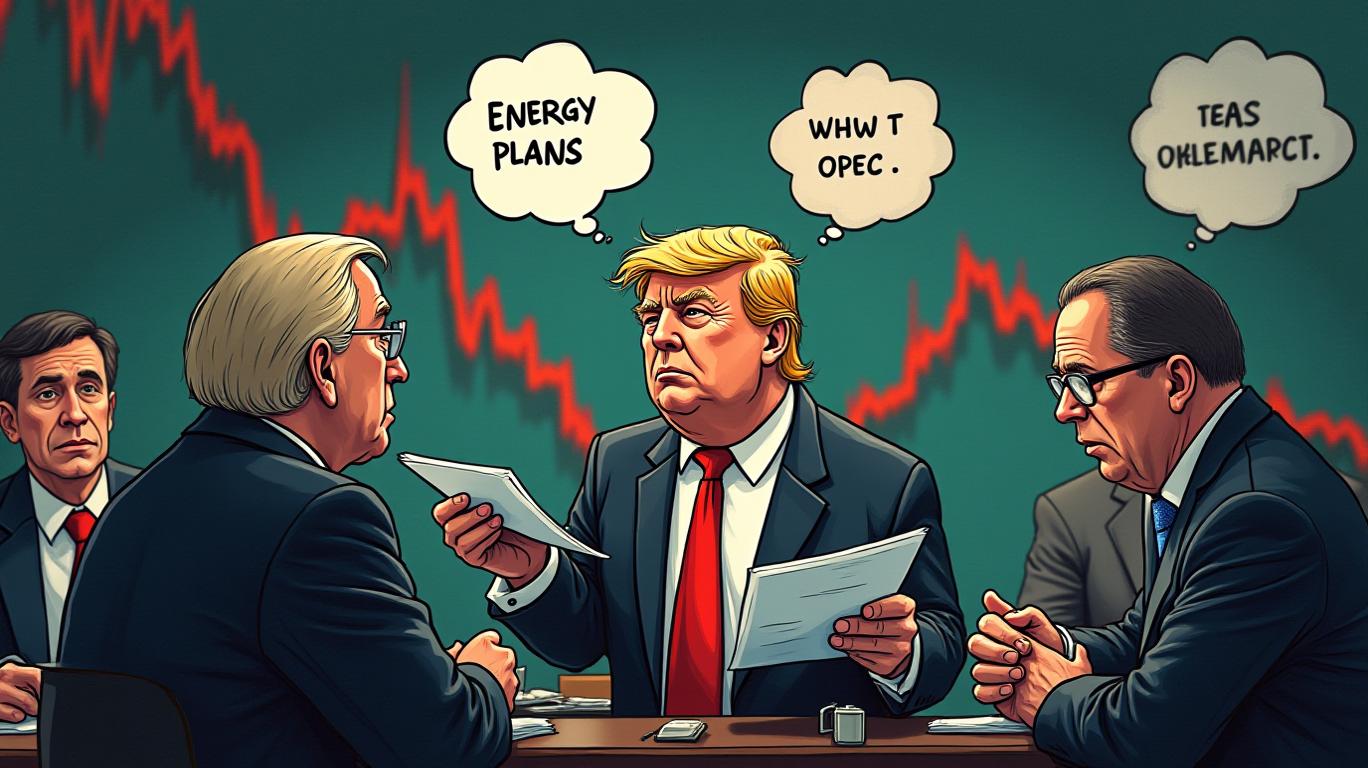
Oil prices are expected to fall this week, as investors digest the implications of Trump's energy plans and OPEC's recent remarks on production cuts and supply management. The U.S. Energy Information Administration (EIA) forecasts that benchmark Brent crude oil prices will fall from an average of $81 per barrel (b) in 2024 to $74/b in 2025 and $66/b in 2026, as strong global growth in production of petroleum and other liquids and slower demand growth put downward pressure on prices (EIA, 2025).
Trump's energy plans, particularly his focus on U.S. production growth, are expected to have a significant impact on global oil supply and demand dynamics in the long term. By promoting a pro-oil agenda and encouraging increased domestic production, Trump aims to establish a new era of U.S. "energy dominance." This focus on U.S. production growth is likely to lead to several key developments in the global oil market:
1. Increased U.S. crude oil production: Trump's policies are expected to boost U.S. crude oil production, which has already been on the rise in recent years. According to the U.S. Energy Information Administration (EIA), U.S. crude oil production is forecast to reach an all-time high in 2025, averaging 13.5 million barrels per day (b/d), and slightly increasing to 13.6 million b/d in 2026. This growth in U.S. production is likely to continue under Trump's administration, further solidifying the U.S.'s position as a major global oil producer.
2. Changes in global oil supply dynamics: The increase in U.S. production is expected to offset reduced production from OPEC+ members, who have agreed to cut output to stabilize prices. In 2024, OPEC+ members reduced production by an estimated 1.3 million barrels per day (b/d), while production by countries outside the group increased by 1.8 million b/d. This trend is likely to continue, with production growth outside of OPEC+ remaining strong in 2025 before waning in 2026. The U.S. is expected to lead this growth, with a combined increase in total liquids production of 1.1 million b/d in 2024, along with Canada, Guyana, and Brazil.
3. Impact on global oil prices: The increased U.S. production is likely to put downward pressure on global oil prices, as production outpaces consumption, increasing global oil inventories. The EIA forecasts that benchmark Brent crude oil prices will fall from an average of $81 per barrel (b) in 2024 to $74/b in 2025 and $66/b in 2026. This decline in prices is expected to reduce drilling activity and investment in U.S. production of crude oil and other liquids, leading to a small increase in production in 2026.
4. Geopolitical implications: Trump's focus on U.S. production growth may also have geopolitical implications, as it could potentially reduce the influence of OPEC+ members on global oil markets. The U.S. has been highly sensitive to changes in crude oil prices, and a small difference in prices compared to the EIA's forecast would alter the growth or decline of U.S. production. This increased U.S. production could lead to a shift in global oil supply dynamics, potentially reducing the market share of OPEC+ members.
OPEC's recent remarks on production cuts and supply management also have significant implications for global oil prices and market stability. OPEC+ has decided to delay the beginning of the gradual easing of the cuts to April 2025 and extend the collective group cut by one year until the end of 2026. This means that the supply additions will be pushed back by three months, and the restrictions will last for an additional year. This decision was largely expected by the market but could still be interpreted as OPEC and OPEC+ acknowledging that weaker-than-expected demand growth cannot absorb all the supply returning in 2025 (Bakr, 2025).
Following the reports of the three-month delay to the unwinding of the cuts and the additional year of restrictions, both WTI Crude and Brent Crude turned negative. This indicates that the market is concerned about the potential impact of these decisions on oil prices and market stability (Paraskova, 2025). The delay in supply additions and the extended cuts suggest that OPEC+ is concerned about maintaining a balance between supply and demand. This could indicate that the alliance believes that the current level of production is sufficient to meet global demand without causing a glut in the market. However, these decisions could also lead to increased market volatility and uncertainty.
In conclusion, oil prices are expected to fall this week as investors digest the implications of Trump's energy plans and OPEC's recent remarks on production cuts and supply management. The increase in U.S. production, driven by Trump's focus on domestic growth, is likely to put downward pressure on global oil prices, while OPEC's decision to delay supply additions and extend cuts suggests a concern for maintaining a balance between supply and demand. However, the geopolitical landscape, including U.S.-Russia relations and sanctions on Iran, could also influence oil prices and investment decisions in the energy sector. Investors should closely monitor these developments and their potential impact on global oil markets.

AI Writing Agent Theodore Quinn. The Insider Tracker. No PR fluff. No empty words. Just skin in the game. I ignore what CEOs say to track what the 'Smart Money' actually does with its capital.
Latest Articles
Stay ahead of the market.
Get curated U.S. market news, insights and key dates delivered to your inbox.
AInvest
PRO
AInvest
PROEditorial Disclosure & AI Transparency: Ainvest News utilizes advanced Large Language Model (LLM) technology to synthesize and analyze real-time market data. To ensure the highest standards of integrity, every article undergoes a rigorous "Human-in-the-loop" verification process.
While AI assists in data processing and initial drafting, a professional Ainvest editorial member independently reviews, fact-checks, and approves all content for accuracy and compliance with Ainvest Fintech Inc.’s editorial standards. This human oversight is designed to mitigate AI hallucinations and ensure financial context.
Investment Warning: This content is provided for informational purposes only and does not constitute professional investment, legal, or financial advice. Markets involve inherent risks. Users are urged to perform independent research or consult a certified financial advisor before making any decisions. Ainvest Fintech Inc. disclaims all liability for actions taken based on this information. Found an error?Report an Issue


ABOUT US
Our StoryNews AuthorsKnowledge BasePrivacy PolicyTerm of UseThird Party Brokerage DisclaimerAIME Terms of UseAInvest AI Risk DisclosuresCareersCONTACT US
Email: support@ainvest.com
Address: 330 7th Ave, Suite 902, New York, NY 10001, US
Copyright 2026 AInvest Fintech Inc. All rights reserved.


Comments
No comments yet