
Oil Market Volatility: Trump's Russia Policy and the Fragile Balance of Geopolitical Supply Chains
 Aime Summary
The global oil market is a chessboard of geopolitical maneuvering, and President Donald Trump's 2025 Russia policy has moved the pieces with unprecedented aggression. By weaponizing trade relationships and imposing unilateral secondary tariffs on countries like India and China—Russia's largest oil buyers—the U.S. has triggered a seismic shift in energy dynamics. While the immediate goal is to cripple Russia's war economy, the ripple effects are reshaping supply chains, inflating prices, and forcing investors to recalibrate their strategies in a world where energy security and geopolitical risk are inextricably linked.
Short-Term Volatility: Tariffs, Sanctions, and the Shadow Fleet
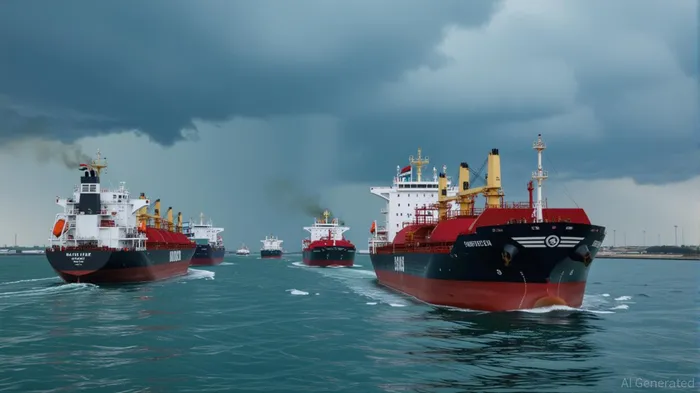
Trump's 100% tariff threats on Indian and Chinese goods have created a high-stakes game of brinkmanship. India, which now imports 2 million barrels of Russian crude daily, has defiantly doubled down on its energy partnerships with Moscow, even as its rupee hit a three-year low. The U.S. response—blacklisting 100 Russian tankers and targeting shadow fleets—has only deepened the complexity of global oil logistics. These shadow fleets, operating outside Western oversight, have enabled Russia to maintain 70% of its pre-war export volumes.
The result? A fragile equilibrium where every tariff threat or diplomatic overture sends shockwaves through the market. Analysts warn that a 1 million barrel-per-day reduction in Russian exports could push Brent crude above $90, exacerbating inflation in an already strained global economy. For investors, this volatility demands agility. Energy producers like ChevronCVX-- (CVX) and ExxonMobil (XOM) stand to benefit from higher prices, but their exposure to geopolitical shocks remains a double-edged sword.
Long-Term Strategic Shifts: The Paradox of Trump's Energy Agenda
While Trump's rhetoric favors fossil fuels, his Russia policy inadvertently accelerates the transition to alternative energy. By destabilizing traditional oil markets, the U.S. has forced countries like India and China to invest in energy diversification. India's Jamnagar refinery, the world's largest, is now a hub for refining Russian crude into refined products for export, while China's Belt and Road Initiative (BRI) is expanding energy infrastructure across Asia and Africa.
Meanwhile, the durability of U.S. clean energy laws—the Infrastructure Investment and Jobs Act (IIJA) and the Inflation Reduction Act (IRA)—has created a policy tailwind for renewables. These laws, which include $369 billion in clean energy incentives, are difficult to reverse, even under a Trump administration. As a result, solar and wind capacity in the U.S. is projected to grow by 15% annually through 2030, driven by both market forces and regulatory inertia.
Portfolio Resilience: Balancing Energy Equities and Hedging Strategies
For investors, the key lies in balancing exposure to energy equities with hedging mechanisms. Diversified energyDEC-- ETFs like AMLP (Alerian MLP Infrastructure) offer a way to capitalize on infrastructure modernization while mitigating sector-specific risks. Similarly, Treasury Inflation-Protected Securities (TIPS) and emerging market diversification can help offset inflationary pressures and currency volatility.
The BRICS bloc's push for dollar-free trade systems—via mechanisms like BRICS Pay and the New Development Bank (NDB)—also presents opportunities. By investing in firms that facilitate these alternative financial ecosystems, such as India's Adani Green Energy or China's Longi Green Energy, investors can tap into the next phase of energy infrastructure.
The Geopolitical Tightrope: Risks and Rewards
Trump's Russia policy is a high-stakes gamble. If Russian exports decline by 1–2 million barrels per day and tariffs persist, the U.S. may gain short-term energy independence but face long-term inflationary risks. Conversely, if OPEC+ compensates for supply gaps, prices may stabilize, but Trump's geopolitical objectives could falter.
Investors must also monitor the potential for a U.S.-Russia-Ukraine ceasefire in late 2025, which could disrupt current trade dynamics and open new markets. In this environment, adaptability is paramountPARA--.
Conclusion: Navigating the New Energy Order
The oil market's volatility under Trump's Russia policy underscores a broader truth: geopolitical risk is no longer a peripheral concern but a central driver of energy sector reallocation. While the immediate outlook is fraught with uncertainty, the long-term trajectory points toward a more diversified and resilient energy landscape. For investors, the path forward lies in strategic diversification—hedging against inflation, capitalizing on renewable momentum, and positioning for the next phase of global energy infrastructure.
In this new era, the winners will be those who see volatility not as a threat, but as an opportunity to rebalance portfolios for both profit and resilience.

Delivering real-time insights and analysis on emerging financial trends and market movements.
Latest Articles
Stay ahead of the market.
Get curated U.S. market news, insights and key dates delivered to your inbox.
AInvest
PRO
AInvest
PRO



Comments
No comments yet