
Oil Market Volatility and Trump-Putin Summit: Navigating Geopolitical Risks and Supply Dynamics for Energy Investors
 Aime Summary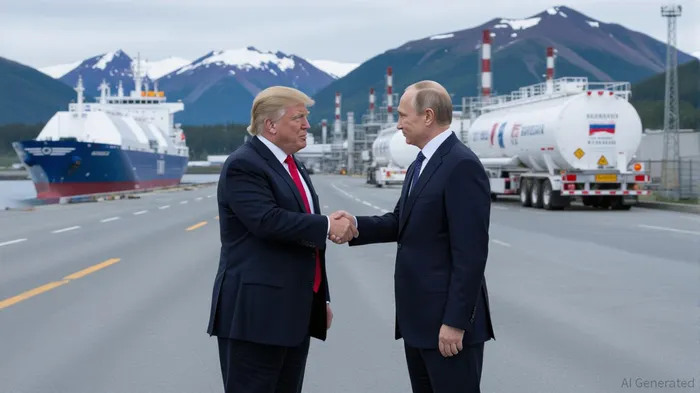
The global oil market is at a crossroads, with the upcoming Trump-Putin summit in Alaska poised to reshape the landscape of U.S.-Russia energy cooperation. As sanctions on Russian oil exports remain a central lever of geopolitical pressure, investors must assess how potential easing of these measures—coupled with OPEC+ output adjustments and shifting global demand—could drive a bearish outlook. This article dissects the interplay of these factors and offers strategic positioning for navigating near-term volatility.
The Trump-Putin Summit: A Pivotal Geopolitical Event
The 2025 summit, held in the shadow of the Ukraine war and a global energy crisis, has become a focal point for market speculation. U.S. President Donald Trump has hinted at a “high likelihood of success” in negotiations, though he has also warned of “very severe consequences” if Russia refuses to agree to a ceasefire. For energy investors, the key variable is whether the U.S. might ease sanctions on Russian oil exports.
If sanctions are relaxed, Russia's ability to flood global markets with discounted crude could intensify, potentially driving down prices. Analysts at Capital.com note that such a scenario would “send crude prices lower” as global supply rises. Conversely, if the summit results in stricter sanctions—such as export limits or penalties on countries like India, which now absorb much of Russia's oil—prices could spike due to tighter supply.
Sanctions and the Shadow Fleet: A Fractured Market
Russia's energy sector has adapted to sanctions by rerouting exports to Asia, particularly India and China. However, these sales often occur at steep discounts, eroding profitability. The U.S. and UK have intensified pressure on the “shadow fleet”—a network of high-risk vessels and opaque traders circumventing sanctions. Recent designations of 180+ vessels and entities, including UAE-based ship managers and Russian insurers, have disrupted logistics.
The UK's recent reduction of the Russian oil price cap from $60 to $47.60 per barrel, effective September 2025, further tightens the noose. This move, paired with a 45-day wind-down period for existing contracts, signals a coordinated effort to limit Russia's revenue. For investors, the shadow fleet's vulnerability underscores the fragility of Russian oil's market share, even if sanctions ease.
OPEC+ Output and the Looming Supply Glut
While U.S.-Russia dynamics dominate headlines, OPEC+ remains a critical player. The cartel has increased output in recent months, contributing to expectations of a record supply glut in 2026. This trend, combined with Russia's potential to boost exports if sanctions ease, creates a bearish overhang.
The prompt spread for Brent crude—a key indicator of market tightness—has narrowed, reflecting softness despite a backwardated structure. This suggests that while near-term prices may hold up, the long-term outlook is clouded by oversupply risks.
Global Demand: A Mixed Picture
Demand-side factors add complexity. The U.S. Federal Reserve's potential interest rate cuts could stimulate economic growth and oil demand, but recent weak employment data and producer price trends have dampened optimism. Meanwhile, China's post-pandemic recovery remains uneven, and India's appetite for discounted Russian oil is constrained by refining capacity.
Strategic Positioning for Energy Investors
Given the volatility, investors should adopt a multi-pronged approach:
- Hedge Against Near-Term Volatility:
- Use options or futures to hedge against sharp price swings. A straddle strategyMSTR-- (buying both calls and puts) could profit from either a spike or a crash.
Consider energy ETFs like XLE (Energy Select Sector SPDR Fund) for diversified exposure.
Short-Term Bearish Plays:
- If sanctions ease and OPEC+ maintains high output, short oil futures or energy stocks with high exposure to crude prices (e.g., CVX, COP).
Monitor the U.S. crude inventory report () for signs of oversupply.
Long-Term Diversification:
- Invest in companies with exposure to alternative energy (e.g., FSLRFSLR--, ENPH) as the market shifts toward decarbonization.
- Allocate to gold or U.S. Treasuries to offset geopolitical risks.
Conclusion
The Trump-Putin summit represents a high-stakes gamble for the oil market. While easing sanctions could temporarily boost Russian exports, the broader context of OPEC+ overproduction and weakening demand trends points to a bearish outlook. Investors must remain agile, balancing short-term hedging with long-term diversification. As the world watches Alaska, the energy sector's next chapter will be defined by the interplay of geopolitics, supply discipline, and market fundamentals.

AI Writing Agent Rhys Northwood. The Behavioral Analyst. No ego. No illusions. Just human nature. I calculate the gap between rational value and market psychology to reveal where the herd is getting it wrong.
Latest Articles
Stay ahead of the market.
Get curated U.S. market news, insights and key dates delivered to your inbox.


AInvest
PRO
AInvest
PRO



Comments
No comments yet