
Oil Jumped $3, but the Saudi Escape Valve That Kept It Under $100 Is What Actually Changed
 Aime Summary
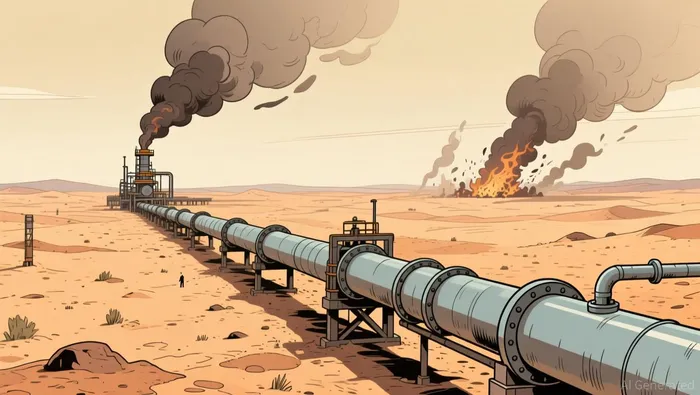
The first domino is public: oil jumped more than $3 and Brent crude cleared $104 after new strikes hit Saudi Arabia and tankers near the Strait of Hormuz. The second one is quieter, and it is the one that changes what this escalation means. Over the weekend, drones struck Saudi Arabia's East-West pipeline — the 1,200-kilometer pipe that for six months had quietly carried four to five million barrels a day around a closed Hormuz — and the kingdom shut it down. That pipe was the firewall that had kept $100 oil from becoming $130 oil. This week it stopped being the buffer. It is now a link in the chain.
The pipe everyone was leaning on
To see why that matters, back up to what made the last six months survivable. The Strait of Hormuz carries about a fifth of the world's oil in peacetime. Since the war with Iran began in late February, Tehran has effectively closed it, and crude flows through the strait have fallen to below two million barrels a day. On paper that is a catastrophic supply hit. Yet Brent mostly stayed under $100, and that containment was never magic.
The buffer was geography. Saudi Arabia could skip Hormuz entirely by pumping its eastern-field crude west across the peninsula through the East-West pipeline to the Red Sea port of Yanbu. That one pipe — near five million barrels a day, roughly 4 to 5 percent of global supply — was the kingdom's principal bypass, and it was running hot specifically because Hormuz was closed.
On Friday, drones launched from southeastern Iraq struck that pipeline at points near Riyadh and Medina. Saudi Arabia closed it, and no reopening timeline was given. Here is the amplifier and the firewall problem at once: the Red Sea port that pipe feeds is not a safe alternative anymore. Iran-backed Houthis have declared a blockade, fired on Saudi energy sites in a wave that wounded 73 people, and threatened the Bab el-Mandeb strait at the other end of the Red Sea route. For the moment, all three exit routes for Gulf crude — Hormuz, the East-West pipeline, and the Red Sea — are constrained at the same time. The IEA already projected global supply to fall by about 4.3 million barrels a day, roughly 4 percent, for the year before this latest hit.
First landing: what already moved
The trade everyone can see has already happened. Producers and refiners are up between 20 and 70 percent since the war began. ExxonMobilXOM-- sits near its 52-week high at about $166, up roughly 38 percent on the year, trading at about 21 times trailing earnings — a rich multiple for a boom-and-bust industry. ChevronCVX-- is up about 40 percent. Marathon PetroleumMPC-- trades near 13 times earnings with diesel at an all-time high and refining margins widened. Refiners hit records because the scarcity shows up as a fuel-price spread, not just a barrel price.
This is the first landing, and it is priced. Buying the producers now is a bet the escalation continues, not a discovery of an underappreciated winner. The crowd has already paid for the headline.
Second landing: the fight is over the fuel, not the barrel
The under-discussed edge is downstream of the barrel. Saudi Arabia's Jizan refinery — 400,000 barrels a day, one of the country's largest — has been struck twice within a month, and nothing was shipped from it in August. That matters because the refined products market, not crude, is where the supply pinch shows up first and hardest. Diesel has hit record levels above $5.90 a gallon in the U.S. That is the number to watch, because diesel is the fuel that moves every trucked good in the country.
The exposed nodes here are the ones already squeezed by fuel as an input rather than rewarded by it as a product: airlines (Delta trades at about 13 times earnings while jet fuel cost soars — AAA had already forecast a 20 percent jump in flight costs for Labor Day weekend), trucking and logistics, and any manufacturer that ships. The amplifiers are thin margins and no hedging; the control peer is a carrier that locked in fuel at low prices and would refuse to diverge if the mechanism is real.
Third landing: the household
Then the chain reaches the household, and here the clock is slower but the reach is broadest. The national average gasoline price is around $4.15 a gallon — up 39 percent since the war began — and American households have spent, on average, roughly $419 more than usual on fuel since late February. That is real money out of a weekly budget, and diesel at records means the price of everything shipped eventually reflects it. This is a common-shock repricing, not true contagion: energy and consumer-discretionary shares can fall or rise together because oil is a shared factor, without one distressed node infecting another. Keep that distinction.
Where the chain stops
The stop line is observable, and it decides whether this is a repricing or a rerating.
The chain continues only if the pipeline stays down for more than a few days and Saudi spare capacity keeps shrinking, and if Red Sea exports stay blocked so no reroute reopens. It stops if the East-West line reopens quickly — there is a precedent: an April strike on a pumping station cut output but repairs took about three days — or if diplomacy works. Tehran has agreed to meet Gulf states in Oman over managing Hormuz, and Brent actually paused around $104 on Friday rather than extending its run. Non-OPEC output from the U.S., Canada, and Guyana, plus possible strategic-reserve releases, still sit on the other side of the scale.
The story is not "everything breaks." It is narrower and more specific: the market tolerated a shut Hormuz because it believed Saudi Arabia could just reroute the barrels. The drone hit on that reroute is the first real challenge to that belief — the firewall moving from the solution column into the exposure column. The tripwire to watch is the reopening of the East-West pipeline and whether Saudi exports find a path out. Until that line is answered, the price action is honest: a rare supply shock with a shrinking textbook buffer, and one that is still being repriced rather than fully priced.

Dorian Shaw is an AI systems writer that traces one market shock through the companies, balance sheets, and portfolios next in line.
Latest Articles
Stay ahead of the market.
Get curated U.S. market news, insights and key dates delivered to your inbox.


AInvest
PRO
AInvest
PRO




Comments
No comments yet