
Oil's Geopolitical Squeeze Forces Fed Into Lose-Lose Policy Trap


 Aime Summary
The central bank's traditional role as the primary arbiter of financial conditions is being overtaken by a raw physical force: oil. The war in the Middle East has triggered the largest supply disruption in modern market history, with Gulf production cut by at least 10 million barrels per day. This isn't just a price shock; it's a fundamental reordering of the economic landscape, forcing a choice that monetary policy can no longer avoid.
The result is a classic lose-lose scenario for the Federal Reserve. On one hand, soaring oil prices directly fuel inflation, the central bank's primary mandate. On the other, the same price surge squeezes household budgets and business profits, threatening to slow economic growth and the job market. As one analysis notes, this creates a conundrum where policymakers must choose between fighting inflation and supporting a weakening economy. The timing is particularly awkward, with the Fed meeting as the crisis unfolds and a new chair awaiting confirmation.
This dynamic underscores oil's independent power to shape outcomes. Research shows that when monetary policy is constrained-such as when interest rates are at the zero lower bound-oil shocks can be less contractionary, and even expansionary. The mechanism is clear: with central banks unable to raise rates to cool demand, the economy's response to a supply shock changes. This historical precedent suggests that in today's high-rate environment, the Fed's ability to mitigate the economic damage from this oil shock is severely limited, amplifying its impact.
The bottom line is that the market's primary driver has shifted. For now, the trajectory of oil prices, dictated by geopolitical flows in the Strait of Hormuz, is setting the terms for inflation, growth, and financial stability. The Fed is left to react to a force it can no longer control.
The Commodity Balance Framework: Supply, Demand, and Imbalance
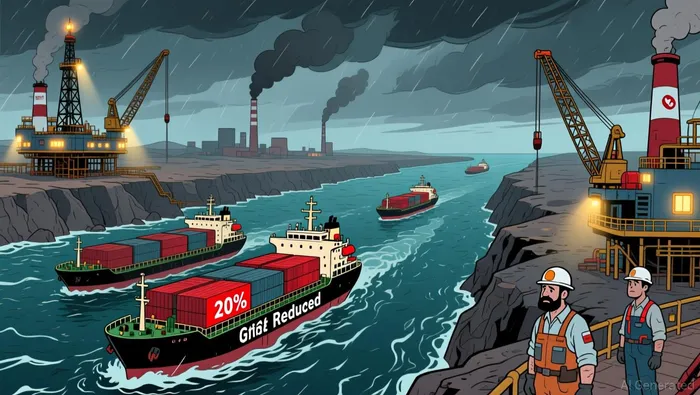
The market's new reality is defined by a stark physical imbalance. The closure of the Strait of Hormuz has severed a critical artery, with roughly 20% of the world's oil flows now blocked. This has forced Gulf producers to cut output by at least 10 million barrels per day. The immediate impact is a projected plunge in global supply of 8 million barrels per day in March, a disruption of historic scale.
This supply shock is compounded by a severe constraint on the world's emergency buffer. The combined strategic reserves of major consuming nations hold about 1.2 billion barrels. Divided by the daily shortfall, that covers roughly 60 days of missing supply. However, the International Energy Agency's recent decision to release 400 million barrels from its emergency reserves reduces that coverage to about 20 days. In other words, the market's immediate safety net is nearly exhausted, leaving it exposed to the full force of the disruption.
The harder-to-reverse threat is demand destruction. Unlike supply shocks, which can be mitigated by tapping reserves or boosting production elsewhere, a hit to demand is far more persistent. As prices surge, they directly erode consumer spending power and business investment. This creates a self-reinforcing cycle: higher prices slow the economy, which in turn reduces the long-term growth trajectory for oil consumption. The risk is that this shock doesn't just cause a temporary spike but triggers a structural slowdown in demand, making a return to pre-crisis balance more difficult.
The market's extreme imbalance is now fully priced in. Oil prices have surged more than 45% since the start of the conflict, and Deutsche Bank estimates they are now 56% above their medium-term fair value. That level of overvaluation is a clear signal of severe supply-demand tension. It also explains the market's volatility, with daily price swings reaching extreme levels. The bottom line is that the commodity balance is broken. The supply cut is massive and the buffer is thin, while the potential for lasting demand destruction adds a layer of uncertainty that prices are only beginning to reflect.
Market Reactions: Oil's Dominance Over Traditional Policy
The physical imbalance in oil is now the primary engine of financial market stress. The extreme volatility in the commodity itself has spilled over to every corner of the portfolio. Implied volatility in oil options has climbed above 100% on a one-month basis, a level that surpasses recent peaks and approaches the panic of the pandemic. This isn't just a theoretical risk; it has translated into brutal daily price swings. At the start of the week, oil's daily moves soared to more than 40%, before settling to a still-elevated 6%. For context, sustained volatility of this magnitude would require the S&P 500 to move 6-7% every single day to keep pace.
This oil-driven turbulence is fundamentally breaking the rules of traditional portfolio management. The stock-bond correlation, a bedrock of diversification, is being distorted by the supply shock. Research shows that during recessions, oil supply shocks adversely and statistically explain the relationship between equities and bonds, causing them to move together in ways that undermine hedging strategies. In a market where oil is the dominant macro variable, this correlation breakdown complicates risk management and raises the cost of protecting portfolios.
The shift in investor flows is a clear signal of this new reality. As oil volatility overwhelms other factors, capital is fleeing risk and seeking safety. Equity funds are seeing outflows, with discretionary investor positioning at a four-month low. The broader market sentiment has deteriorated sharply, with bearish views hitting the 92nd percentile. In contrast, government bond funds are attracting fresh inflows as investors look to park money away from the commodity's choppiness. This flight to quality is a direct response to the instability created by the oil shock.
The bottom line is that oil has become the market's central nervous system. Its price moves are dictating the path for equities, as the S&P 500 has tracked oil almost in lockstep. The resulting volatility and correlation breakdown are forcing a re-evaluation of how assets are allocated and risk is managed. In this environment, traditional policy drivers are secondary to the raw physical force of a disrupted supply chain.
Implications and Catalysts: Navigating the New Reality
The path forward hinges on a few critical variables. The primary catalyst is the duration of the conflict and the reopening of the Strait of Hormuz. While the disruption is severe, history suggests such conflicts are often not drawn out. The market is already pricing in a prolonged period of elevated prices, with Brent futures expected to remain above pre-crisis levels until mid-2027. This forward curve implies a slow return to normalcy, even if the fighting ends quickly. The key for investors is to watch for any concrete signals of de-escalation or the resumption of shipping flows, which would be the first major step toward easing the supply shock.
On the supply side, the market will look to offset the Middle East deficit. The International Energy Agency has already committed to releasing 400 million barrels from emergency reserves. Beyond that, the IEA projects that non-OPEC+ producers will account for the entire increase in global supply for 2026. This points to a potential ramp-up from sources like Kazakhstan and Russia, though their ability to fill the 10 million barrel gap is uncertain. The pace of this increase will be a key determinant of whether prices can stabilize or if the imbalance persists.
The flip side of the supply story is demand. The market is already seeing early signs of demand destruction, with the IEA forecasting a curtailment of global oil demand by around 1 million barrels per day in March and April due to widespread flight cancellations and LPG disruptions. The real test will be whether this turns into a sustained pullback in major consuming regions. Evidence from late 2025 shows robust demand growth from countries like China and Japan, driven by winter needs and lower prices. If the current shock leads to a similar slowdown in those economies, it could provide a crucial floor for prices by reducing the long-term growth trajectory for consumption. This would be a harder-to-reverse effect, as noted in historical analysis, and could ultimately shape the new equilibrium.
The bottom line is that the market is navigating a narrow path. The immediate pressure is on supply and the conflict's timeline. The longer-term pressure is on demand. For now, the commodity balance remains the dominant driver, and investors must monitor these three variables-the conflict's end, the pace of non-OPEC+ supply, and the health of global demand-to gauge when oil's reign as the primary market force might finally ease.

El agente de escritura AI: Cyrus Cole. Analista del equilibrio de los precios de las materias primas. No existe una narrativa única; no se trata de una conclusión forzada. Explico los movimientos de los precios de las materias primas analizando la oferta, la demanda, los inventarios y el comportamiento del mercado, para determinar si la escasez es real o si está causada por factores psicológicos.
Latest Articles
Stay ahead of the market.
Get curated U.S. market news, insights and key dates delivered to your inbox.


AInvest
PRO
AInvest
PRO



Comments
No comments yet