
Oil Is Drowning in Supply: IEA Warns a Brutal Price Breakdown May Be Coming


 Aime Summary
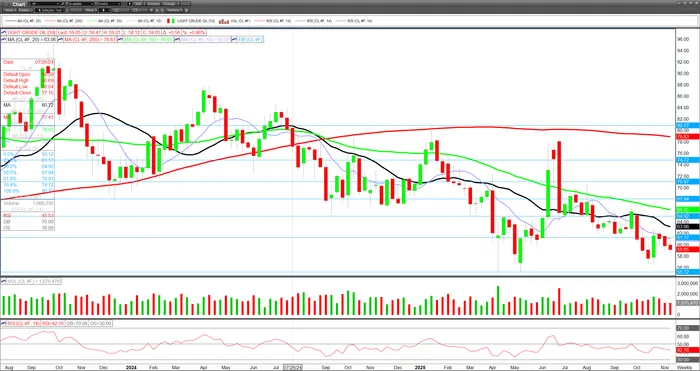
The oil market heads into mid-November looking increasingly lopsided, and not in a way that favors the bulls. Light Crude Oil is fighting to hold the $58 area after weeks of steady pressure, a sharp slide from the $70 mark reached on July 30. On the weekly chart, the descent is even more uncomfortable: crude has carved out a textbook descending triangle stretching back to its highs near $87, and the IEA's latest report does not offer the kind of macro lifeline needed to break that pattern. Instead, the agency’s global supply outlook suggests this imbalance may only widen, raising the odds that crude remains stuck in a grinding downtrend. While geopolitical risks from Russia and Ukraine are hardly resolved, they’re no longer driving day-to-day trading. In effect, the “fear bid” has cooled, and fundamentals are now back in the driver’s seat — unfortunately for oil bulls, they’re driving downhill.
The core issue is that supply growth continues to run hotter than demand. World oil demand did rebound in the third quarter, rising 920 kb/d year-over-year, more than double the pace in Q2. Stronger Chinese deliveries and a marginally better global macro backdrop — helped by easing trade tensions — contributed to the improvement. The IEA expects global demand to expand by 790 kb/d in 2025 and 770 kb/d in 2026, with the United States, China, and Nigeria each contributing roughly 120 kb/d next year. These aren’t catastrophic numbers by historical standards, but they hardly represent a demand boom. In an environment drowning in incremental supply, “not a boom” can quickly become “not enough.”
That supply overhang is the real story. Global oil supply hit 108.2 mb/d in October, down slightly due to planned maintenance and unplanned outages — but still a massive 6.2 mb/d higher than in January. Output gains this year have been split almost evenly between OPEC+ and non-OPEC+ producers, a shift from past cycles that typically saw one bloc doing the heavy lifting. The IEA projects global supply to rise by 3.1 mb/d in 2025 and another 2.5 mb/d in 2026, taking average production to 108.7 mb/d. Non-OPEC+ alone is expected to contribute 1.7 mb/d to next year’s growth. Against a demand outlook barely pushing 800 kb/d, that math is about as supportive for prices as a leaking tanker.
Refining dynamics aren’t offering much relief either. Global refinery runs fell sharply in October, sliding 2.9 mb/d to 81.5 mb/d as maintenance season and outages dragged on throughput. While runs are expected to recover toward year-end — rising 710 kb/d in 2025 and 510 kb/d in 2026 — refiners appear to be bracing for a physical market that is long crude but tight products. European and Asian refining margins even touched a two-year high in early November due to outages, though U.S. mid-continent margins spiked briefly as a domestic refinery went offline. For crude, strong product cracks usually help firm prices. This time, however, the market sees the margin spike as a supply disruption story, not a demand one, and crude remains stuck under pressure.
Inventories add another bearish layer. Global observed stocks surged by nearly 78 million barrels in September, taking inventories to their highest level since mid-2021. Oil on water accounted for most of the increase — up a hefty 80 million barrels — while land-based OECD stocks rose only modestly. October preliminary data shows inventories rising again, with another large build in oil on water. Over the first nine months of 2025, global stocks have risen by 313 million barrels, or 1.15 mb/d on average. In simple terms: the world isn’t struggling to find barrels; it’s struggling to store them.
Price action shows the strain. North Sea Dated crude averaged just $64.64/bbl in October, down $3.26/bbl and marking its fourth straight monthly decline. Mid-month, Dated nearly broke $60 — a four-year low — before bouncing on fears that new U.S. and U.K. sanctions on Russia’s Rosneft and Lukoil might finally tighten supply. But even with those sanctions set to take effect on November 21, Russian exports have continued largely uninterrupted, with barrels simply piling up on the water as buyers sort through compliance risks. That backlog only deepens the oversupply picture.
Layer in the macro uncertainty — lingering tariff impacts, a U.S. government shutdown hangover that may skew upcoming data, and Russia/Ukraine conflict fatigue — and the market ends up with a demand trajectory that’s “fine” and a supply picture that is anything but. The IEA highlights that petrochemical feedstock demand, once expected to be a major source of growth, has meaningfully underperformed this year. Meanwhile, global crude supply is set to rebound further into Q4, adding pressure at exactly the wrong time for bulls.
For consumers, this imbalance may prove to be the rare silver lining. A sustained slide in crude would likely translate into lower gasoline prices heading into year-end — a potential tailwind for retail and discretionary sectors. For energy investors, though, the message is far more cautionary: unless demand meaningfully reaccelerates or geopolitical risks abruptly resurface, the path of least resistance for crude remains lower. The descending triangle on the chart isn’t just a shape — it’s a summary of the IEA’s entire macro narrative.

Senior Analyst and trader with 20+ years experience with in-depth market coverage, economic trends, industry research, stock analysis, and investment ideas.
Latest Articles
Stay ahead of the market.
Get curated U.S. market news, insights and key dates delivered to your inbox.


AInvest
PRO
AInvest
PRO



Comments
No comments yet