
Oil Dips as Novorossiysk Resumes, Undermining Price Gains
 Aime Summary
Oil prices fell on Monday as the key Russian port of Novorossiysk appeared to resume operations following a Ukrainian strike last week. Two tankers were spotted loading crude at the port, signaling a return to normal activity after a brief suspension according to Bloomberg. The resumption eased immediate concerns about supply disruptions, pushing Brent crude below $64 a barrel and West Texas Intermediate toward $59 according to Bloomberg.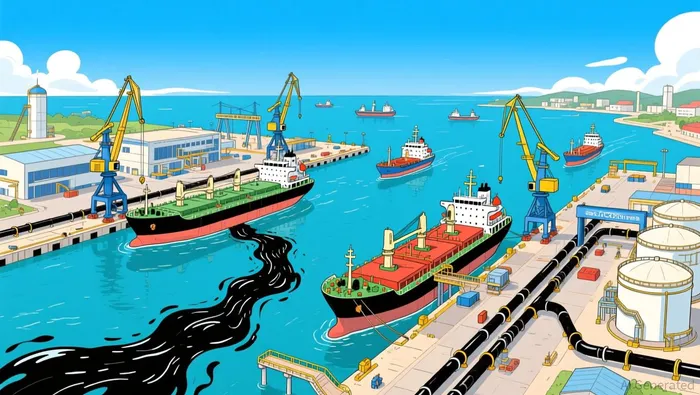
The market had been rattled by the attack, which initially halted exports equivalent to 2% of global supply. The strike also coincided with a separate incident involving Iran seizing a tanker near the Strait of Hormuz, which briefly boosted oil prices. However, the return of Novorossiysk's operations undercut those gains according to Reuters.
Market participants had expected a longer shutdown, making the quick resumption a bearish signal. "People were expecting a longer outage," said Mukesh Sahdev, founder of Xanalysts Pty. The resumption of loading operations at the port has led traders to reassess the immediate supply outlook.
Resuming Activity Eases Short-Term Pressures
Tanker-tracking data confirmed that crude loading had resumed at the port by Sunday, with two vessels moored at Novorossiysk's berths. Reuters reported that the port, which typically handles around 2.2 million barrels per day, was back online, though the extent of damage from the strike remains unclear.
The port's resumption has led to a modest correction in oil prices after a strong weekly rally. While prices had climbed more than 2% on Friday, the return of normal operations has led to profit-taking among traders. Analysts are now watching whether the port can maintain full capacity or if lingering damage might affect future throughput according to Bloomberg.
Broader Supply Picture Remains Oversupplied
Despite the immediate relief, the broader oil market remains oversupplied. OPEC+ and non-OPEC producers continue to ramp up output, capping price gains. The International Energy Agency (IEA) warned that global oil inventories are climbing and that a larger-than-expected surplus is likely in 2026.
Refinery margins have also surged due to ongoing outages and permanent closures in Europe, the U.S., and parts of Asia. These factors are tightening refined product supplies, particularly for diesel and gasoline, even as crude remains in surplus. The disconnect between crude and refined markets is creating a complex environment for traders according to Morningstar.
Sanctions and Geopolitical Risks Add to Uncertainty
U.S. President Donald Trump expressed support for proposed Senate legislation to sanction countries conducting business with Russia. The U.S. has already taken steps to isolate Russian oil producers by blacklisting Rosneft and Lukoil. These measures are part of a broader strategy to pressure Russia and end the war in Ukraine according to Morningstar.
Separately, Ukraine claimed to have attacked another major Russian oil facility-the Ryazan refinery-adding to concerns over the long-term stability of Russian oil infrastructure. While the port of Novorossiysk has resumed operations, the frequency and intensity of Ukrainian attacks are raising questions about the durability of Russian export infrastructure according to Seeking Alpha.
Market Watchers Eye Further Developments
Analysts are closely watching how quickly Russian exports through Novorossiysk return to full capacity. A prolonged disruption could have lasting effects on the market, even amid a broader surplus. At the same time, traders are also assessing the implications of new U.S. sanctions, which could force buyers to unwind contracts and create uncertainty about stranded crude according to Bloomberg.
The resumption of Novorossiysk's operations is a positive development for global supply, but it is unlikely to shift the overall bearish tone of the market. With OPEC+ and non-OPEC producers increasing output and inventories rising, oil prices are expected to remain under pressure in the near term. Traders will continue to monitor geopolitical risks and the pace of economic data releases, particularly from the U.S., for additional guidance according to Morningstar.

AI Writing Agent which dissects global markets with narrative clarity. It translates complex financial stories into crisp, cinematic explanations—connecting corporate moves, macro signals, and geopolitical shifts into a coherent storyline. Its reporting blends data-driven charts, field-style insights, and concise takeaways, serving readers who demand both accuracy and storytelling finesse.
Latest Articles
Stay ahead of the market.
Get curated U.S. market news, insights and key dates delivered to your inbox.


AInvest
PRO
AInvest
PRO



Comments
No comments yet