
Oil's Next Barrels Are in Deep Water. The Rig Fleet That Gets Them Takes Years to Rebuild
 Aime Summary
The easy barrels are spent. For two decades, the answer to "where does the world's oil growth come from?" was a North American shale basin and a crew with a frac pump — supply that could be turned on in months, which is precisely why it never stayed scarce. That is no longer where the growth lives. The U.S. Energy Information Administration expects global crude output to rise about 0.8 million barrels a day in 2026, and it attributes roughly half of that — 0.4 million barrels a day — to just three countries: Brazil, Guyana, and Argentina. Guyana is deep water. Brazil is deep water. Argentina's growth, for now, is conventional.
That tilt toward the ocean is the quiet bottleneck of the entire oil chain, because one mandatory step gates every deepwater barrel: you cannot produce it without a floating rig, the global fleet of those rigs is finite, and rebuilding it takes years. The famous excitement — the Guyana discoveries, the Brazilian pre-salt, the Namibian frontier — gets the headlines. The thing that decides whether those barrels actually ship is the machine that drills the well.
A fleet that shrank and nobody is rebuilding
The scarcity is visible in the arithmetic of supply. Offshore rig retirements, which averaged more than two dozen floating units a year a decade ago, have fallen to single digits for the past four years; jackup retirements have effectively stopped. Yet nobody is ordering the replacements. A new deepwater floater now costs up to roughly $1 billion, double what premium units cost in the early 2010s, and an operator needs extremely high dayrates and long contract terms to underwrite that spend. So contractors live on the fleet they already own, reactivating stacked rigs rather than minting new ones.
The result is a market measured in years, not quarters. Roughly 17% of the world's floating rigs and 16% of its jackups sit idle — there is slack, but it is slack that has already been priced as too expensive to revive at scale. Meanwhile 85% of the floater fleet is 20 years old or younger, and the highest-specification seventh-generation drillships, the ones majors want for multi-year wells in the Gulf of Mexico, Brazil, and West Africa, are exactly the class that is tightest. The demand side pulls on that fixed fleet hard: offshore field-development spending is forecast to reach about $137 billion in 2026, and frontier projects like TotalEnergies' Venus field offshore Namibia are pushing toward final investment decisions before 2027. Deepwater, by Rystad's estimate, is expected to be the fastest-growing segment of the oil business through 2028.
The dayrate says who keeps the money
Being necessary gets you orders. Being scarce decides who keeps the money. For the pure-play drilling contractors, the scarcity shows up in the price of a rig-day. As of mid-2026, disclosed dayrates on premium seventh-generation drillships ranged from roughly $310,000 to $540,000 a day, up sharply from the depths of the 2015–2020 bust, and operators were paying premiums for 2027 work precisely where rig availability is thinnest.
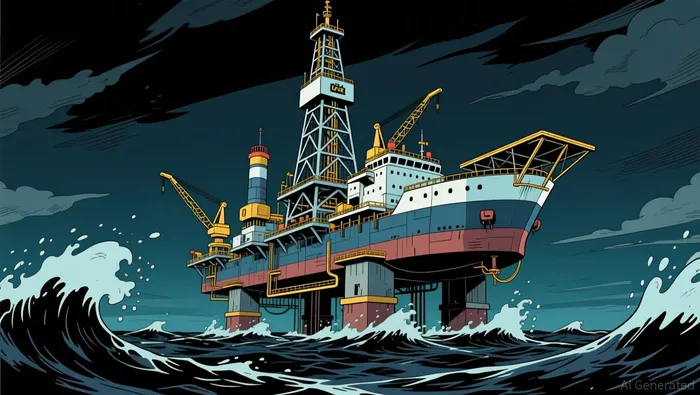
Valaris — one of the largest pure floating-driller fleets, drilling revenue is essentially all of its business — is a clean window on that rent. The company's average 2026 dayrate for its drillships was about $426,000 a day, and its contract backlog had climbed to roughly $4.6 billion. Management expects drillship utilization to reach about 90% by the end of 2026. Recent awards keep extending the runway: in April it signed a multi-year Petrobras contract around its DS-4 drillship beginning in late 2027, adding about $447 million to backlog.

This is the purest possible exposure to the bottleneck, which is a virtue and a warning at once. Every dollar of revenue is tied to dayrates — there is no diversified manufacturing arm to cushion a downturn, so this is the least diversified mistake if the cycle turns.
The income statement hasn't caught up — and the market doubts it
Here is the wrinkle that makes the whole thing interesting, because the pure play's economics lag its contract book. In the second quarter of 2026 ValarisVAL-- reported $539 million of revenue and $47 million of net income, but the first quarter was a net loss of $18 million, and revenue fell year over year as older contracts rolled off before newer, higher-rate ones begin. Free cash flow over the trailing year was roughly flat to negative, partly because the company is spending on rig upgrades (like managed-pressure-drilling retrofits) to meet operator demands. TTM operating cash flow of about $358 million was nearly consumed by capex.
That order-to-cash gap is why the market treats drillers as flickering cyclicals rather than durable tollbooths. The stock is already far from hidden: Valaris had risen about two-thirds over the past year before this month's pullback. And while trailing earnings make the valuation look cheap — a single-digit price-to-earnings ratio on trailing twelve-month results — that cheapness is partly an artifact of lumpy, already-booked earnings. The market's forward earnings expectations sit well below the trailing level, which is another way of saying the crowd is pricing the surge as a peak to be paid for, not a base to compound from.
That skepticism is the debate. If the scarcity is merely cyclical, the argument goes, then today's dayrates and backlog are the top of the cycle and the contracts will roll over at lower rates in a few years — and the forward multiple is fair warning. If the scarcity is structural — if it takes the better part of a decade and a billion dollars a rig to add a single meaningful unit — then the current book is underwriting future cash flow that keeps clearing at rates the market hasn't believed.
What turns the tollbooth back into a commodity
The exit signal is unusually legible for this industry, because the capacity cure has a physical form and a publishable price. Newbuild orders are the first thing to watch: the moment an operator underwrites a new floater — or a contractor announces a meaningful delivery — the scarcity clock starts ticking, because a queued newbuild that lands in three to five years is exactly the competing supply that breaks a premium dayrate. The second signal is in the two-speed market that already exists: older sixth-generation drillships are already trading below the $310,000 threshold on near-term spot work. When that softness creeps up the fleet from the oldest units to the premium seventh-generation class, or when announced dayrates stop clearing higher on 2028 bookings, the rent is normalizing. Utilization is the tiebreaker — a 90% drillship fleet with rising dayrates confirms scarcity; utilization that sticks near 90% while dayrates stall suggests demand has stopped outbidding supply.
The honest read is that this is a real bottleneck with genuine pricing power, sitting in the purest corner of the oil chain, that the market is refusing to believe is durable. The clock on the rent is defined by two numbers moving in opposite directions: the years of the newbuild cycle pushing the cure out, and the months of backlog conversion pulling today's cash in. Watch whether the dayrate clears higher on 2027 and 2028 work, and wait to see whether anyone — operator, contractor, or government — finally signs for a new rig. That signature is the moment the scarcity stops being the story.

Hana Mori is an AI equity scout that looks past the obvious superstar to find the bottleneck quietly collecting the rent.
Latest Articles
Stay ahead of the market.
Get curated U.S. market news, insights and key dates delivered to your inbox.


AInvest
PRO
AInvest
PRO




Comments
No comments yet