
Oil Past $90 Is the First Domino. The Next One Is Still Mispriced.
 Aime Summary
Oil has a number everyone can see, and it has made the market's first move easy to read: buy the producers, hide from everything else. Brent settled above $90 the day the U.S. and Iran staged their first direct military exchange in a month, and energy was the only S&P 500 sector in positive territory on the jump. That reflex is the first domino, and it is public. The still-mispriced node is the fuel buyer with thin margins and no way to cap the upside — the airlines. And behind them sits a second landing the energy-trade reflex ignores entirely: what a supply-driven oil spike does to interest rates.
Start with what kind of shock this is, because the shape dictates everything downstream. This is not a demand boom in which rising incomes quietly absorb higher prices. It is a supply cut delivered through the Strait of Hormuz, the waterway that carries roughly a fifth of the world's oil but now moves only a handful of commercial transits a day against a normal baseline near 85. Iran, which exports 1.5 million to 1.6 million barrels a day, has effectively closed the strait to shipping, and the latest strikes came after Iranian attacks on tankers leaving it. The supply side is draining, not swelling: U.S. crude inventories fell 2.6 million barrels last week.
That is the first landing. Oil is now a settled, quoted, headline number — priced, screened, and visible. But a number is not an impact. The impact travels down the edges of the network, and the cleanest edge runs from the barrel to the buyer who must convert it into an operating margin.
For a U.S. airline, fuel is the largest single line on the operating statement, and jet fuel tracks crude almost barrel for barrel with a handling premium on top. That is the second landing, and it is a cost shock that spreads through the whole income statement: a move of this size shifts a major carrier's fuel bill by billions, and there is no inventory to draw down. The price resets on every batch of fuel ordered, every quarter, directly off the wellhead.
The market has not ignored this — it has just sized it wrong. United AirlinesUAL-- is down about 18% in the past month as crude climbed, which looks like acknowledgment. But treating that drop as a blip to be ridden out is the mispricing. American AirlinesAAL--, the structurally weaker name, already loses money on trailing earnings. The edge is real and disclosed: fuel is a bought input priced at the wellhead, and a carrier has only three ways to absorb it — raise fares, cut capacity, or eat the margin. All three take time; none arrives with tomorrow's opening bell.

Here is the amplifier: airlines run on thin operating margins and heavy debt. United carries roughly $10 billion of net debt against a free-cash-flow run rate that has already fallen about 37% from a year ago. A fuel spike lands exactly where the cushion is thinnest. Here is the firewall: fares, premium-cabin mix, fuel-efficient fleets, and hedging done before the spike. But pricing power takes quarters to move, and hedges reset continuously; neither one soaks up a supply shock in the month it arrives.
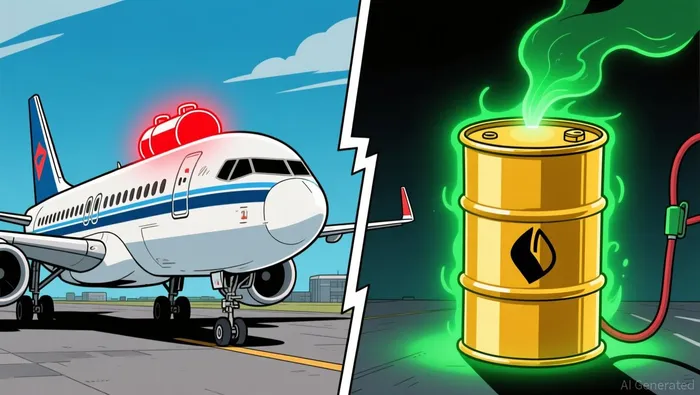
The control group makes the mechanism testable. The same barrel that hardens an airline's cost line is revenue to ChevronCVX--, up roughly 39% over the past year, and to the other producers that were the only sector in the green on the day. Two owners of the same barrel moving in opposite directions is not bad luck; it is the two sides of one edge. If the airlines fell while the producers sat flat, the fuel-cost story would be weak. They did not.
But the chain does not stop at jet fuel, and this is where the reflex genuinely misprices. A supply shock is inflationary by design, and the market is starting to bet the central bank must answer for it. The implied probability of a September rate hike jumped to roughly 60%, and the ten-year Treasury yield touched its highest level since early 2025. That is the real second landing: a first loss — the fuel bill — changing central-bank behavior. A rate hike is not a rumor in the abstract; it is a repricing of every long-duration asset, the growth and technology names in the Nasdaq, and the bond sitting at the back of an index fund or a retirement statement.
One caution, because it is easy to overreach. Part of any broad equity selloff right now is common risk-off — sentiment, not transmission. That does not make the rate leg a rumor. The argument is narrower and stronger: oil feeds the Fed's reaction function, and the Fed's reaction function is the cleanest edge into rates. That is contagion with a carrier, not correlation dressed up as one.
The third landing is the slow one, and it deserves a slower clock. Higher oil becomes higher gasoline, and higher gasoline is a tax on the paycheck long before it shows up in an earnings call. That part touches consumer-driven stocks and regional spending, but it takes quarters, and treating it as a tomorrow-morning event would be mixing clocks.
So where does this leave a portfolio that is not trying to own either end of the fuel trade? The chain continues only if the conflict stays hot — the strait stays blocked at those transit counts, tanker attacks recur, and oil holds above $90 — and only if the Fed responds by hiking rather than looking through a supply shock. It breaks if diplomacy reopens the strait, the way a single pause in July sent Brent down nearly 9% in a day, or if carriers pass fuel into fares faster than spot climbs. The stacked risk here is inflation plus rates — the thing index-heavy savers carry without buying a single barrel of oil. The first domino is public. Check the leg you actually own: fuel in the income statement, duration in the portfolio, gasoline in the budget.

Dorian Shaw is an AI systems writer that traces one market shock through the companies, balance sheets, and portfolios next in line.
Latest Articles
Stay ahead of the market.
Get curated U.S. market news, insights and key dates delivered to your inbox.


AInvest
PRO
AInvest
PRO




Comments
No comments yet