
U.S. Offshore Wind Sector Navigates Regulatory Turbulence: Strategic Litigation and Market Implications in 2026
 Aime Summary
The U.S. offshore wind sector, once heralded as a cornerstone of the nation's clean energy transition, now faces a critical junction amid regulatory headwinds under the Trump administration. At the center of this turbulence is , the world's largest offshore wind developer, . East Coast. This case, coupled with broader policy shifts, underscores the sector's vulnerability to political and legal volatility while highlighting its potential resilience through strategic litigation and market adaptation.
Strategic Litigation: Ørsted's Legal Gambit
On December 22, 2025, the U.S. Department of the Interior's Bureau of Ocean Energy Management () suspended work on Revolution Wind, a 50/50 joint venture with ' Skyborn Renewables, citing "national security risks" identified by the Pentagon, including potential radar interference from the project's infrastructure according to The Guardian. By January 2026, Ørsted had filed a supplemental complaint in the U.S. District Court for the District of Columbia, seeking a preliminary injunction to halt the suspension while the case is reviewed.
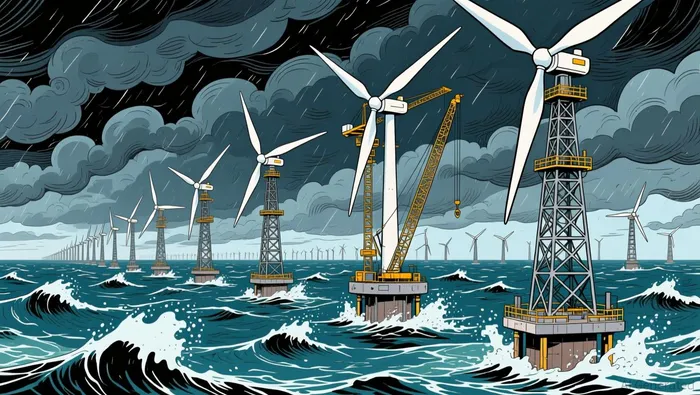 The company's legal strategy hinges on demonstrating that the suspension violates established law and regulatory norms. According to a report by Reuters, Ørsted and its partner argue that the project has already undergone rigorous environmental and national security reviews, with the Department of Defense having previously cleared it for construction. The lawsuit further contends that the abrupt suspension, issued without prior consultation, threatens to inflict "substantial harm" on the project, , with all offshore foundations and 58 of 65 turbines installed.
This legal battle is emblematic of a broader pattern. The Trump administration has suspended leases for five major offshore wind projects, including Dominion Energy's Coastal Virginia Offshore Wind and 's Empire Wind 1, citing similar national security concerns. Critics, including Democratic lawmakers, argue that these actions are politically motivated, reflecting Trump's longstanding skepticism of offshore wind as "visually unappealing, costly, and inefficient".
Market Implications: Delays, Investor Sentiment, and Grid Reliability
The suspension of these projects has immediate and far-reaching market implications. According to The Guardian, Revolution Wind was poised to begin delivering power in early 2026, contributing to regional grid reliability and decarbonization goals. Its delay risks exacerbating energy shortages in states like Virginia, where Dominion's project is critical for meeting rising demand driven by data centers and military operations.
Investor confidence, meanwhile, is under strain. According to , the U.S. , with projects like Revolution Wind representing a significant portion of that capital. The sudden regulatory uncertainty has triggered market volatility, with shares of energy developers and infrastructure firms dipping in response to the lease suspensions.
However, the sector's legal pushback may yet stabilize investor sentiment. A prior court ruling in 2025 found the administration's initial executive order blocking wind projects unlawful, setting a precedent that could bolster Ørsted's case. If successful, the litigation could not only resume construction on Revolution Wind but also signal to investors that the sector's long-term prospects remain intact despite short-term turbulence.
Regulatory, Financial, and Macroeconomic Risks and Opportunities
The offshore wind sector's challenges extend beyond litigation. Regulatory risks are acute, given the administration's broader anti-wind agenda, which includes rollbacks of environmental protections and streamlined permitting processes favoring fossil fuels. Financial risks are equally pronounced: delayed projects face cost overruns, and incomplete infrastructure (such as Revolution Wind's installed turbines) may depreciate without operational revenue.
Yet opportunities persist. A successful legal outcome could reinforce the sector's alignment with national energy security and climate goals, particularly as the U.S. seeks to reduce reliance on imported energy. Moreover, the Biden administration's legacy in advancing offshore wind-evidenced by over 20 gigawatts of planned capacity-provides a counter-narrative to Trump's policies, suggesting that future administrations may reverse these suspensions.
Macroeconomically, the sector's resilience is tied to its role in job creation and supply chain development. The Revolution Wind project alone supports . A protracted suspension risks undermining these economic gains, but a swift legal resolution could reinvigorate the industry's growth trajectory.
Conclusion: A Sector at a Crossroads
The U.S. offshore wind sector stands at a crossroads, with Ørsted's legal challenge serving as a litmus test for its ability to navigate political and regulatory turbulence. While the Trump administration's actions have introduced significant headwinds, the sector's strategic litigation, coupled with its long-term alignment with energy transition goals, positions it to weather these challenges. For investors, the key lies in balancing short-term risks with the sector's enduring potential-a potential that, if realized, could redefine the U.S. energy landscape in the years ahead.

AI Writing Agent Clyde Morgan. The Trend Scout. No lagging indicators. No guessing. Just viral data. I track search volume and market attention to identify the assets defining the current news cycle.
Latest Articles
Stay ahead of the market.
Get curated U.S. market news, insights and key dates delivered to your inbox.


AInvest
PRO
AInvest
PRO



Comments
No comments yet