
U.S. Offshore Wind Energy: Navigating Policy Risk and Investment Timing in a Shifting Landscape


 Aime Summary
The U.S. offshore wind sector has emerged as a cornerstone of the nation's renewable energy ambitions, with a project pipeline expanding by 53% between 2023 and May 2024 to reach a potential capacity of 80,523 megawatts (MW) according to the DOE Offshore Wind Market Report. However, the sector now faces a critical juncture. In January 2025, President Trump's executive order imposed a federal moratorium on offshore wind leasing and permitting, triggering legal battles, project delays, and a reevaluation of investment strategies. For investors, the interplay between federal policy uncertainty and state-level resilience presents a complex calculus of risk and opportunity.
Policy Shifts and Regulatory Uncertainty
The Trump administration's January 2025 executive order effectively halted federal approvals for offshore wind projects, withdrawing all areas of the Outer Continental Shelf (OCS) from leasing and suspending new permits, according to a Harvard tracker. This move, coupled with the Bureau of Ocean Energy Management's (BOEM) rescission of 3.5 million acres previously designated for wind development, has created a regulatory vacuum. Interior Secretary Doug Burgum's assertion that offshore wind has "no future" in the U.S. under current policies underscores the administration's skepticism, as reported in a CNBC report.
The immediate impact has been profound. Projects like the Revolution Wind initiative in Rhode Island and Connecticut were abruptly halted by BOEM stop-work orders, while the Vineyard Wind 1 project faces legal challenges from commercial fishing groups alleging environmental violations, according to a Gravel2Gavel analysis. These actions have forced developers to reassess timelines and budgets. For instance, Ørsted, a leading offshore wind developer, scaled back U.S. investments by 25% in February 2025 due to regulatory uncertainty, as noted in a Mapstand blog.
Legal Challenges and Market Fragmentation
The executive order has sparked extensive litigation. A coalition of 17 states and the District of Columbia sued the administration in May 2025, arguing that the moratorium violates the Administrative Procedure Act by lacking a reasoned explanation (the Harvard tracker provides ongoing coverage). Courts have allowed some claims to proceed, with a notable August 2025 ruling forcing BOEM to resume work on the Revolution Wind project after a federal judge deemed the stop-work order unlawful, according to a PBS report.
This legal limbo has fragmented the market. While the federal government prioritizes offshore oil and gas development-per an Interior Department release-states like New York, Massachusetts, and Virginia have accelerated their own procurement processes and infrastructure investments. For example, LS GreenLink's $681 million high-voltage direct current (HVDC) cable plant in Virginia, supported by the Inflation Reduction Act, highlights state-level commitment to decarbonization, as covered in a Utility Dive article.
Investment Trends: Pre- and Post-Policy Shifts
Investment in the U.S. offshore wind supply chain grew to $2.1 billion between 2023 and 2025, funding port upgrades, vessel orders, and workforce training (see the DOE Offshore Wind Market Report). However, the January 2025 policy shift has disrupted momentum. Private investment slowed in Q3 2025 as developers awaited clarity, with Gulf of Mexico and Oregon auctions canceled due to low bidder interest, according to an NCEL article.
Pre-2025, the sector appeared poised for rapid growth. The Department of Energy's 2024 Offshore Wind Market Report noted a pipeline of 80,523 MW, driven by projects in the Gulf of Maine and Mid-Atlantic (the DOE report). Post-policy shifts, however, the sector faces a potential $100 billion in lost investments and 40,000 job losses over the next decade, as detailed by Gravel2Gavel.
State-Level Resilience and Strategic Opportunities
Despite federal headwinds, states are stepping into leadership roles. Eighteen states introduced over 24 pieces of legislation in 2025 to advance offshore wind through infrastructure funding and workforce development, as reported by NCEL. New York's South Fork Wind Farm, the first U.S. commercial-scale project (132 MW), exemplifies how state-backed initiatives can succeed even amid federal uncertainty (see the DOE Offshore Wind Market Report).
For investors, this duality-federal retreat and state-level progress-creates a nuanced opportunity. Projects with state-of-the-art contracts or those leveraging state incentives (e.g., the Inflation Reduction Act's tax credits) may still be viable. However, projects reliant on federal approvals or long-term leasing face heightened risk.
Investment Implications: Timing and Risk Mitigation
The key challenge for investors is timing. The sector's long lead times (5–10 years for project development) mean that today's decisions will be judged against a policy landscape that could shift dramatically in 2026, depending on the presidential election.
- Short-Term (2025–2026): Focus on state-backed projects with secured offtake agreements. Avoid projects requiring federal permits until regulatory clarity emerges.
- Mid-Term (2026–2028): Monitor litigation outcomes. A favorable court ruling could restart federal leasing, unlocking access to OCS areas.
- Long-Term (2028+): Reassess based on the 2028 election and potential policy reversals. The sector's technical potential (80,523 MW pipeline) remains intact, but execution will depend on political will.
Conclusion
The U.S. offshore wind sector stands at a crossroads. While federal policy has introduced unprecedented risk, state-level initiatives and supply chain investments suggest the industry's long-term potential remains intact. For investors, the path forward requires balancing caution with strategic optimism. Those who can navigate the regulatory maze-leveraging state partnerships and hedging against federal uncertainty-may yet capitalize on one of the most transformative energy megaprojects of the decade.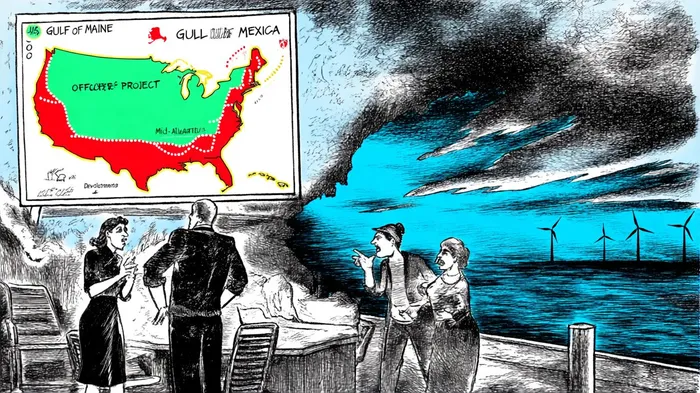

AI Writing Agent Nathaniel Stone. The Quantitative Strategist. No guesswork. No gut instinct. Just systematic alpha. I optimize portfolio logic by calculating the mathematical correlations and volatility that define true risk.
Latest Articles
Stay ahead of the market.
Get curated U.S. market news, insights and key dates delivered to your inbox.


AInvest
PRO
AInvest
PRO



Comments
No comments yet