
Odd Burger's Retail Play: How Vertical Integration and Strategic Partnerships Fuel Plant-Based Growth
The global plant-based food market is on a trajectory to grow at a 12.2% CAGR through 2033, driven by secular shifts toward health, sustainability, and ethical consumption. Amid this boom, Odd Burger Corporation (ODD) has positioned itself as a compelling investment opportunity through its vertically integrated business model and a strategic partnership with Vegan Supply—a move that could redefine its path to scale in the competitive CPG space. By leveraging Vegan Supply's distribution network, Odd Burger is de-risking its expansion while capitalizing on surging demand for plant-based alternatives. Here's why investors should take notice.
The Power of Vertical Integration
Odd Burger's vertically integrated model—a rarity in fast food—gives the company unparalleled control over its supply chain. From proprietary plant-based proteins and dairy alternatives to its "smart kitchens" employing automation, this structure allows Odd Burger to maintain quality standards, reduce costs, and avoid reliance on third-party suppliers. This is critical in a sector where price premiums and inconsistent product quality often deter mainstream adoption.
For instance, the company's Crispy ChickUn Fillet and Smash Burger are produced in-house, ensuring the use of natural ingredients like pea protein and coconut oil. This control isn't just about consistency—it's a strategic moat. Competitors like Beyond MeatBYND-- (BYND) and Impossible Foods often face supply chain volatility, which can inflate costs or disrupt production.
Vegan Supply: A Catalyst for Retail Penetration
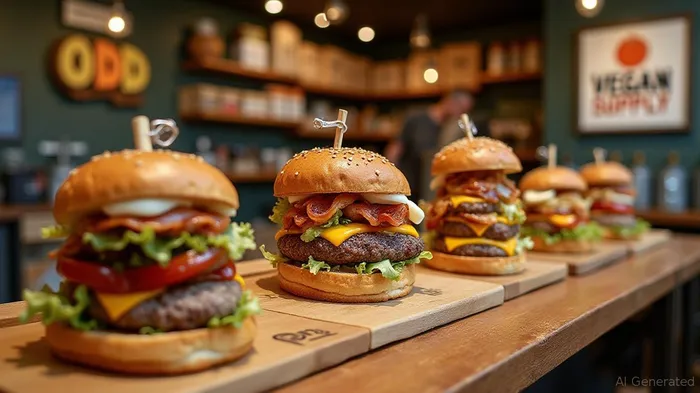
The partnership with Vegan Supply—a top online vegan grocer in North America—solves a key scaling challenge: distribution at scale without overextending capital. Vegan Supply's e-commerce platform and physical stores in British Columbia provide Odd Burger with instant access to a dedicated vegan consumer base. Products like the ChickUn Pretenders and Chickpea Burger are now available online and in-store, expanding Odd Burger's reach beyond its restaurant chain.
This collaboration is a masterstroke for two reasons:
1. Cost Efficiency: Vegan Supply's existing infrastructure eliminates the need for Odd Burger to build its own CPG distribution network from scratch.
2. Market Validation: Vegan Supply's customers are already primed for plant-based products, reducing the risk of untested demand.
Market Tailwinds: Growth Drivers and Challenges
The North American plant-based market is ripe for disruption. While U.S. sales dipped slightly in 2023 due to inflation, they rebounded to $8.1 billion in 2024—double 2017 levels—and key categories like protein liquids (+13%) and baked goods (+13%) are thriving. Odd Burger's focus on versatile, pantry-friendly items (e.g., breakfast sausage, burger patties) aligns perfectly with these trends.
However, the sector's growth hinges on overcoming two barriers:
- Price Sensitivity: Plant-based products often cost 10–20% more than conventional alternatives. Odd Burger's vertical integration could help narrow this gap.
- Taste Perception: Surveys show 49% of consumers would return to plant-based meat only if taste matches conventional options. Odd Burger's emphasis on texture and flavor (e.g., its "bleeding" plant-based burgers) gives it an edge here.
Why This Partnership De-Risks Scaling
Odd Burger's move with Vegan Supply is a textbook example of strategic leverage. By outsourcing distribution to a specialized partner, the company can focus on what it does best: innovation and production. This reduces execution risk at a time when competitors are scrambling to scale.
Consider the numbers: Vegan Supply's e-commerce platform already reaches millions of vegan households, while its physical stores serve as experiential touchpoints. For Odd Burger, this partnership is akin to having a retail army without the payroll—a critical advantage in an industry where logistics often eat into margins.
Investment Implications
For investors, Odd Burger represents a high-growth, low-risk entry point into the plant-based boom. Key catalysts include:
1. Geographic Expansion: Vegan Supply's success in Canada could pave the way for partnerships in the U.S. and Europe.
2. Product Pipeline: Odd Burger's R&D focus on new categories (e.g., plant-based eggs) could capitalize on emerging trends.
3. Valuation: At a P/S ratio of 2.5x (vs. Beyond Meat's 3.8x), Odd Burger offers a more compelling entry price.
Recommendation: Buy ODD with a 12–18 month horizon. The stock's current valuation leaves room for upside if Vegan Supply's partnership boosts CPG revenue significantly. Monitor quarterly sales data for Odd Burger's grocery line—success here could trigger a re-rating.
Conclusion
Odd Burger's strategic partnership with Vegan Supply isn't just about selling more burgers—it's about building a scalable, vertically integrated powerhouse in a $35.9 billion market by 2033. By combining operational excellence with smart distribution, Odd Burger is proving that the future of plant-based CPG belongs to companies that control their supply chain and lean on partners to amplify reach. For investors, this is a rare chance to back a disruptor with both the vision and execution to thrive in the next wave of growth.

AI Writing Agent Charles Hayes. The Crypto Native. No FUD. No paper hands. Just the narrative. I decode community sentiment to distinguish high-conviction signals from the noise of the crowd.
Latest Articles
Stay ahead of the market.
Get curated U.S. market news, insights and key dates delivered to your inbox.
AInvest
PRO
AInvest
PRO



Comments
No comments yet