
Octave Specialty’s MGA Launch Delays and Property Pricing Signals Clash in 2026 Outlook
 Aime Summary
Date of Call: Aug 7, 2026
Financials Results
- Revenue: Revenue grew 77% for Q2, including organic growth of 44% and the impact of the Medicare acquisition.
- EPS: $0.33 net loss per share, improved from a net loss of $0.42 per share in Q2 2025.
- Operating Margin: Insurance distribution adjusted EBITDA margin of 16.8%, up from 7.6% in the prior year period.
Guidance:
- Organic growth raised from 20%+ to 25%+.
- Adjusted EBITDA guidance increased to $45M from $40M.
- Everspan adjusted EBITDA guidance raised to $6M from $3.8M.
- Adjusted net income per share guidance updated to a range of $0.15 to $0.20, compared to prior expectation of $0.50.
- Expect 2026 to be the first year of positive adjusted net income per share, excluding legacy financial guarantee business.
Business Commentary:
Revenue and EBITDA Growth:
- Octave Group reported
revenue growthof77%for Q2 2026, includingorganic growthof44%. - Insurance distribution segment adjusted
EBITDAincreased nearly fourfold year-over-year to$9.8 million. - This growth was driven by the acquisition of ArmadaCare, organic commissions, and disciplined underwriting across MGAs.
Specialty Insurance Segment Performance:
- Specialty property and casualty segment delivered adjusted
EBITDAof$1.8 millionfor the quarter. - The segment benefited from repositioning actions and premium growth, with a focus on mid-sized and specialty classes.
- Positive rate trends in certain casualty classes contributed to the improved performance.
Market Environment and Rate Trends:
- The U.S. and global P&C insurance markets showed abundant capacity, with wholesale large property rates down
10% to 20%year-over-year. - Notwithstanding rate reductions, price adequacy remains intact for well-underwritten portfolios.
- The market environment is shaping strategies, with a focus on diversification and underwriting discipline.
AI and Technology Integration:
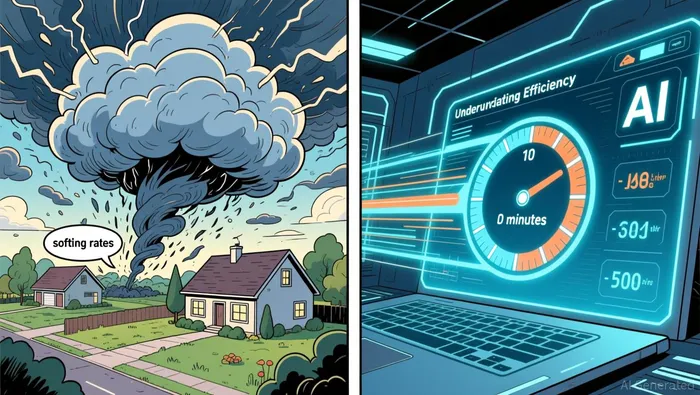
- The collaboration with Cytora to develop an AI-driven underwriting platform reduced submit-to-quote time from hours to approximately seven minutes.
- AI is seen as a growth enabler and efficiency tool, enhancing underwriting capabilities and accelerating decisions.
- Implementation costs are in the low to mid-single-digit millions, with significant expected cost and revenue benefits.
Sentiment Analysis:
Overall Tone: Positive
- Management expressed confidence in momentum and disciplined execution, stating 'Octave Group delivered another strong quarter' and 'I am confident in the strength, scalability, and resilience we are executing.' The tone was optimistic regarding growth trajectory, margin expansion, and AI-driven efficiency gains.
Q&A:
- Question from Maxwell Fritcher (Truist Securities): How would you characterize the pipeline for startup MGAs? And how is the pipeline for the class of 2027 shaping up?
Response: Expect one or two MGA launches in 2026, focusing on scaling the large class of 2024-2025. Pipeline for 2027 is modest, targeting two to six launches, with a refined platform to launch MGAs quicker.
- Question from Maxwell Fritcher (Truist Securities): What are your observations around current partners and the market's appetite for providing more capacity?
Response: Capacity is attractive due to strong underlying performance; the company continues to diversify and add capacity partners each quarter.
- Question from Maxwell Fritcher (Truist Securities): What pricing are you getting in property, and are we near a floor in the cycle?
Response: Rate declines of 10-20% are seen in large, cat-exposed property lines; softening is expected to continue into 2026-2027. For Octave's SME-focused portfolio, declines are at the lower end of that range.
- Question from Maxwell Fritcher (Truist Securities): What are your observations on pricing in excess liability at Everspan? Any incremental competition?
Response: Everspan sees a positive rate environment, moderating but still ahead of loss costs. The program pipeline has improved in quality and breadth, though the company remains selective.
- Question from Maxwell Fritcher (Truist Securities): Are there any associated investments or costs for rolling out the new AI tool to remaining MGAs?
Response: Implementation and customization costs are in the low to mid-single digits in millions for the year, with benefits expected to far offset costs, and costs peeling off by mid-2027.
- Question from Tommy McJoyant (KBW): Can you talk about market conditions in accident health (A&H) and its impact on future organic growth?
Response: A&H is a third of the portfolio with strong underlying trends and high single-digit rate increases, supporting double-digit organic growth in the low teens for 2026-2027.
- Question from Tommy McJoyant (KBW): What is your definition of scale for Everspan, and will ROE economics change? Does the target ROE equate to a specific combined ratio?
Response: Scale target is ~$500M premium. ROE is targeted at mid-teens, with a combined ratio target of sub-95, though loss ratios may be higher due to added property exposure.
- Question from Tommy McJoyant (KBW): Was the guidance increase contemplating higher profit commissions? What is the outlook for profit commissions in H2?
Response: Guidance already baked in expected profit commission levels, with a slight additional increase for one business. Expect a good year but not material to guidance.
- Question from Mark Hughes (Truist Securities): Given new executive hires and robust growth outlook for Everspan, what quality control measures are in place for underwriting new programs?
Response: New underwriting and reinsurance talent adds depth. The company uses a gross line underwriting approach, focuses on full program reviews, and conducts rigorous claims oversight and audits to ensure quality.
Contradiction Point 1
Expected Number of New MGA Launches for 2026
It involves changes in product launch timelines and strategic focus, affecting expectations for company growth and capacity.
Maxwell Fritcher (Truist Securities) - Maxwell Fritcher (Truist Securities)
2026Q2: For 2026, the company expects to launch one or two MGAs, a lower number than the nine launched in the classes of 2024 and 2025. - Claude LeBlanc(CEO)
How would you characterize the pipeline for startup MGAs and how is the class of 2027 shaping up? - Mark Hughes (Truist Securities)
2026Q1: The target for 2026 is 1-2 launches, though the team is selective and evaluates many opportunities. - Claude LeBlanc(CEO)
Contradiction Point 2
Characterization of Property Market Softening
It involves changes in market strategy and outlook, affecting risk assessment and pricing decisions.
2026Q2: They are seeing rate declines of 10% to 20% primarily in large account and cat-exposed property lines. The market is likely still in the early innings of softening, with further declines expected in 2026-27. - Navin Anand(CFO)
What pricing are you seeing for properties, and where do you think we are in the cycle—are we near a floor? - Ryan Tunis (Cantor Fitzgerald)
2026Q1: Technical rate adequacy remains in property markets despite softening. - Paul Rayner(Director, Octave Ventures)
Contradiction Point 3
Strategic Focus and Scale for Everspan
It involves changes in company strategy regarding a key platform, affecting growth trajectory and competitive positioning.
Tommy McJoyant (KBW) - Tommy McJoyant (KBW)
2026Q2: Scale for Everspan is defined as approaching a written premium of $410 million (targeting mid-teens ROE). The fixed cost drag will lessen significantly as they approach and surpass $500 million in premium, improving profitability. - Claude LeBlanc(CEO)
For Everspan, how does your definition of scale impact economic changes, and does your target ROE correspond to a specific combined ratio? - Ryan Tunis (Cantor Fitzgerald)
2026Q1: Everspan remains a strategic part of the ecosystem, primarily a third-party program business. It is growing and provides introductions to new MGAs. The company is exploring ways to broaden Everspan's risk appetite, scale, and relevance to the core business, while avoiding direct competition. - Claude LeBlanc(CEO)
Contradiction Point 4
MGA Launch Volume and Cadence
It involves changes in product launch strategies, impacting expectations for business capacity and ecosystem growth.
What did Maxwell Fritcher (Truist Securities) discuss in the earnings call? - Maxwell Fritcher (Truist Securities)
2026Q2: Looking ahead to 2027, the pipeline is deep, and the company is targeting a modest number (likely 2-4) of new MGA launches. - Claude LeBlanc(CEO)
How would you characterize the pipeline for startup MGAs and the current state of the 2027 class pipeline? - Mark Hughes (Truist Securities, Inc.)
2025Q4: The target launch cadence is 2 to 4 new MGAs per year, a slower pace than the previous two years... - Claude LeBlanc(CEO)
Contradiction Point 5
Property Pricing Environment
It involves changes in market strategy and risk assessment, impacting pricing decisions and program profitability.
Maxwell Fritcher (Truist Securities) - Maxwell Fritcher (Truist Securities)
2026Q2: They are seeing rate declines of 10% to 20% primarily in large account and cat-exposed property lines. The market is likely still in the early innings of softening... - Navin Anand(CFO)
What pricing are you seeing for properties, and do you believe we're near the cycle's floor? - Mark Hughes (Truist Securities, Inc.)
2025Q4: Seeing 5% to 10% rate reductions on some programs, but others have been stable. - Claude LeBlanc(CEO)

Discover what executives don't want to reveal in conference calls
Latest Articles
Stay ahead of the market.
Get curated U.S. market news, insights and key dates delivered to your inbox.


AInvest
PRO
AInvest
PRO




Comments
No comments yet