
The Oceanic Alliance: How South Korea and India Are Charting a New Course in Global Shipbuilding
The $200 billion global shipbuilding market is on the cusp of a seismic shift. A strategic partnership between South Korea's HD Hyundai and India's Cochin Shipyard Limited (CSL) is merging cutting-edge technology with cost-efficient labor, positioning the duo to challenge China's dominance and redefine maritime manufacturing. This alliance, anchored in geopolitical ambition and economic pragmatism, offers investors a front-row seat to a transformative industry realignment.
The Strategic Partnership: A Marriage of Technology and Cost Efficiency
The 2024 MoU between HD Hyundai and CSLCSL-- marks a paradigm shift in shipbuilding collaboration. South Korea brings decades of expertise in constructing high-value vessels like LNG carriers and eco-friendly ships, while India leverages its low labor costs and strategic geographic position in the Indian Ocean. The partnership's cornerstone is Cochin Shipyard's new 310-meter drydock—a state-of-the-art facility capable of handling large commercial vessels—paired with plans for a ₹100 billion ($1.17 billion) joint venture shipyard in Thoothukudi, Tamil Nadu. 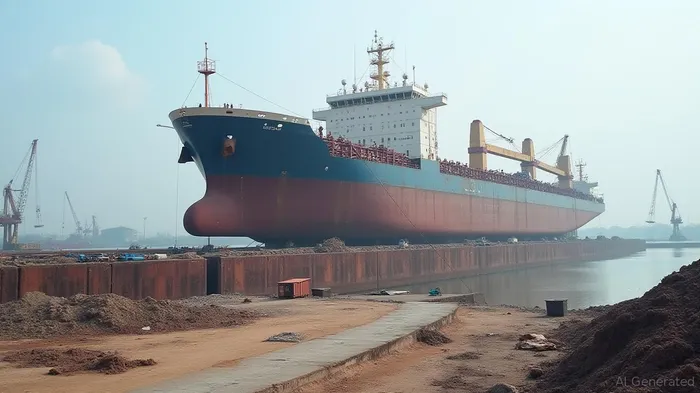
The Thoothukudi project, if finalized, would specialize in building Very Large Crude Carriers (VLCCs) and other high-tonnage ships, directly addressing India's long-term goal of becoming a top-10 shipbuilder by 2030. Meanwhile, HD Hyundai's technical know-how—from advanced propulsion systems to digital ship design—is being transferred to CSL's workforce through joint training programs. This synergy reduces production costs while elevating India's technical capabilities, creating a formidable competitive edge.
Technological Synergy Driving Market Share Gains
South Korea currently leads in high-margin segments like LNG carriers, holding 80% of global orders in 2024. Yet China's 62.9% global order share in 2024 highlights its dominance in low-margin bulk carriers. The HD Hyundai-CSL partnership aims to bridge this gap by combining South Korea's premium technology with India's cost advantages.
For instance, an LNG carrier built at the Thoothukudi shipyard could cost 15–20% less than a comparable vessel from South Korea alone, while still meeting global emissions standards. This pricing power could lure buyers in emerging markets, where affordability is critical. Additionally, CSL's existing projects—such as India's Indigenous Aircraft Carrier—demonstrate its ability to handle complex, high-tech vessels, a capability now fortified by HD Hyundai's expertise.
Geopolitical Leverage and Regional Influence
Beyond economics, this alliance is a geopolitical masterstroke. India's “Make in India” initiative and its push to reduce reliance on Chinese manufacturing align perfectly with the partnership. By establishing Kochi as a hub for ship repair and fabrication—complemented by a 2025 MoU with Dubai's Drydocks World—the region becomes a linchpin for maritime logistics in the Indian Ocean.
This infrastructure also serves strategic interests. A robust Indian shipbuilding sector reduces New Delhi's dependence on foreign warship imports, while enhancing its influence in regional trade corridors. For South Korea, the partnership secures a foothold in Asia's fastest-growing economy, countering China's Belt and Road Initiative and deepening ties with a democratic ally.
Implications for Competitors and the Supply Chain
The ripple effects are already evident. China's shipyards, though cost-competitive, risk losing market share to India-South Korea's hybrid model. Meanwhile, Japan—a traditional rival—is accelerating its own partnerships, such as JMU's collaboration with India's GRSE.
Supply chains are also evolving. Korean shipbuilders may outsource lower-margin work to India, freeing up capacity for high-end projects. This division of labor could streamline global shipbuilding, reducing delivery times and lowering costs for customers. For investors, this dynamic creates opportunities in both shipyards (e.g., CSL's equity) and maritime infrastructure stocks, as ports and repair facilities expand.
Investment Opportunities: Where to Look?
- HD Hyundai (KRX: 011070): The company's stock has risen 28% since 2022 as it diversifies into green shipping. The Thoothukudi joint venture could unlock further upside if finalized, especially in LNG and eco-friendly ship segments.
- Cochin Shipyard Limited (CSL): While CSL's public listing is pending, its role as India's flagship shipbuilder positions it to benefit from government subsidies like the ₹25,000 crore Maritime Development Fund. Investors should monitor its progress in exporting to the UAE, Norway, and the Netherlands.
- Maritime Infrastructure: Port operators and ship repair firms in India's southern states (e.g., DP World's Kochi terminal) could see demand surge as the region becomes a repair hub for vessels transiting the Indian Ocean.
Challenges Ahead
Labor shortages in South Korea—where 14,000 workers are needed annually—remain a hurdle. HD Hyundai's collaboration with Seoul National University to train engineers offers a partial solution, but delays in the Thoothukudi project could strain investor confidence. Additionally, China's aggressive pricing tactics and subsidies may limit market share gains in the short term.
Conclusion
The HD Hyundai-CSL alliance is more than a business deal—it's a blueprint for reshaping global shipbuilding. By marrying South Korea's tech prowess with India's cost efficiency and geopolitical clout, the partnership is poised to capture a growing slice of the $200 billion market. For investors, this presents a rare opportunity to capitalize on a sector primed for consolidation and innovation. As the Indian Ocean becomes the new epicenter of maritime manufacturing, the tide is turning in favor of this oceanic alliance.

Stay ahead of the market.
Get curated U.S. market news, insights and key dates delivered to your inbox.


AInvest
PRO
AInvest
PRO



Comments
No comments yet