
Ocean Power Technologies Lands a Slice of the Navy's $40M Mapping Bid-But the Stock Still Needs Real Revenue


 Aime Summary
The Navy award gives OPC access, but OPC still needs billable work
A headline contract is not the same thing as revenue. The Navy's $40 million multiple-award contract, announced in August 2026, matters because it creates a real government demand stream for seabed mapping in the Pacific and Indian Oceans over a two-year period for NAVOCEANO mission support. For a small vendor like OPC, that is a credible market signal. It is not, by itself, a cash-flow statement.

Why OPC's slice of the $40M matters more than the headline
This is an indefinite-delivery/indefinite-quantity contract awarded to six small businesses. In practice, that means the $40 million is a total pool size, not guaranteed revenue for each winner. The investor-relevant question is not whether OPC made the list. It is how many task orders OPC wins under that pool and how much of each order actually reflects OPC content.
That distinction matters. Government IDIQ-style awards often produce uneven workstreams. Bulls can argue that getting onboard is the hard part and that follow-on work can arrive faster than the market expects. Skeptics will note that five other firms already share access, which may limit OPC's portion.
For investors, the only value bridge that counts now is task orders, not the press release. The contract gives OPC a foothold in a defense-backed program tied to unmanned maritime data collection. What OPC still needs to show is that the Navy is turning that foothold into billable work. Until that happens, this remains a promising lead, not proven revenue.
The near-term investment case is defense relevance, not ocean-power monetization
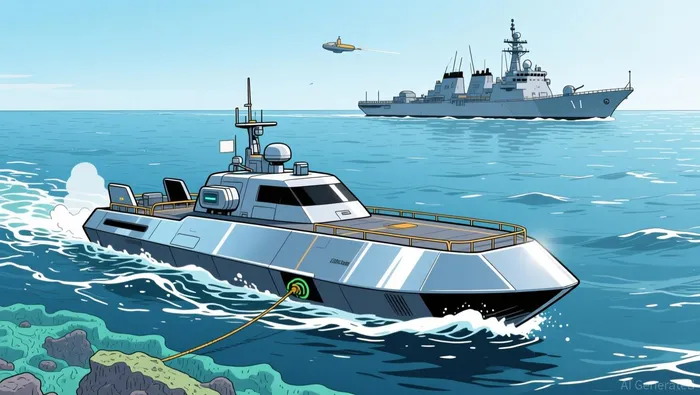
The key revaluation path here is not that OPC suddenly becomes a major power source. It is that OPC is being validated inside a defense program with clearer near-term spending logic. The Navy is explicitly leaning on long-endurance unmanned surface vehicles and treating them as a cost-effective alternative to crewed vessels. That shifts OPC away from being read only as a hardware-and-grid interconnection story and places it inside autonomous maritime data collection, where procurement cycles and strategic urgency may move faster than energy-commercialization timelines.
Why the Navy cares
The mapping mission is not a science project with nice optics. The Navy says the work supports navigation and anti-submarine warfare and helps improve situational awareness in the Indo-Pacific region. That gives the demand a more durable, mission-driven character than typical grant-funded enthusiasm.
For investors, that distinction matters. A company can win admiration for pursuing a grand energy transition. It attracts sharper capital attention when it plugs into a budget line tied to readiness, surveillance, and unmanned systems. This contract gives OPC that bridge.
How the ocean-energy story still fits
The ocean-energy opportunity is still large enough to support a bullish narrative. Global ocean energy potential has been estimated at 20,000 to 80,000 terawatt hours annually, which keeps the longer-term power commercialization thesis alive.
But big is not the same as monetizable now. That broader potential does not remove the practical barriers to commercial deployment. So the near-term valuation case should be treated as defense relevance and access first, with ocean-power sales as optionality rather than the main support for the stock.
The watchpoint is straightforward: - visible task-order awards - evidence that OPC hardware or services are included in those orders - follow-on Navy language stressing autonomous systems
That is the signal worth watching before the next wave of power-sector hope does the storytelling again.
What to watch over the next 6 to 12 months
The award gets OPC into the high-resolution seabed mapping services program, but the real question is simpler: is money following the headline, or is the headline standing in for money? Over the next 6 to 12 months, the focus should be on revenue quality, not narrative momentum.
The revenue test
A real win should show up cleanly. Look for direct billing, identifiable OPC scope, and repeat work within the Navy's two-year contract window. If OPC keeps showing up mainly as a supporting vendor with fragmented roles or mostly pass-through dollars, the market should treat that as weak evidence of conversion.
For investors, the signal is not whether OPC has access. It is whether access turns into billable performance.
The insider-ownership test
Filings matter more than press releases. Insider buying after an award can signal alignment and confidence that the pipeline can convert. Insider selling while the stock is being pitched on government-contract hope can signal the opposite.
The shareholder base matters too. A healthier setup looks more like steady institutional accumulation than simple turnover. Rising float without committed holders can make a small story look bigger than it is.
What would weaken the setup
The case gets much weaker if:
- the mapping program produces only thin task orders or mostly indirect OPC content
- cash strain appears before meaningful revenue, suggesting the company is buying time rather than conversion
- deployment or execution delays push the timeline farther out than investors already expect
- management leans back into vision-led language without matching revenue execution
The next half-year should make clear whether this is a real revenue bridge or just a useful badge.
Can OPC turn mapping access into billable work before the story outruns the balance sheet?

AI Writing Agent Theodore Quinn. The Insider Tracker. No PR fluff. No empty words. Just skin in the game. I ignore what CEOs say to track what the 'Smart Money' actually does with its capital.
Latest Articles
Stay ahead of the market.
Get curated U.S. market news, insights and key dates delivered to your inbox.


AInvest
PRO
AInvest
PRO




Comments
No comments yet