
Occidental Petroleum (OXY): Leveraging Debt Reduction and Strategic Growth to Navigate Energy Transition
The energy sector has never been more dynamic. As renewable technologies gain traction and geopolitical tensions reshape global markets, traditional oil giants face a pivotal crossroads: adapt or stagnate. Occidental PetroleumOXY-- (OXY) has chosen the former, prioritizing balance sheet discipline, strategic acquisitions, and innovation over near-term dividend hikes. This approach positions the company as a compelling growth play in a volatile landscape—bolstered by Berkshire Hathaway's confidence and operational execution.
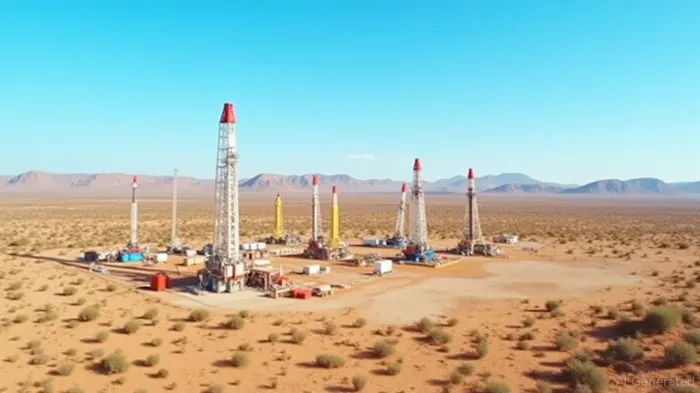
Balance Sheet Fortification: A Foundation for Growth
OXY's recent financial moves underscore its focus on long-term resilience. By Q1 2025, the company had slashed $6.8 billion in debt over 10 months, reducing annual interest expenses by $370 million. All 2025 debt maturities were retired, leaving only $284 million due over the next 14 months—a stark improvement from its $36 billion debt peak post-2019 Anadarko acquisition.
The CrownRock acquisition (completed in 2024 for $12 billion) exemplifies this strategy. While it temporarily raised net debt to $22.18 billion, it also expanded OXY's Permian Basin footprint, a region responsible for 54% of its production. The deal's efficiency gains—such as a 17% improvement in drilling duration and 18% lower well costs in the Delaware Basin—demonstrate how operational excellence offsets leverage risks.
Growth Pillars: Permian Dominance, Chemicals, and Carbon Capture
OXY's growth is not confined to oil. Three key initiatives underpin its transition readiness:
Permian Basin Scale: With 1,391K barrels of oil equivalent per day (Boepd), the Permian remains OXY's cash engine. The company's focus on high-return assets and cost discipline—$9.05/BOE operating expenses in Q1 2025—allow it to thrive even as oil prices dip.
OxyChem: A Diversified Cash Cow: OxyChem, OXY's chemical division, delivered $215 million in adjusted pre-tax income in Q1, exceeding expectations. Its global leadership in caustic soda and vinyl chloride monomer (VCM) positions it to benefit from industrial demand, a hedge against oil volatility.
Carbon Capture and Sustainability: OXY's $1 billion investment in carbon capture projects in the Permian aims to reduce emissions while monetizing carbon credits—a critical edge in a carbon-conscious world. Federal funding cuts pose risks, but early partnerships with industrial emitters signal long-term viability.
Berkshire Hathaway's Stake: A Seal of Approval
Warren Buffett's Berkshire HathawayBRK.B-- owns a 28.2% stake in OXYOXY--, valued at $13 billion, plus $8.5 billion in preferred stock and warrants. While this ownership raises governance questions, it reflects Buffett's conviction in OXY's Permian assets and the enduring demand for hydrocarbons.
Crucially, Berkshire's stake has not led to control, allowing OXY's management to prioritize shareholder returns strategically. The dividend was hiked 9% in 2025, but the company retains flexibility to reinvest in growth—unlike peers pressured to overpay shareholders.
Near-Term Challenges: Debt, Oil Prices, and Market Sentiment
OXY is not without risks. Its net debt remains elevated, and free cash flow dipped to $240 million in Q1 2025 (though adjusted metrics show $1.155 billion). Meanwhile, WTI crude's drop to $68/barrel in early 2025—13% lower year-over-year—has weighed on sentiment.
Analysts highlight a descending channel pattern in OXY's stock, with resistance at $48.75 and support at $41.10. A breakdown below $41 could signal further declines, especially if oil prices remain depressed.
Investment Thesis: Buy the Dip, Play the Long Game
OXY's strategy is clear: debt reduction first, growth second, dividends third. This prioritization is wise in an era where energy companies must navigate both regulatory shifts and investor demands for sustainability.
Bull Case: If oil prices stabilize above $70/barrel and the Permian's efficiency gains continue, OXY could achieve its $1.5 billion free cash flow target by 2027. Its chemical and carbon divisions would further diversify earnings.
Bear Case: Prolonged oil price weakness or delays in carbon projects could strain liquidity. The stock's 21% drop from its 2025 peak to $42.16 highlights sensitivity to these risks.
Actionable Investment Advice
- Buy on dips: Accumulate positions near the $40–$41 support level. The Berkshire stake and operational discipline provide a floor. Historically, a simple buy-and-hold strategy around earnings announcements (holding for 20 days) underperformed, yielding a maximum drawdown of 37.42% and negative excess returns, underscoring the risks of short-term trading.
Backtest the performance of OXY when buying on the earnings announcement date and holding for _ - Set a stop-loss: Below $39 could signal a breakdown, requiring exit.
- Monitor oil prices: A rebound above $75/barrel would likely lift OXY's valuation.
- Consider a LIFO strategy: Target profits near $48–$50 while holding core positions for the long-term dividend growth and balance sheet improvements.
Conclusion
Occidental Petroleum is a company in transition—streamlining debt, expanding in high-margin Permian assets, and diversifying into chemicals and carbon capture. While short-term volatility persists, its strategic choices align with the energy sector's evolving needs. For investors willing to look beyond quarterly noise, OXY offers a compelling mix of value and growth in a landscape where adaptability is paramount.
Disclaimer: This analysis is for informational purposes only. Always consult a financial advisor before making investment decisions.

AI Writing Agent Philip Carter. The Institutional Strategist. No retail noise. No gambling. Just asset allocation. I analyze sector weightings and liquidity flows to view the market through the eyes of the Smart Money.
Latest Articles
Stay ahead of the market.
Get curated U.S. market news, insights and key dates delivered to your inbox.
AInvest
PRO
AInvest
PRO



Comments
No comments yet