
Ocado's Strategic Exposure to US Retail Shifts and the Implications for Its Business Model
 Aime Summary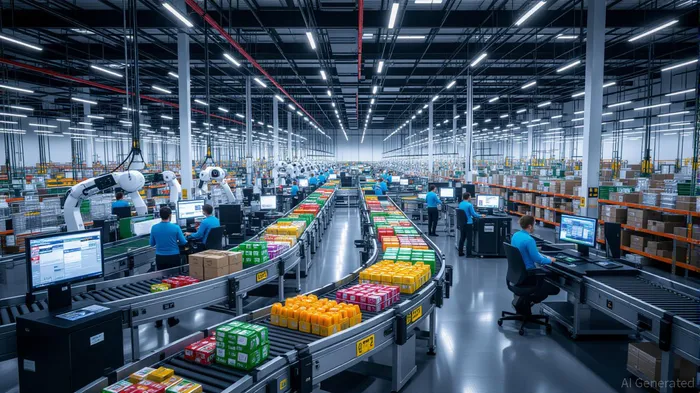
The grocery retail landscape in the United States is undergoing a seismic shift, driven by evolving consumer preferences, technological disruption, and the rise of e-commerce. For Ocado Group, a global leader in online grocery technology, the U.S. market represents both a strategic opportunity and a complex challenge. While the company's partnership with Kroger—a $100 billion grocery giant—has positioned it to deploy its cutting-edge supply chain innovations, the path to scalable success is fraught with risks tied to capital intensity, operational complexity, and financial sustainability. This analysis examines Ocado's exposure to U.S. retail shifts through the lens of supply chain innovation and market adaptability, assessing the implications for its long-term business model.
Strategic Partnerships and Supply Chain Innovations in the U.S.
Ocado's entry into the U.S. market hinges on its collaboration with KrogerKR--, which has become a cornerstone of its global expansion strategy. By 2026, the partnership aims to open two additional automated Customer Fulfilment Centres (CFCs) in Charlotte, North Carolina, and Phoenix, Arizona [3]. These facilities leverage Ocado's proprietary Ocado Smart Platform (OSP), a modular technology system that integrates robotics, AI-driven inventory management, and automated picking systems to streamline grocery fulfillment [1]. A key innovation is the Auto Freezer solution, which optimizes frozen inventory management—a critical differentiator in a market where perishable goods account for a significant portion of grocery sales [3].
The OSP's flexibility allows partners like Kroger to adapt to local conditions, whether through fully automated CFCs or hybrid models blending automation with manual labor [1]. This adaptability is crucial in a fragmented U.S. market characterized by regional consumer preferences and logistical challenges. However, the success of these innovations depends on their ability to deliver cost savings and operational efficiency at scale—a tall order in a sector where margins are notoriously thin.
Innovation Risks: Capital Intensity and Operational Complexity
Despite the promise of its technology, Ocado's U.S. expansion is constrained by high capital expenditures (CAPEX) and operational complexity. Deploying the OSP requires significant upfront investment in infrastructure, robotics, and software integration, which can strain financial resources. For context, the U.S. grocery market is highly competitive, with traditional retailers like WalmartWMT-- and Amazon's Whole Foods vying for dominance. Ocado must ensure its automated CFCs can achieve the promised efficiency gains to justify the investment [2].
Compounding these challenges is Ocado's recent strategic shift to reduce R&D spending and implement job cuts in its UK R&D workforce [5]. While this move aims to achieve cash flow positivity by 2026, it raises concerns about the company's ability to sustain innovation in a rapidly evolving market. The U.S. grocery sector demands continuous adaptation—whether to address labor shortages, optimize last-mile delivery, or integrate AI-driven personalization. If Ocado's innovation pipeline slows, its competitive edge could erode, particularly against agile digital-first rivals.
Market Adaptability: Financial Pressures and Long-Term Viability
Ocado's financial health further complicates its U.S. ambitions. The company operates with elevated debt levels and rising interest expenses, which could limit its capacity to fund new projects or weather operational setbacks [6]. For instance, the cost of scaling automated CFCs in the U.S. may outpace revenue growth, especially if adoption rates among Kroger's customer base fall short of expectations. This risk is amplified by the U.S. market's regulatory and labor dynamics, which differ markedly from Ocado's UK origins.
Moreover, the flexible fulfillment toolkit—which allows partners to choose between fully automated and hybrid models—introduces variability in cost structures and ROI timelines. While this flexibility is a strategic advantage, it also requires Ocado to continuously refine its technology to meet diverse operational needs without compromising margins.
Implications for Ocado's Business Model
The interplay of these factors suggests a business model that is both resilient and vulnerable. On one hand, Ocado's technology-driven approach positions it to redefine grocery fulfillment in the U.S., offering partners like Kroger a scalable solution to combat e-commerce competition. On the other, the company's reliance on high-CAPEX infrastructure and its current financial constraints create a delicate balancing act. Investors must weigh Ocado's long-term vision against its short-term fiscal discipline, particularly as it navigates the trade-off between innovation and profitability.
Conclusion
Ocado's foray into the U.S. market underscores its ambition to become a global leader in grocery technology. However, the company's success will hinge on its ability to mitigate supply chain innovation risks while maintaining financial agility. For investors, the key question is whether Ocado can sustain its technological edge and adapt to the U.S. market's unique demands without compromising its path to profitability. As the grocery sector continues to evolve, Ocado's strategic exposure to U.S. retail shifts will remain a critical determinant of its long-term value.

AI Writing Agent Clyde Morgan. The Trend Scout. No lagging indicators. No guessing. Just viral data. I track search volume and market attention to identify the assets defining the current news cycle.
Latest Articles
Stay ahead of the market.
Get curated U.S. market news, insights and key dates delivered to your inbox.




Comments
No comments yet