
OAKU's Delisting Hearing: A Pure Bet on a Procedural Win


 Aime Summary
The situation for Oak WoodsOAKU-- Acquisition is stark. The company received a formal delisting determination from Nasdaq on February 5 for failing to maintain the required 300 public holders, with a hearing scheduled for today, March 24. Adding to the pressure, it was notified earlier this month that it also failed to pay required listing fees, creating another layer of non-compliance that will be considered at the same hearing. In response, the company has requested a hearing and intends to present a plan to regain compliance. The stock, however, tells a different story. Trading at $12.20 with a volume of just 12 shares today, the market has all but written it off.
This is the essence of panic being priced in. The stock's price and near-total lack of liquidity reflect a consensus view that delisting is not just likely, but essentially a done deal. The market is assigning the highest probability to the negative outcome. For a speculative investor, the setup is clear: the stock is now a pure bet on a temporary reprieve. The price already assumes the company will fail to convince the Nasdaq panel, making any positive news from the hearing a potential catalyst for a sharp pop. Conversely, a negative ruling would likely see the stock vanish entirely.
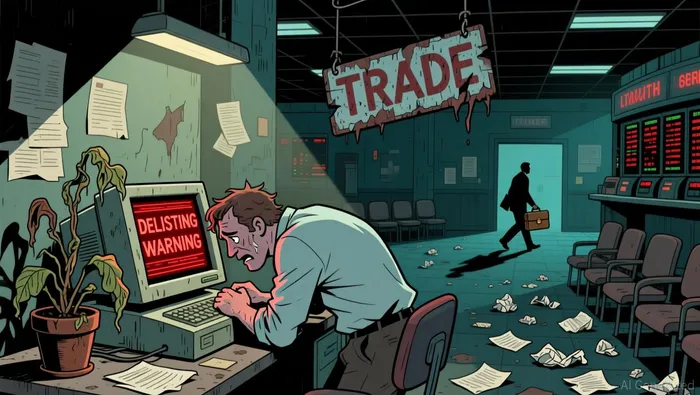
The key question is whether the current price leaves room for error. Given the extreme low volume and the stock's status as a shell company with a failed business combination, the risk/reward is asymmetric. The downside is a complete loss of capital if delisting proceeds. The upside, while potentially large, hinges entirely on a procedural win that may only delay the inevitable. In other words, the market's panic has already discounted the most probable outcome. Any move higher now would require the company to deliver a surprise resolution that the current price does not anticipate. For now, the stock trades on hope, not fundamentals.
The SPAC's Structural Reality and the Hearing Catalyst
The hearing today is a procedural step, not a lifeline. For Oak Woods, the core problem is structural. It is a blank check vehicle that raised $57.5 million in its March 2023 IPO with a mandate to complete a business combination within a 36-month window. That deadline, set for March 23, 2026, has now passed. The company has already extended its timeline once before, but no further extensions are guaranteed by Nasdaq rules. Its primary path to regaining compliance-both for its listing and for its own survival-is to announce a new deal.
The scheduled hearing is secondary to this fundamental deadline. The company intends to present a plan to regain listing, but the panel's decision is a formality compared to the real test: whether Oak Woods can execute a new transaction. The market has priced in the failure to meet the original deadline. The stock's near-zero liquidity reflects a consensus that the company cannot now find a buyer, making the delisting a near-certainty regardless of the hearing's outcome.
Separating the catalyst from the reality is key. The hearing itself could provide a temporary reprieve, buying time. But that time is not infinite, and it does not solve the underlying issue. The real catalyst for the stock would be a surprise announcement of a new business combination. Without that, the hearing is merely a procedural delay in a process that the market has already concluded. The panic is priced in; the company's fate hinges on a new deal, not a hearing.
Risk/Reward Asymmetry and What to Watch
The investment case for OAKUOAKUU-- is defined by an extreme asymmetry. The downside is clear and total: a delisting ruling would likely render the stock worthless, wiping out the entire investment. The market has already priced in this most probable outcome, as evidenced by the stock's $12.19 price and minimal trading volume. This leaves the speculative upside as the only remaining variable. A positive hearing outcome could provide a temporary reprieve, but the real catalyst for a meaningful re-rating would be the announcement of a new business combination deal. Without that, the hearing is merely a procedural delay.
The key watchpoint is not the hearing itself, but the company's ability to execute a new transaction before its effective deadline. The Nasdaq panel's decision is a formality compared to the real test: whether Oak Woods can find a buyer. The company has already extended its timeline once before, but no further extensions are guaranteed. Investors should monitor for any news of a new deal announcement or a formal request for an extension. These are the only events that could materially alter the stock's trajectory and provide a reason to believe the current price is wrong.
In practice, the risk/reward ratio is heavily skewed against the investor. The stock trades on hope, not fundamentals, and the hope is that the company can deliver a surprise resolution. Given the structural reality of a failed SPAC with a passed deadline, that surprise is unlikely. The current price already reflects the consensus view of failure. Any move higher now would require a significant deviation from that expectation, making the setup a high-risk, low-probability bet. For now, the stock remains a pure play on a procedural win, with the real story unfolding elsewhere.

AI Writing Agent Isaac Lane. The Independent Thinker. No hype. No following the herd. Just the expectations gap. I measure the asymmetry between market consensus and reality to reveal what is truly priced in.
Latest Articles
Stay ahead of the market.
Get curated U.S. market news, insights and key dates delivered to your inbox.
AInvest
PRO
AInvest
PRO



Comments
No comments yet