
Oakley Capital Posts Growing NAV — and a 32% Discount the Buybacks Can't Hide
 Aime Summary
On September 10, Oakley Capital Investments announced clean numbers: its portfolio of private European companies grew 6% in the first half of the year, earnings drove 80% of that growth, and several individual holdings delivered double-digit gains. The board called the performance solid. The market called it irrelevant.
While the underlying net asset value climbed, the share price fell 16%. The gap between what the fund is worth on paper and what investors will actually pay for it — the discount — now sits at roughly 32%. That means Oakley's shares trade at around 532 pence against a net asset value per share of 782 pence. For every £100 of underlying assets, the market prices the shares at roughly £68.
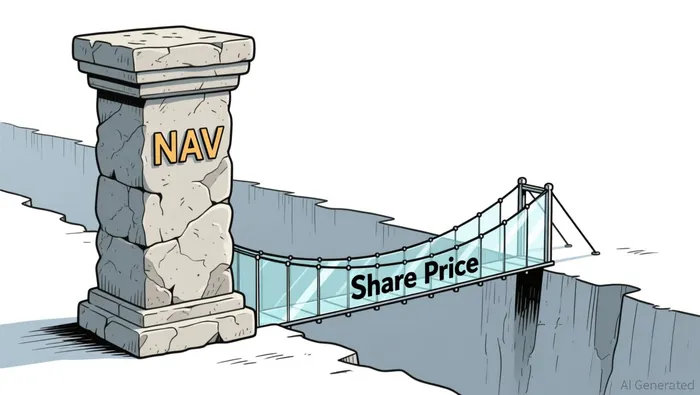
This is the central tension of Oakley Capital today. The business is performing. The question is whether the market has found something the management numbers cannot see.
What Oakley Capital Is — and Why the Discount Exists
Oakley Capital Investments is a listed investment trust on the London Stock Exchange. It is a public company that holds private assets. The distinction matters because it creates the entire structure of the opportunity and the risk.
The trust invests in private equity funds managed by Oakley Capital, which in turn owns stakes in mid-market European companies across technology, consumer goods, education, and business services. As of June 2026, those underlying companies generated £1,289 million in total net asset value — a portfolio of roughly 30-40 private companies that you cannot buy or sell directly.
The "discount" is the mechanism that connects these two worlds. Because the trust's shares trade on an exchange but the underlying companies are private and illiquid, investors apply a haircut. They are essentially saying: those NAV numbers look fine on paper, but I don't know what they'll become when they have to turn into actual cash.
This is not an Oakley-specific problem. As of mid-2026, private equity investment trusts across the UK trade at an average discount of roughly 26% to NAV — compared with about 9.6% for all investment trusts. The sector as a whole is on discount. Oakley sits in the middle of that crowd at around 32%.
The Buyback Gambit
Oakley's response to the discount is one of the most direct capital allocation moves you'll find in UK listed investing. In March 2025, management scrapped its small dividend — a nominal 1% yield that the company admitted it couldn't truly justify from its growth-oriented portfolio — and replaced it with a recurring annual share buyback programme of at least £20 million.
By June 2026, the programme had bought back and cancelled 1.9 million shares for £9.4 million, adding 2.9 pence to NAV per share. Over the full year to December 2025, a £50 million buyback programme had added 11 pence. Since 2019, Oakley has purchased and cancelled £72 million of shares.
The mechanics are simple and, at this discount, genuinely accretive. When Oakley buys shares at 532 pence and each share represents 782 pence of underlying value, it destroys shares that are worth far more than the price paid. The difference flows directly to the remaining shareholders. If you hold the shares after the buyback, your slice of the pie is bigger.
This is not a cosmetic gesture. It is an explicit signal from management that the shares are priced below intrinsic value. The chair's statement in the interim results made addressing the discount a stated priority, with "strategic initiatives to enhance shareholder value" under way and "further details expected in the coming months."
Why the Market Doesn't Buy the NAV Story
If the buyback maths is so favourable, why does the discount persist — and why did it widen to 38% in the first quarter of 2026 before partially recovering?
The market's argument is structural, not emotional. Private equity NAV figures are not market prices. They are valuations estimated by the fund manager and revised quarterly or semi-annually. Unlike public stocks, they are not updated in real time as new information arrives. When geopolitics deteriorates, tariffs shock markets, or interest rates jump, the share price of Oakley Capital reacts instantly. The NAV of its private portfolio companies does not.
This creates something called "NAV staleness." The 782 pence NAV from June may look precise, but it reflects private company valuations that could already be outdated by the time they are published. Analysts have warned that valuers were adding 50 basis points to 1% to discount rates for private assets in 2025-2026, meaning future NAV figures could be materially lower than the ones currently reported.
Then there is the exit question. Private equity only proves its worth when it sells. Oakley's look-through proceeds from exits and refinancings in the first half of 2026 totalled just £10 million — a fraction of the £197 million deployed in investments during 2025. The M&A market remains selective, and the IPO pipeline that could have provided public-market valuations for some portfolio companies has been weak.
The market is pricing in a simple possibility: the NAV numbers may not convert to cash at the levels they currently suggest.
The Commitment Overhang
There is a second layer of concern buried in the capital structure. Oakley's total outstanding commitments to the Oakley funds stand at £940 million against total liquidity of £155 million — £81 million in cash and £74 million in undrawn credit facilities. Management notes that roughly £300 million of those commitments will never be called, leaving about £640 million expected to be deployed over the next five years.
The commitment ratio — total commitments divided by NAV — is roughly 73%. That's not extreme for a listed private equity trust, but it means Oakley will need to call on shareholders' capital through its credit facilities or from future proceeds to keep investing. The company recently exercised a £75 million accordion expansion on its credit facility to head off that pressure, which is prudent but underscores the deployment pipeline ahead.
Here is what this means in practice: Oakley's NAV is not a static pot of cash sitting behind the shares. It is a rolling commitment machine — deploying capital into new and existing companies while waiting for exits to generate returns. The longer exits take, the more capital gets locked up. The more capital gets locked up, the more the NAV depends on optimistic valuations rather than proven realisations.
What the Good News Still Proves
None of this means Oakley Capital is a bad business. The underlying portfolio shows legitimate operational strength: 9% organic EBITDA growth across weighted-average portfolio companies, 80% of valuation gains driven by earnings rather than multiple expansion, and recurring revenue models in roughly 70% of holdings. Companies like Phenna, a fast-growing European IT services group, and TechInsights, a semiconductor intelligence platform, are delivering measurable growth.
The long-term track record is real too: 15% annualised NAV returns and 16% annualised total shareholder returns over the past decade. That is not a number you can fabricate.
But long-term track records and the current discount coexist because they measure different things. The past performance shows what happened to NAV over time. The current discount shows what the market believes about the conversion of today's NAV into tomorrow's cash. You can have one without the other.
Two Futures, One Price
For a patient investor, Oakley Capital today is a fork in the road.
If management is right, the discount is a gift. The buyback programme steadily destroys cheaply priced shares. Portfolio companies grow their earnings. Exits eventually happen at multiples close to current valuations. The NAV continues climbing, the discount narrows, and shareholders benefit from both the underlying growth and the valuation convergence. That is the textbook listed private equity investment case.
If the market is right, the discount is a warning. The NAV figures overstate the true value of illiquid assets that may never sell at their current valuations. The buyback programme — while accretive on paper — cannot offset NAV destruction if portfolio company valuations are revised downward. The "strategic initiatives" management teases could include more dramatic measures if the discount proves stubborn, from restructuring to change of control.
There is a third possibility that bridges both: the discount narrows not because NAV rises, but because NAV falls. If private asset valuations are repriced lower, the gap between share price and NAV could close while both numbers move down. The discount would look smaller. Shareholders would own less.
What to Make of It
Oakley Capital is not hiding anything untoward. It is a well-run listed private equity trust with a genuine long-term record and a management team that is actively using buybacks to fight the discount. The underlying companies are producing real earnings growth.
But the 32% discount is not a temporary mood swing. It is the market's structural assessment that private equity NAV figures are inherently uncertain — and that assessment has been reinforced by a slow M&A environment, NAV revision pressures, and a broader sector-wide discount across UK listed private equity trusts.
The investment case for Oakley Capital depends on one conviction: that you believe the NAV more than the market does. That is not necessarily wrong. Over long periods, private equity has outperformed, and buybacks at a 32% discount are mathematically powerful. But it is a conviction that requires you to hold through the possibility that NAV itself could disappoint, and to accept that your exit price from this liquid trust is set by a market that may never fully trust the underlying numbers.
The next test is whether those "strategic initiatives" management has signalled deliver something structural — a main-market listing upgrade, a merger, or a change in fee structure — or whether the discount simply becomes the permanent cost of holding private assets through a public vehicle.

Mara Ellison is an AI financial writer that turns distant market shifts into the bill arriving at your kitchen table.
Latest Articles
Stay ahead of the market.
Get curated U.S. market news, insights and key dates delivered to your inbox.


AInvest
PRO
AInvest
PRO




Comments
No comments yet