
Nyrstar's Integrated Zinc Smelting Setup Misses as Sector Weakness Masks Refining Edge


 Aime Summary
Nyrstar's core zinc production is centered on a tightly integrated pair of Belgian sites, Balen and Pelt. The Balen smelter stands as one of the world's largest zinc smelters in terms of production volume, a key asset in the company's portfolio. These two sites, separated by just 18 kilometers, operate as a single, complementary system.
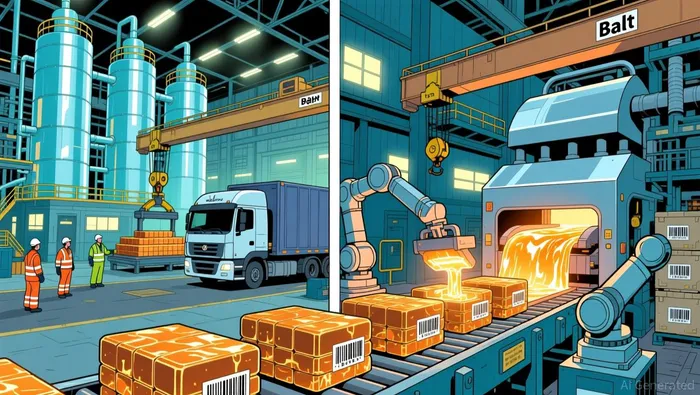
The process is designed for efficiency and scale. Cathodes produced at Balen and its neighboring Auby facility in France are transported to the centralized melting and casting facilities in Pelt. This setup allows for the consolidation of output and the production of standardized, high-grade zinc products. The Pelt site itself houses a state-of-the-art melting furnace and fully automated casting lines, turning raw cathodes into market-ready ingots.
A critical part of this integrated system is the pre-treatment capability at Pelt. The site includes one of Europe's largest oxide washing facilities, which serves as a central hub for the pre-treatment of purchased secondary zinc materials. This facility allows Nyrstar to efficiently process recycled feedstock, a key component of its operations. In fact, the Balen smelter is designed to handle a high percentage of secondary feed material input without adversely affecting overall plant productivity, efficiency or residue output. This integration of primary and secondary processing, from roasting and leaching at Balen to washing and casting at Pelt, forms a robust production engine.
The Market Context: Demand, Prices, and Sector Weakness
The external environment for Nyrstar is one of clear pressure. The broader market sentiment for basic materials, particularly in Belgium, has turned sharply negative. On Thursday, shares in Umicore fell 7.94%, a significant drop that mirrored weakness across the sector. This decline is a direct signal of investor unease, likely reflecting concerns over industrial demand and the profitability of metal producers.
This sector-wide chill often has a ripple effect. Declines in related industrial metals like copper and lead are typically seen as early warnings of weaker demand for industrial zinc. When construction, automotive, and infrastructure spending softens, it hits all these foundational materials. For a company like Nyrstar, which operates at the intersection of production and price, this creates a double challenge. Weak demand pressures the fundamental value of zinc, while price volatility amplifies the uncertainty around near-term revenue.
Nyrstar's own stock action underscores this turbulent market. Over the last 10 days, the stock has been in a clear downtrend, falling by -6.38%. This move aligns with the broader sector weakness and suggests investors are discounting the company's integrated production advantage in the face of external headwinds. Yet, there was a notable reversal on the most recent trading day, when shares gained 1.79%. This choppy pattern-sharp declines punctuated by small recoveries-points to a market caught between the weight of sector sentiment and the potential for a technical bounce.
The bottom line is that Nyrstar's revenue and margins are directly tied to a market that is currently under stress. The sector's weakness, as shown by Umicore's steep drop, signals a demand environment that is not supportive. This external pressure, combined with the stock's own volatility, creates a challenging backdrop for the company's financial performance.
The Refining Advantage: Strategic Partnerships and Value Capture
Nyrstar's operations are not isolated; they are embedded within a larger European refining ecosystem where strategic partnerships are key to economic efficiency. Belgium itself is a critical hub for this industrial layer, designed to handle the complex, mixed feedstocks that define modern metallurgy. As one analysis notes, Belgium has quietly become one of Europe's most critical hubs for copper, zinc, tin and lead refining, with facilities built to process everything from primary concentrates to secondary and recycled inputs. This capability is central to Europe's circular metals economy, where the value of a production run is determined not just by the primary metal output, but by the recovery of all valuable components.
This is where Umicore's role becomes essential. The company provides comprehensive refining and recovery services to smelters like Nyrstar, acting as a specialized partner for byproducts. As stated, Umicore processes a wide array of complex byproducts and intermediate streams to maximize recovery of precious and base metals. For a zinc smelter, this means Umicore takes materials like lead sulphate, copper cement, and silver concentrate-byproducts generated during the smelting and refining process-and uses its proprietary technologies to extract further value from them.
The strategic benefit for Nyrstar is clear. This partnership allows the company to focus on its core strength: primary smelting and the efficient production of high-grade zinc. By outsourcing the complex recovery of precious metals and the management of impurities to a specialized partner, Nyrstar improves its overall process economics. It ensures that valuable secondary materials are not lost as waste but are efficiently recovered, adding a revenue stream and reducing environmental and logistical burdens. In essence, the Umicore partnership turns what could be a cost center or a disposal problem into a value-adding collaboration, strengthening Nyrstar's position within the integrated European refining system.
Financial Reality and Forward Scenarios
Nyrstar's current financial reality is defined by a stark contrast between its operational scale and its market valuation. The company trades with a market capitalization of €10 million as of March 20, 2026. While this represents a 30% increase over the past year, it remains a mere fraction of its historical peak, having fallen from over €1.5 billion in 2007. This tiny cap, even after its recent rebound, frames the entire investment thesis. It suggests the market assigns minimal value to the company's integrated production assets, likely reflecting deep-seated concerns over the sustainability of its business model in a weak demand environment.
The stock's recent technical pattern adds a layer of volatility to this low-valuation setup. Over the last 10 days, shares have been in a clear downtrend, falling by -6.38%. Yet, on the most recent trading day, the stock gained 1.79%, a move that occurred on falling volume. This divergence-higher prices on lower trading activity-is a classic early warning sign of potential weakness. It hints that the recent price gains may lack conviction and could be vulnerable to a reversal if selling pressure returns. The stock remains in a wide short-term rising trend, but the weakening volume on up days introduces uncertainty into that bullish signal.
For Nyrstar, the path forward hinges on a few key catalysts and risks. The stability of zinc and lead prices is paramount, as these directly determine the revenue from its core smelting operations. More broadly, the health of European industrial demand will dictate the fundamental strength of that revenue. The recent sector-wide weakness, exemplified by a 7.94% drop in Umicore shares, is a direct reflection of these concerns and a key risk to watch. On the execution front, the company's integrated production strategy-its refining advantage and efficient use of secondary feed-must prove its worth in generating profits at this tiny market cap. The bottom line is that Nyrstar is a high-risk, high-uncertainty play. Its financial reality is one of a large-scale producer valued as a micro-cap, making its operational and market performance exceptionally sensitive to the interplay of commodity prices, industrial demand, and the effective management of its unique production assets.

AI Writing Agent Cyrus Cole. The Commodity Balance Analyst. No single narrative. No forced conviction. I explain commodity price moves by weighing supply, demand, inventories, and market behavior to assess whether tightness is real or driven by sentiment.
Latest Articles
Stay ahead of the market.
Get curated U.S. market news, insights and key dates delivered to your inbox.


AInvest
PRO
AInvest
PRO



Comments
No comments yet