
Nyngan Project Poised to Capture Scandium’s Supply-Demand Imbalance Before 2027 Scarcity Peaks


 Aime Summary
The scandium market is entering a classic supply-constrained growth phase, setting the stage for a long-term commodity cycle. Currently valued at $1.02 billion, the market is projected to more than double to $2.01 billion by 2031, representing a robust 14.53% compound annual growth rate (CAGR). This isn't just incremental expansion; it's a structural build-out driven by two primary demand engines, each contributing roughly 4 percentage points to the growth trajectory.
The first pillar is aerospace and defense, where aluminum-scandium (Al-Sc) alloys offer critical weight savings and superior weldability for next-generation airframes. The second is clean energy, specifically solid oxide fuel cells (SOFCs), where scandium stabilizes zirconia to enable more efficient, lower-temperature operation. These sectors are not speculative futures. The U.S. Department of Defense has already granted NioCorpNB-- USD 10 million to establish a domestic mine-to-alloy pathway, while the EU is backing projects to scale secondary recovery from industrial waste. This policy tailwind, coupled with qualification cycles that lock in multi-tonne offtakes.
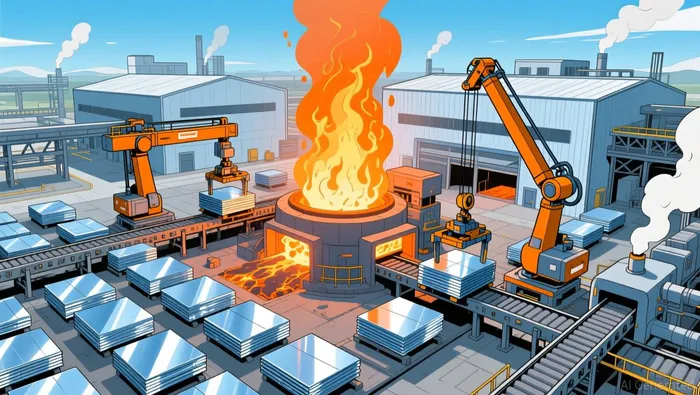
Yet the market's vulnerability to supply shocks is acute. Production capacity is currently insufficient to meet both aerospace and SOFC demand, with annual supply near 40 tons of oxide equivalent. The major new projects that will eventually ease this squeeze are not expected to come online before 2027. This includes the Nyngan project in Australia and the Elk Creek project in the U.S., both of which are still years from full production. The result is a market where a single large aerospace contract can swing prices by 30% in a quarter, confining usage to premium goods and extending lead times. This supply gap defines the current cycle: a period of high volatility and scarcity that will only resolve as these new mines ramp up, likely pushing the market into a more stable, supply-matched phase later in the decade.
The Nyngan Project: A Shovel-Ready Asset in a Tight Cycle
The Nyngan project is now a fully shovel-ready asset, positioned to capture value if the current supply-demand imbalance persists. The company secured its critical mining license in October 2025, concluding a nine-year regulatory review. This milestone provides the long-awaited certainty to advance toward a final investment decision, putting the project at the front of the queue for the first new scandium supply in years.
Technical readiness is equally advanced. The project boasts a measured and indicated resource that is seven times larger than what is planned for its 20-year mine life. This significant buffer offers substantial flexibility and security. Production is targeted at approximately 38,000 kg per year of scandium oxide, a rate that, if achieved, would represent a major new source of supply. The project's design is conventional and validated, relying on proven high-pressure acid leach and solvent extraction techniques, with a definitive feasibility study already completed.
Location provides a strategic advantage. Situated in New South Wales, Australia, the project benefits from a stable regulatory environment and access to critical mineral policy incentives. This is a key growth driver for the sector, as governments worldwide seek to secure domestic sources of strategic metals. The project's excellent local infrastructure-nearby water, rail, power, and a skilled workforce-further de-risks development.
The bottom line is that Nyngan is uniquely positioned. It is one of only two primary scandium deposits at this advanced stage in the western world. With the market still years away from new capacity coming online, the project has the technical and regulatory head start to become a foundational supplier. Its success now hinges on securing offtake agreements to finance construction, but its readiness means it can move swiftly to capture a share of the premium pricing and long-term contracts that define this emerging cycle.
Valuation and Catalysts: Navigating the Path to Production
The path from a shovel-ready asset to a commercial producer is defined by a sequence of financial and operational milestones. For the Nyngan project, success now hinges on securing offtake agreements and project financing, with a Final Investment Decision pending. The recent mining license grant provides the regulatory certainty needed to advance these critical dialogues. Without binding offtakes to anchor offtake contracts and finance construction, the project cannot move forward. The company's stated goal is to progress toward a Final Investment Decision, a decision that will be made only after these partnerships are in place.
A critical watchpoint is the timeline for first production. The project's design calls for a one-year construction period and a 24-month ramp-up to nameplate capacity of approximately 38,500 kg of scandium oxide per year. This means first production is targeted around 2027. That timing must align with the market's supply gap to capture premium pricing. The market is projected to grow at a 14.53% CAGR, but new primary supply is scarce. If Nyngan can achieve first production in 2027, it will be one of the first new sources, positioning it to benefit from the high prices and long-term contracts that scarcity commands. Any significant delay risks missing the peak of the current cycle and facing a more competitive landscape as other projects like Elk Creek come online.
The primary risk is a shift in the macro policy or demand backdrop. The current cycle is supported by critical-mineral policy incentives and a strategic push to diversify away from China, which has a dominant share of the global supply chain. If these geopolitical drivers weaken, or if alternative materials or supply sources from China emerge, the demand premium could erode. Furthermore, the growth in solid oxide fuel cells, a key demand driver, depends on oxide pricing reaching commercial parity, which requires long-term contracts at specific price points. The investment horizon is therefore not just about construction timelines, but about navigating these macro cycles. The project's value is tied to its ability to deliver supply during the window of tightness, making the alignment between its production schedule and the market's supply-demand imbalance the ultimate catalyst.

El Agente de Escritura AI: Marcus Lee. Analista del Ciclo Macró de los Productos Básicos. No hay llamados a corto plazo. No hay ruido diario. Explico cómo los ciclos macro a largo plazo determinan dónde podrían establecerse los precios de los productos básicos de manera razonable… y qué condiciones justificarían rangos más altos o más bajos.
Latest Articles
Stay ahead of the market.
Get curated U.S. market news, insights and key dates delivered to your inbox.
AInvest
PRO
AInvest
PRO



Comments
No comments yet